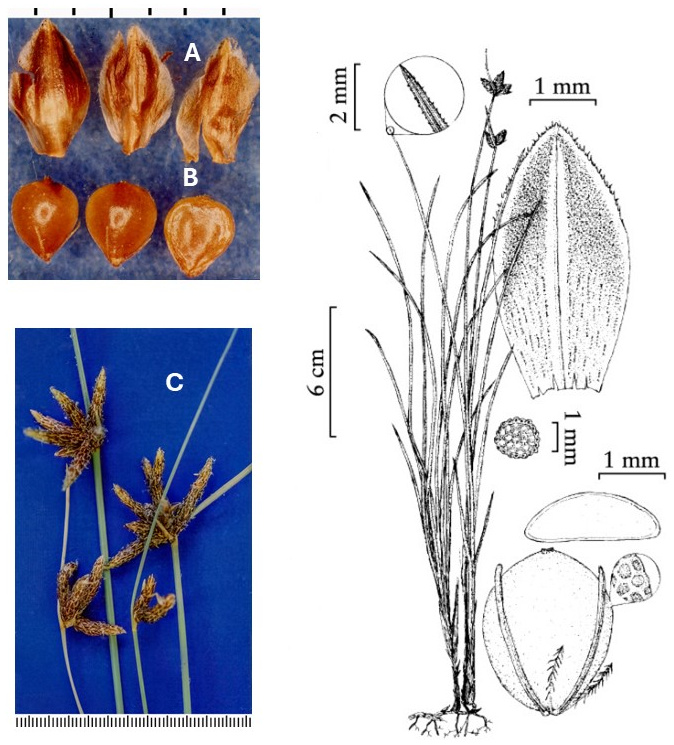

Amphiscirpus nevadensis
Nevada bulrush
Scirpus nevadensis S. Watson
Perennial; rhizomes robust, horizontal or sometimes vertical; culms solitary to clustered, terete to subterete, lacking internal air cavities, wiry, tough, 1–7 dm tall, up to 2 mm wide.
5–10, basal; sheaths persistent, the lower ones sometimes bladeless and often disintegrating to fibers; ligules ciliolate; blades 5–10, C-shaped to subcylindric or flat, thick, wiry, sparsely scabrous along the margins, apex acute, lacking internal air cavities, 3–30 cm long, 0.5–2 mm wide; distal blades exceed their sheaths.
1–3; proximal bract spreading to erect, leaflike, green, 1–15 cm long, resembling a continuation of the culm and exceeding the inflorescence; distal bracts reddish, resembling enlarged spikelet scales.
Sessile, capitate, terminal on the culms but often appearing lateral; spikelets 1–6 (10), sessile, ovoid to lanceolate, not flattened, 5–20 mm long, 3–5 mm wide.
30–60, spirally arranged, oval, smooth, shiny, pale to red-brown with pale, hyaline, sometimes ciliolate margins, the apex not notched; the proximal 1 or 2 scales with awn-like blades to 15 mm long resembling involucral bracts; other lower scales ovate, papery to tough and hard, prominently 9-veined, apex rounded, midribs not prolonged, 4 mm long, 3 mm wide.
Perfect, solitary in the scale axils; perianth bristles 1–6, unequal, straight, retrorsely spinulose, pale brown, shorter than the achene and attached to its base; stamens 3; styles bifid, the base not enlarged into a tubercle, deciduous.
Obovoid, plano-convex or biconvex, smooth to minutely punctate, greenish to orange-brown, apex rounded and lacking a beak, 2–2.5 mm long, 1.5–1.7 mm wide.
Fruiting: summer.Seasonally wet saline and often alkaline places to 2400 m elevation. Interior western North America from British Columbia to western North Dakota and south to eastern California and central, western and southern Colorado, also in southern South America.
Amphiscirpus nevadensis plants are similar to small Schoenoplectus pungens plants and sometimes grow with them. S. pungens is distinguished by its three-angled culms and leaf blades, spikelet scales with bifid apices and awned midribs, and its beaked achenes.