
Cladium californicum
California sawgrass, Sawgrass
Cladium mariscus (L.) Pohl var. californicum S. Watson, Mariscus californicus (S. Watson) Fernald
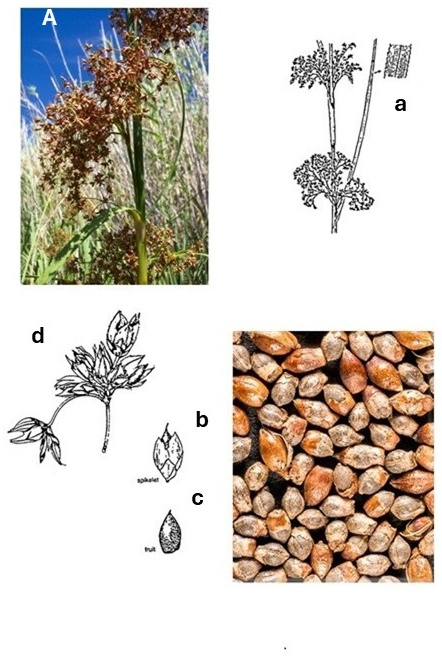
Coarse perennial forming dense clumps; rhizomes stout, 20 cm long, 10 mm in diameter; culms subterete to subtriangular, 1–2 m tall, 5–10 mm thick.
Cauline; ligules absent, blades flat to broadly V-shaped, serrated with cartilaginous teeth along the margins and abaxial side of the midvein, 1–2 m long, 7–10 mm wide.
Three or more, leaf-like, spreading.
Terminal and lateral, panicle-like, purplish brown, 30–50 cm long with flexuous branches (to 3rd and sometimes 4th order); peduncles at least partially covered by the leaf sheaths; spikelets numerous, mostly in groups of (3) 4–6, ellipsoid to lanceolate with acute apices, reddish brown, to 3 mm long.
Few, spirally arranged, ovate to oblong-lanceolate with a distinct midvein, reddish-brown, 2.5–3 mm long, 2 mm wide, lowest scale empty, middle scale empty or subtending staminate flowers, terminal scale subtending a perfect flower.
Perfect and staminate; perianth lacking; stamens 2, anthers 2 mm long, connective apices 0.1 mm; styles trifid, 1–1.5 mm long; stigmas 1–1.5 mm long.
Ovoid, barely trigonous, the base truncate and the apex acute, smooth or irregularly rugulose, glossy purplish brown, 1.5–2 mm long, 1 mm wide; the persistent style base forms a beak 0.2 mm long.
Fruiting: spring—summer.Alkaline marshes, swamps, and springs from sea level to 2000 m elevation. Rare in the Intermountain Region. Occurs in Arizona, California, southern Nevada, southern Utah, Texas, and Mexico. Most Utah populations were inundated by Lake Powell.