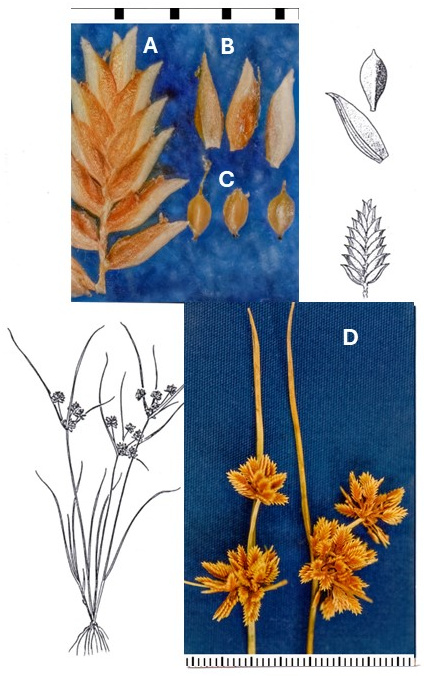

Cyperus acuminatus
Tapertip flatsedge, Short-pointed flatsedge
Tufted annual with fibrous roots; culms slender, roundly trigonous or subcompressed, multistriated, distil half glabrous or rarely scabridulous, sometimes thickened at the base, 0.5–4.5 dm tall, 0.4–1.2 mm thick.
Few, 2–6 to a culm, borne near the base, slender, elongate, flat or V—shaped, light green, scaberulous on the margins, shorter than or about equal to the culm, 8–12 cm long, 1–3 mm wide; sheaths often reddish at the base.
3–6, erect to ascending or somewhat spreading, elongate, unequal, some or all of them much longer than the inflorescence, 3–12 cm long, 1–2.5 mm wide.
Umbels with 2–5 very short (0.2–3 cm), unequal rays terminating in dense globose clusters of 8–60 spikelets 5–18 mm wide; spikelets ovate-oblong, strongly flattened, pale green becoming light to reddish brown, 3–7 mm long, 2.5–3.5 mm wide.
Straight, wingless, persistent; scales deciduous.
8–25, 2-ranked, closely set and overlapping, the tip of each scale surpassing the one beneath it, ovate-lanceolate, somewhat hyaline and cellular-reticulate, prominently 2-keeled, shortly recurved-acuminate at the tip, yellowish to light brown or reddish brown with a lighter or greenish nerved center, 1.5–2.5 mm long, 0.5–1.4 mm wide, deciduous at maturity.
Perfect; perianth lacking; stamen 1, anther 0.5 mm; style trifid.
Obovoid-elliptic or oblong, trigonous, abruptly contracted at the base, slenderly stipitate, smooth, brown, 0.6–1.1 mm long, 0.3–0.6 mm wide with a short apiculate beak formed from the style base.
Fruiting: June–October.Drying shores, mudflats, disturbed seasonal wetlands, and other wet places, usually in sandy soils, 0 to 1500 m. Tolerant of alkali. Uncommon in the Intermountain Region where it is reported from locations in west-central Nevada and central and southern Utah and northern and central Colorado. Washington to New Hampshire and south from California to Alabama; Mexico.