
Eleocharis coloradoensis
Colorado spikerush, Dwarf spikerush
Eleocharis parvula (R. & S.) Link x Bluff, Nees & Shauer var. anachaeta (Torrey) Svenson, E. p. var. coloradoensis (Britton) Beetle, Scirpus coloradoensis Britton
Dwarf tufted perennial, 2–9 cm tall, forming mats from short, slender, horizontal rhizomes up to 1.5 mm diameter that are often terminated by broadly oblong to orbicular tubers to 4 mm long; culms cylindric, very soft, 0.2–0.5 mm thick.
Generally solitary near the culm base and tightly clasping it; upper sheath thinly membranous, often disintegrating, reddish basally, apex rounded or acute; tooth absent.
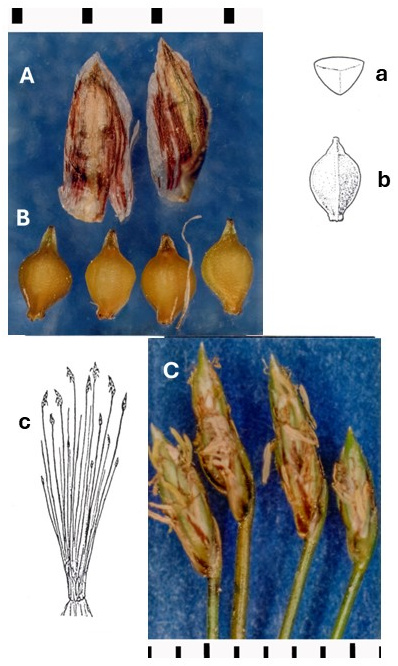
Solitary, 4–6 flowered, ovoid or oblong-cylindric, base usually cuneate, apex acuminate, 3–8 mm long, 1–1.5 mm thick; floral scale tips appressed, giving the spikelet a smooth outline.
6–25, ovate to lanceolate, bright orange to brown, midstripe green to pale, margins purplish, apex obtuse to acute, 1.7–2.5 mm long; lowest scale completely clasping the culm, one-half or less of the spikelet length, lacking a flower.
Perfect; perianth bristles mostly absent, seldom 5, very unequal, when present coarsely barbellate, to one-half the achene length; stamens 2–3, anthers .05—.08 mm; styles trifid.
Obovoid, subtriangular, prominently 3-angled or sometimes 2-angled, finely roughened, medium to dark brown, apex truncate, 0.5–1.1 mm long, 0.5–0.7 mm thick; tubercles about 0.1 mm high, often indistinct and merging with the achene summit in color, form, and texture.
Fruiting: summer.Drying margins of fresh or brackish lakes and ponds, streams, and vernal pools. Generally inland to 2100 m. In the Intermountain Region occurs locally in Idaho, Nevada, Oregon, and Utah. Distributed from Oregon to Alberta and Saskatchewan and south from California to Mississippi and Mexico.
Eleocharis coloradoensis is similar in habit to E. acicularis, which has a flower in the lowest spikelet scale, very different achenes, and lacks tubers.