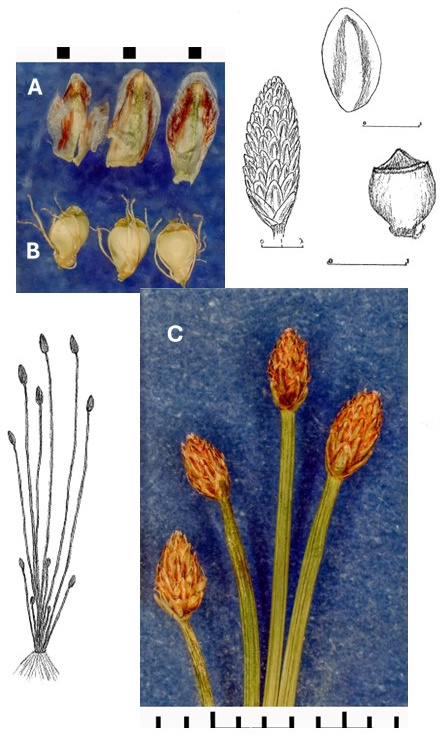

Eleocharis engelmannii
Engelmann’s spikerush
Eleocharis engelmannii var. detonsa A. Gray, E. e. var. monticola (Fernald) Svenson, E. monticola Fernald, E. monticola Fernald var. leviseta Fernald
Annuals with few stems or forming dense clumps; rhizomes absent; culms erect or ascending, cylindric, ribbed, firm to soft, dark green, up to 40 cm tall, 0.5–1.5 mm thick.
1 or 2, basal, extending to 4.5 cm up the culm, upper sheath membranous, persistent, fragile to somewhat firm, pale brown, apex obtuse to acute; tooth often present and up to 0.3 mm long.
None.
Solitary with more than 40 tightly clustered flowers, erect, lanceolate to ovoid or subcylindric, reddish brown to brown, apex obtuse or acute, 5–10 (20) mm long, 2–3 (4) mm thick.
25–100 (200), 8–12 per mm of rachilla, orbicular to ovate-oblong, membranous, margins reddish-brown or hyaline, midstripe pale or greenish keeled, apex obtuse to acute, 2–2.5 mm long, about 1 mm wide; lowest scale clasping about two-thirds of the culm and without a flower.
Perfect, perianth bristles (0) 5–8, stout, brown, from rudimentary to reaching the tubercle summit; stamens 3; anthers yellow-brown, 0.3–0.8 mm long; styles trifid or some bifid in the same spikelet.
Broadly ovate, lenticular, smooth, shiny, straw-colored ripening to dark brown, 0.9–1.1 mm long, 0.7–1.1 mm wide; tubercles distinct, sessile on the achene summit, much lower than wide, one-fourth or less as high as the achene.
Fruiting: spring—fall.Wet shores, marshes, and disturbed places to 2400 m. Local in the Intermountain Region occurring in southeastern Oregon, west-central Idaho, northwestern Nevada, and southern Utah. Southernmost British Columbia east to Ontario and Maine and south to California, Texas and Mississippi.
Eleocharis engelmannii is easily confused with closely related E. obtusa and E. ovata (see under E. obtusa), which differ mainly in their tubercle widths as indicated in the key. Specimens in which the perianth bristles are absent or rudimentary may deserve taxonomic recognition as E. engelmannii var. detonsa A. Gray (=E. monticola Fernald var. leviseta Fernald).