
Lipocarpha micrantha
Smallflower halfchaff sedge, Small-flowered dwarf bulrush, Small-flowered hemicarpha
Hemicarpha micrantha (Vahl) Pax, H. subsquarrosa (Muhlenberg) Nees, Isolepis subsquarrosa (Muhlenberg) Schrader, Scirpus micranthas Vahl, S. subsquarrosus Muhlenberg
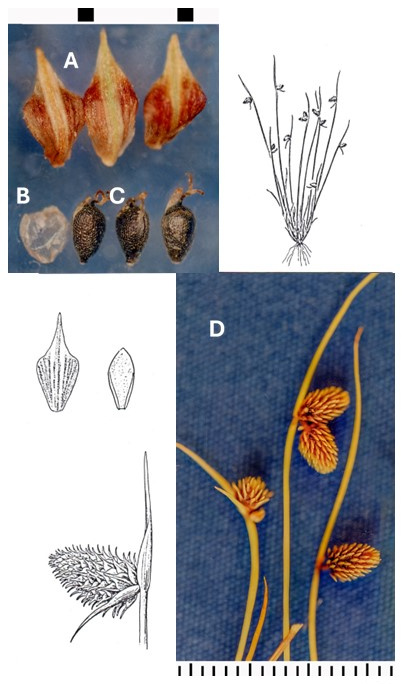
Delicate, tufted annuals with fibrous roots; culms slender, terete to compressed, glabrous, ribbed, 3–20 cm tall, 0.3–0.5 mm wide, outer culms recurved-spreading.
1–2, basal, very narrow; 1.5–10 cm long, 0.3–0.5 mm wide; old sheaths present; lower sheath ribbed dorsally, bladeless; upper sheath very thin, hyaline ventrally; blade channeled, lightly ribbed, brownish, sharp pointed at the tip, much shorter than the culms.
2–3, unequal; lowest 2–5 cm long, erect, channeled, lightly ribbed, longer than the others and appearing as a continuation of the stem; upper reduced and spreading.
1–3 clusters of globose to narrowly ovoid spikes, sessile, terminal but appearing lateral on the stem, not bristly, 1–5 mm long, 1–2 mm thick, each with numerous, sessile, spirally arranged spikelets, each with a single perfect flower.
Outer scale obovate, thick, firm, 0.5–1.0 mm long, 0.3–0.4 mm wide, abruptly contracted to a blunt spreading mucro or a short, stout awn tip that is longer on the lower scales, brownish to reddish brown, greenish to pale along the midstripe; inner scale adaxial, inconspicuous, very thin, hyaline, unvasculated or imperfectly vasculated, obtuse-truncate or toothed at the apex, 0.1–0.2 mm long, up to half the length of the achene (but obsolete to exceeding the achene) and partially enclosing its adaxial side, usually disarticulating with the achene.
Perfect; perianth bristles absent; stamens 1 (2); anthers 0.1–0.25 mm; style deeply forked, elongate, deciduous at maturity.
Obovoid, dorsiventrally compressed, short apiculate or with a short mucro, light to dark brown, 0.4–0.7 mm long, 0.2–0.3 mm wide, 1.5–2.5 times as long as wide.
Fruiting: June–September.Wet bottomlands, floodplains, riverbanks, sandbars, tidal marshes, and beaches from sea level to 1500 m elevation. Uncommon in the Intermountain Region. Scattered occurrences in west-central Idaho, northwestern Nevada, and south-central Utah. Tropical regions, Africa, South and Central America, north through the United States, and in eastern and western Canada.
Lipocarpha aristulata (Colville) G. C. Tucker (awned halfchaff sedge) is similar to L. macrantha, differing primarily in the presence of longer inner scales (0.5–0.8 mm long) that may be slightly shorter or longer than the achene; culms (2–15 cm) and leaves (1–6 cm) are slightly shorter and spikes (1–5 [8] mm) and rhomboid outer scales (0.9–1.6 mm) are slightly longer than those of L. macrantha. L. aristulata occurs on sandy soils along pond shores, streambanks, and emergent shorelines in tropical America, north through Midwest and eastern United States. It is uncommon in the western states with scattered occurrences from Arizona and California north to southern Washington and Wyoming.