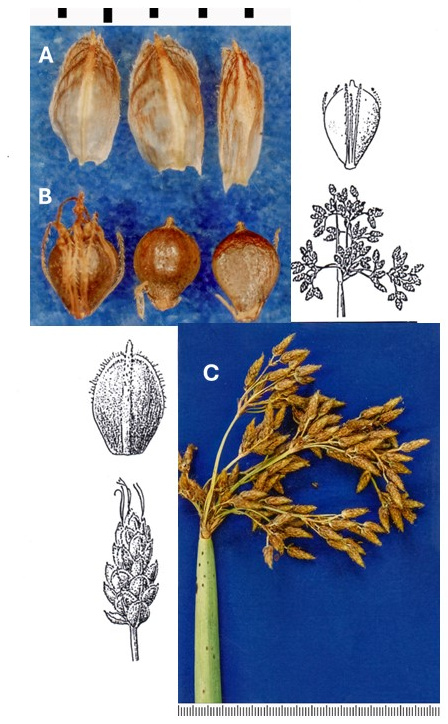

Schoenoplectus tabernaemontani
Softstem bulrush, Great bulrush
Schoenoplectus validus (Vahl) A. Löve & D. Löve, Scirpus lacustris L. subsp. tabernaemontani (C.C. Gmelin) A. Löve & D. Löve, S. tabernaemontani (C.C. Gmelin), S. validus Vahl
Stout perennials that form large, dense colonies from long, robust rhizomes 3–10 mm in diameter; culms cylindric, soft (usually easily crushed between the fingers and flattened when pressed), 0.5–2 (3) m tall, 2–10 mm thick.
3–4, all near the base; sheath fronts hyaline and splitting, often leaving fibers; blades 1–2, C-shaped to flat in cross-section, smooth or the margins minutely scabrous, 2–200 mm long, 1–4 mm wide, shorter than the sheaths.
Main bract usually erect, appearing as a continuation of the culm, C-shaped to subterete, margins sometimes scabridulous, 1–8 (10) cm long.
Panicle-like, open to compact, branched 2–4 times; branches flexible, 15 (25) cm long; spikelets 15–200, usually solitary or in clusters of 2–4 (7), ovoid to oblong ovoid, obtuse to acuminate at the apex, reddish brown, 3–17 mm long, 2.5–4 mm thick.
Oblong-ovate, thin, margins ciliate (woolly) with fairly short, contorted hairs, scabrous on the awn and midrib and sometimes on the flanks, uniformly dark to pale orange-brown, sometimes straw-colored, midrib often paler or green, 2–3.5 mm long and 1.5–2 mm wide; apex notched about 0.3 mm deep, mucro or awn straight or bent, not contorted, 0.2–0.8 mm long.
Perfect; perianth bristles 6, retrorsely spinulose, brownish, about equaling the achene; stamens 3 with straplike filaments; styles bifid or a few trifid in the same spikelet.
Broadly ovoid, plano-convex, lenticular, rounded distally, smooth, brown, 1.5–1.8 mm long (including 0.2–0.4 mm apiculus or short beak), 1.2–1.7 mm wide.
Fruiting: June–August.Fresh to brackish marshes, shores, stream bars, fens, bogs, and disturbed places from sea level to 2400 m elevation. Often emergent in water to 1 m deep. Distributed nearly worldwide, occurs in all North American provinces and states. Widespread in the Intermountain Region.
Schoenoplectus acutus: Besides the differences given in the key, the spikelet scales of S. acutus are usually much less scabrous and the margins have longer cilia. S. heterochaetus: Spikelet scales are mostly longer (3–4 mm) and their apices are more deeply notched (mostly 0.5–1 mm deep).