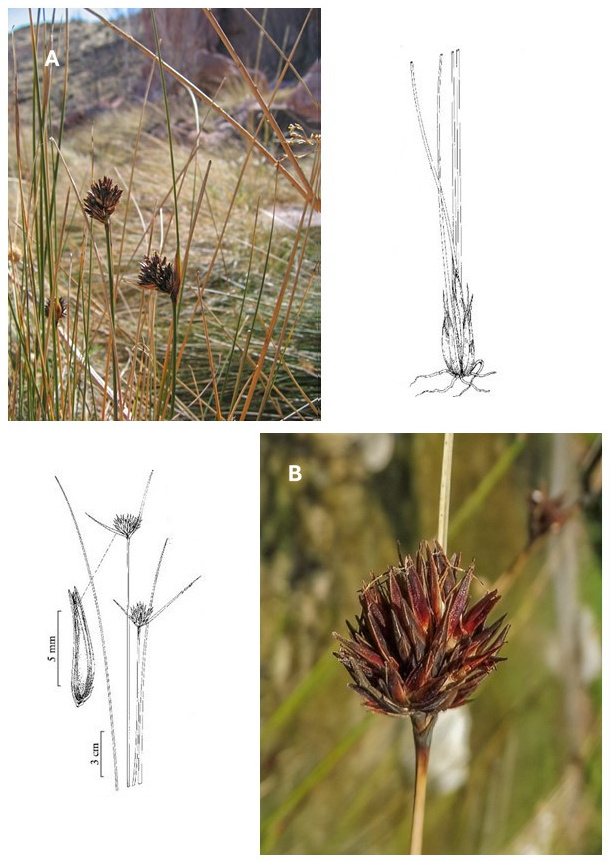

Schoenus nigricans
Black bogrush, Black sedge
Perennial, densely cespitose, wiry; culms stiff, glabrous, terete to rounded-trigonous, hollow to spongy with air cavities, 20–70 cm tall, less than 1 mm wide; rhizomes short or absent.
Basal, erect, stiff, some nearly equaling the culms; sheaths shiny, brown to black, wider than the blades; blades smooth to scabrid, rolled, margins entire to slightly serrate, 10–40 cm long, 1–2 mm wide.
1–2, leaflike, oblique to erect, unequal, stiff, apex acute, green to dark brown, 0-6 (8) cm long, 1–1.5 mm wide.
Terminal, unbranched head, ovoid, dense, 1–2 cm in diameter; spikelets 10–25, flattened, ellipsoid, dark purple or black; rachilla deciduous.
2-ranked; basal scales (2–3) empty; fertile scales (3–8) oblong, somewhat sheathing, acuminate, scabrous distally.
Perfect; perianth bristles 6, plumose, deciduous, exceeding the achene; stamens 3; styles trifid.
Ovoid, somewhat trigonous, apex obtuse, white, glossy, smooth to slightly reticulate, 1–2 mm long, 0.9–1.2 mm wide.
Fruiting: August–September.Uncommon. Grasslands, marshes, peat bogs, and hot springs from sea level to 2000 m, often in alkaline or calcareous soils. Death Valley and southern California Mountains, central and southern Nevada (Clark and Nye Counties), New Mexico, Texas, Florida, Mexico, Eurasia, north Africa, Australia.