

USDA Forest Service, Rocky Mountain Research Station. General Technical Report RMRS-GTR-xxx.
United States Department of Agriculture
Field Guide to Intermountain Cyperaceae (excluding Carex)
Forest Service Rocky Mountain Research Station General Technical Report RMRS-GTR-xxx Month 2026
The Authors
Emerenciana Gabilo Hurd is a Botanist (retired) from the USDA Forest Service Rocky Mountain Research Station in Boise, Idaho. Originally from the Philippines, she holds a B.S. degree in biology from Whitman College, Walla Walla, Washington, and M.S. and Ph.D. degrees in botany from Northern Arizona University, Flagstaff.
S. Galen Smith (deceased) was Professor Emeritus in the Department of Biological Sciences at the University of Wisconsin-Whitewater and Honorary Fellow in the Department of Botany at the University of Wisconsin, Madison. He completed a Ph.D. degree in botany at the University of California-Berkeley and taught at Iowa State University and the University of Wisconsin-Whitewater. His main specialty was the taxonomic treatments of Schoenoplectus, Bolboschoenus, Isolepis, Amphiscirpus and Eleocharis for the Flora of North America.
Ann M. DeBolt is a Botanist (retired) from land management agencies (Bureau of Land Management, US Forest Service) and the Idaho Botanical Garden. She holds a B.S. degree in botany from the University of Montana, Missoula, and an M.S. degree in botany from Oregon State University, Corvallis.
Nancy L. Shaw is a Research Scientist (emeritus) with the USDA Forest Service Rocky Mountain Research Station in Boise, Idaho. She completed a Ph.D. degree in Crop Science with a seed technology emphasis at Oregon State University. orcid.org/0009-0004-9414-5370
Acknowledgments
The idea of developing a series of field guides to the grasslike plants of intermountain riparian areas was suggested by Dr. Warren P. Clary, Project Leader (retired) of the former Riparian-Stream Ecosystems Research Work Unit at the Rocky Mountain Research Station. We appreciate his advice and leadership in the accomplishment of this work. Additional publications in this series are the Field guide to intermountain rushes (Hurd et al. 1994) and the Field guide to intermountain sedges (Hurd and others 1998). Our appreciation also goes to Joe Duft (deceased), Sherel Goodrich, Mabel Jankovsky-Jones, and Gary Hurd for providing specimens of uncommon species. For assistance with manuscript preparation, we thank Melissa Scholten and Danielle Weber. Our thanks to Wayne Padgett, USDI Bureau of Land Management, Utah State Office (retired); Denise Culver, Colorado Natural Heritage Program (retired), and Dave Weixelman, USDA Forest Service, Region 5 (retired), for reviews of the current document, and Anne Halford, USDI Bureau of Land Management, Idaho State Office (retired) and Corey Gucker, Great Basin Fire Science Exchange, for reviews and assistance in improving its structure and contents. We also thank Don Mansfield, College of Idaho (retired); Joy Mastrogiuseppe, Washington State University (retired); and Chris Murphy, AECOM, for reviews of an earlier version of the manuscript. Special thanks to Wayne Padgett who scanned the photographs and provided valuable advice and encouragement!
This research was supported in part by the USDA Forest Service, Rocky Mountain Research Station. The findings and conclusions in this publication are those of the authors and should not be construed to represent any official USDA or U.S. Government determination or policy.
Cover illustration: Schoenoplectus acutus, drawn by Lenora Oosterhuis, an emigrant from Holland, a Forest Ecologist, and a freelance Biological Artist living in Boise, ID.
Rocky Mountain Research Station 240 West Prospect Road Fort Collins, CO 80526
Hurd, Emerenciana Gabilo; Smith, S. Galen; DeBolt, Ann M.; Shaw, Nancy L. 202X. Field guide to Intermountain Cyperaceae (excluding Carex). Gen. Tech. Rep. RMRS-GTR-xx. Fort Collins, CO: U.S. Department of Agriculture, Forest Service, Rocky Mountain Research Station. XXX p.
This manual describes morphological characteristics for 15 genera and 49 species of intermountain Cyperaceae. Genus and species descriptions, an illustrated morphology for each genus, dichotomous keys, a glossary, and an index of common and scientific names simplify its use. Line drawings and photographs illustrate diagnostic features of each species. The guide is not inclusive; comprehensive local floras should be consulted to confirm identification. The genus Carex is treated separately in RMRS-GTR-10, Field guide to intermountain sedges.
Keywords: Grasslike species, plant taxonomy, revegetation, riparian, wetlands
Introduction
Cyperaceae species occur in a wide range of wetland or riparian settings. In the Intermountain Region, these range from seeps and springs to the shores of the Great Salt Lake. These plants help to stabilize streambanks, catch sediment, and filter runoff, thus improving downstream water quality and slowing flood waters. They contribute to the conservation of biological diversity by providing habitat for numerous species of fish, birds, small mammals, plants, and other organisms. Healthy wetland communities provide livelihoods, recreational opportunities, and aesthetic enjoyment for human populations.
Past and current human uses of wetlands have contributed to their widespread degradation and loss through water diversions, nutrient inputs, urban expansion, expansion of exotic weeds into destabilized communities, and climate change impacts. The UN Decade on Restoration (2021–2030) and increasing recognition of the importance of wetland communities have focused efforts to better manage and restore this valuable resource, either passively by removing destabilizing factors, ensuring water quality and quantity, or with more active intervention including weed control and planting (Kettenring and Tarsa 2020; Henry et al. 2024).
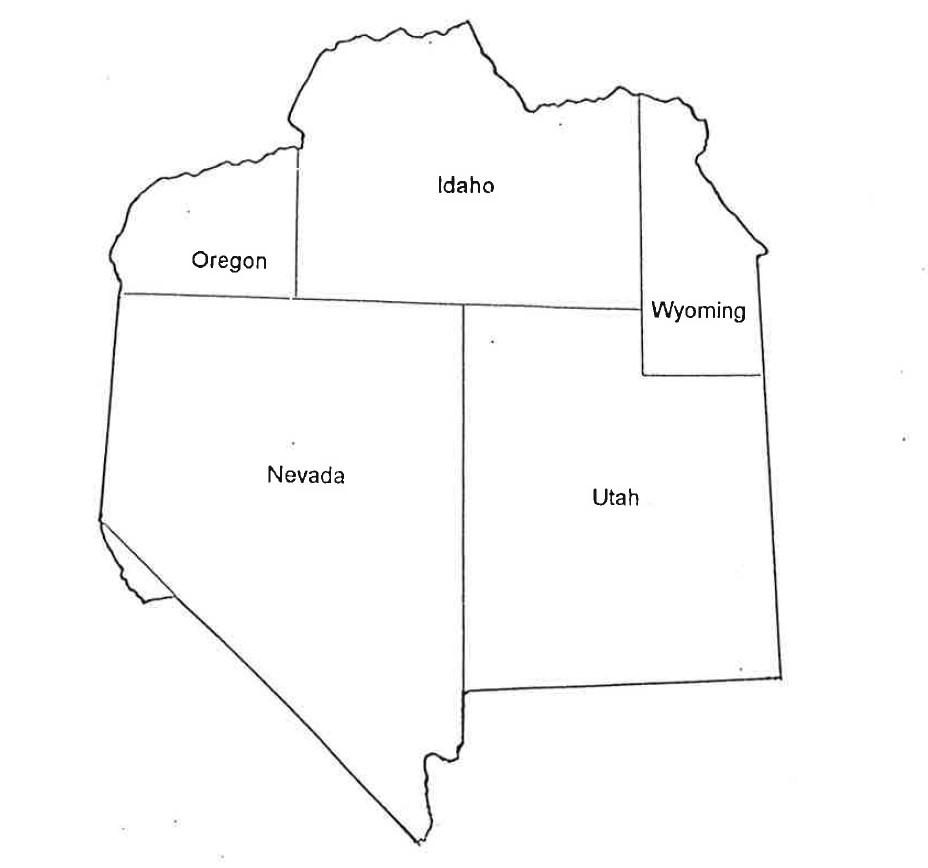
Accurate identification of Cyperaceae species is essential for land managers, wetland scientists, and other specialists facing the challenge of managing, protecting, and restoring the communities where they occur. Many members of the 15 Cyperaceae genera occurring in the Intermountain West are not easily identified. This field guide and the Field guide to Intermountain sedges (Hurd et al. 1998) can be used along with other resources to assist in making identifications. This guide is not inclusive; readers are advised to consult comprehensive local floras to verify identifications. The geographic area encompassed by this guide includes southeastern Oregon, Nevada, Utah, western Wyoming, and Idaho south of the Salmon River (fig. 1).
This field guide begins with a description of the Family Cyperaceae followed by a key to the genera. Genera are then presented in alphabetical order by scientific name. Each genus description includes illustrations of its characteristic morphology, and, where appropriate, a dichotomous key to its species. Species descriptions for each genus are arranged alphabetically by scientific name and generally include characteristics of its growth habit, leaves, bracts, inflorescences, floral scales, flowers, achenes, habitat, and distribution. Comparisons with similar species are provided where appropriate. Drawings and photographs illustrate the diagnostic morphology of each species. A glossary of botanical terms and an index of common and scientific names follows the technical descriptions.
Common names, morphological descriptions, habitat requirements, and geographical distributions were derived from the literature, online databases, and examination of specimens and notes from the herbarium at the Rocky Mountain Research Station, Boise, ID; Reno/Nesh Herbarium, University of Nevada, Reno; Intermountain Herbarium, Utah State University, Logan; Monte L. Bean Herbarium, Brigham Young University, Provo, UT; and Tucker Herbarium, Albertson College of Idaho, Caldwell, ID. Most photographs and some line drawings for this publication were prepared by the senior author. Permission for use of additional photographs was provided by the USDI Bureau of Land Management Seeds of Success Program, Oregon Flora, California Botanic Garden, USDA NRCS PLANTS Database, Trent Draper, and Gabriel Campbell, Portland University. Additional line drawings were used with permission from the Flora of North America Association (Flora of North America Editorial Committee 2002), the Jepson Flora Project (Jepson Flora Project, eds. (2025), and the University of Washington Press (Hitchcock et al. 1969). Taxonomy follows the Flora of North America Editorial Committee (2002) and USDA NRCS PLANTS Database (2024).
References
Plant distributions
- Catalogue of Life. 2025. Amsterdam, The Netherlands: Catalogue of Life Secretariat. catalogueoflife.org doi 10.48580/dgnz3
- Consortium of Pacific Northwest Herbaria. 2017. Seattle, WA: University of Washington Herbarium, Burke Museum of Natural History and Culture. (https://www.burkemuseum.org)
- Integrated Taxonomic Information System. 2025. Integrated Taxonomic Information System. www.itis.gov (Accessed 2025 March 25).
- Intermountain Region Herbarium Network Record Search. 2026. https://intermountainbiota.org/portal/collections/search/index.php (Accessed 7 August 2026).
- SEINet – Regional Networks of North American Herbaria Steering Committee. 2017. SEINet Regional Networks of North American Herbaria. (https://symbiota.org/seinet)
- U.S. Department of Agriculture, Natural Resources Conservation Service (USDA NRCS). 2024. The PLANTS Database, Version 3.5 (http://plants.usda.gov 01/05/2024) National Plant Data Team, Greensboro, NC.
- USDI Geological Survey. 2017. Biodiversity Information Serving Our Nation (BISON). U.S. Geological Survey. (https://www.gbif.us/data/?view=MAP)
Literature
- Ball, Peter W. 2002. Kobresia Willdenow. Kobrésie. In: Flora of North America Editorial Committee, eds. Flora of North America north of Mexico. Vol. 23. Magnoliophyta: Commelinidae (in part): Cyperaceae. New York: Oxford University Press: 252-253.
- Ball, Peter W.; Reznicek, A. A.; Murray, David F. 2002. Cyperaceae Jussieu. Sedge Family. In: Flora of North America Editorial Committee, eds. Flora of North America north of Mexico. Vol. 23. Magnoliophyta: Commelinidae (in part): Cyperaceae. New York: Oxford University Press: 3-8.
- Ball, Peter W.; Wujek, Daniel E. 2002. Eriophorum Linnaeus. Cottongrass, bog-cotton, linaigrette. In: Flora of North America Editorial Committee, eds. Flora of North America north of Mexico. Vol. 23. Magnoliophyta: Commelinidae (in part): Cyperaceae. New York: Oxford University Press: 21-27.
- Beetle, Alan A. 1944. Studies in the genus Scirpus. L. VII. Conspectus of sections represented in the Americas. American Journal of Botany. 31: 261-265.
- Browning, J.; Gordon-Gray, K.D.; Smith, S.G. 1995. Achene structure and taxonomy of North American Bolboschoenus (Cyperaceae). Brittonia. 47: 433-445.
- Bruhl, Jeremy J. 1995. Sedge genera of the world: relationships and a new classification of the Cyperaceae. Australian Systematic Botany. 8: 125-305.
- Bruhl, Jeremy J.; Watson, Leslie; Dallwitz, M.J. 1992. Genera of Cyperaceae: Interactive identification and information retrieval. Taxon. 41: 225-234.
- Chadde, Steve W. 1998. A Great Lakes wetland flora: A complete illustrated guide to the aquatic and wetland plants of the upper Midwest. Calumet, MI: Pocketflora Press. 569 p.
- Corcoran, Mary Lucy. 1941. A revision of the subgenus Pycreus in North and South America. Bio. Ser. 37. Washington, DC: The Catholic University of America. 68 p.
- Cranfill, Raymond. 1993. Cyperaceae. Sedge family. In: Hickman, James C., ed. The Jepson manual: Higher plants of California. Berkeley: University of California Press: 1106-1107, 1138, 1140-1145.
- Crins, William J. 2002. Trichophorum. Persoon. Club-rush, trichophore. In: Flora of North America Editorial Committee, eds. Flora of North America north of Mexico. Vol. 23. Magnoliophyta: Commelinidae (in part): Cyperaceae. New York: Oxford University Press: 28-31.
- Cronquist, Arthur; Holmgren, Arthur H.; Holmgren, Noel H.; Reveal, James L.; Holmgren, Patricia K. 1977. Intermountain flora: vascular plants of the Intermountain West, U.S.A. Vol. 6. The monocotyledons. New York: Columbia University Press. 584 p.
- Culver, Denise R.; Lemly, Joanna M. 2013. Field guide to Colorado’s wetland plants: Identification, ecology and conservation. Denver, CO: U.S. Environmental Protection Agency, Region 8. 694 p.
- Davis, Ray J. 1952. Flora of Idaho. Provo, UT: Brigham Young University Press. 836 p.
- Dorn, Robert D. 1977. Manual of the vascular plants of Wyoming. Vol. 1. Equisetaceae to Grossulariaceae. New York: Garland Publishing, Inc. 801 p.
- Danylyk, Ivan M.; Olshanskyi, Igor G.; Zhygalova, Svitlana L. 2017. A new nomenclatural combination in Schoenoplectiella (Cyperaceae). Phytotaxa 299(1): 138-140.
- Fassett, Norman C. 1957. A manual of aquatic plants. 2d ed. Madison: The University of Wisconsin Press. 405 p. with revised appendix by Eugene C. Ogden.
- Fernald, M.L. 1905. The North American species of Eriophorum. Part 1. Synopsis of American species. Rhodora. 7: 81-92.
- Flora of North America Editorial Committee, eds. 2002. Flora of North America north of Mexico. Vol. 23. Magnoliophyta: Commelinidae (in part): Cyperaceae. New York: Oxford University Press. 608 p.
- Friedland, Solomon. 1941. The American species of Hemicarpha. American Journal of Botany. 28: 855-861.
- Goodrich, Sherel; Huber, Allen. 2014. Uinta Flora. Ogden, UT: U.S. Department of Agriculture, Forest Service, Intermountain Region in cooperation with Ashley National Forest. 314 p.
- Grant, Verne E. 1959. Cyperaceae. Sedge family. In: Munz, Philip A.; Keck, David D.A California flora. Berkeley: University of California Press: 1414-1428.
- Harrington, H.D. 1954. Manual of the plants of Colorado. Denver, CO: Sage Books. 666 p.
- Henry, Annie L.; Robinson, Rae; Sinnott, Kate; Brunson, Mark W.; Ernst, Adrienne; Tarsa, Emily; Kettenring, Karin M. 2024. Got plants? Availability of and challenges to production of native plants for wetland restoration. Restoration Ecology. 32(4): e14120. 13 p. doi: 10.1111/rec.14120
- Hickman, James C. 1993. The Jepson manual: higher plants of California. Berkeley, CA: University of California Press. 1312 p. + appendices.
- Hines, David M. 1975. A monograph of the Eleocharis ovata complex (Cyperaceae) in North America. Ann Arbor, MI: University of Michigan. 235 p. Dissertation.
- Hitchcock, C. Leo; Cronquist, Arthur. 2018. Flora of the Pacific Northwest: An illustrated manual. Second ed. Giblin, David E.; Legler, Ben S.; Zika, Peter; Olmstead, Richard G., eds. Seattle: University of Washington Press in association with Burke Museum of Natural History and Culture. 882 p.
- Hitchcock, C. Leo; Cronquist, Arthur; Ownbey, Marion; Thompson, J.W. 1969. Vascular plants of the Pacific Northwest. Part 1. Vascular cryptogams, gymnosperms, and monocotyledons. Seattle: University of Washington Press. 914 p.
- Hurd, Emerenciana G.; Goodrich, Sherel; Shaw, Nancy L. 1994. Field guide to Intermountain rushes. Gen. Tech. Rep. INT-306. Ogden, UT: U.S. Department of Agriculture, Forest Service, Intermountain Research Station. 56 p.
- Hurd, Emerenciana G.; Shaw, Nancy L.; Mastrogiuseppe, Joy; Smithman, Lynda C.; Goodrich, Sherel. 1998. Field guide to Intermountain sedges. Gen. Tech. Rep. RMRS-GTR-10. Ogden, UT: U.S. Department of Agriculture, Forest Service, Rocky Mountain Research Station. 282 p.
- Jepson Flora Project, eds. 2025. Jepson Flora Project. University of California, Berkeley: University of California and Jepson Herbaria. https://ucjeps.berkeley.edu/eflora/ (Accessed 2025 March 25).
- Kartesz, J.T. 2015. The Biota of North America Program (BONAP). 2015. Taxonomic Data Center (http://www.bonap.net/tdc) Chapel Hill, N.C.
- Kettenring, Karin M.; Tarsa, Emily E. 2020. Need to seed? Ecological, genetic, and evolutionary keys to seed-based wetland restoration. Frontiers in Environmental Science. 8: article 109. doi: 10.3389/fenvs.2020.00198
- Koyama, Tetsuo. 1958. Taxonomic study of the genus Scirpus Linné. Journal of the Faculty of Science, University of Tokyo. Section 3 Botany. 7: 271-366.
- Kral, Robert. 2002a. Fimbristylis Vahl. Fimbristyle. In: Flora of North America Editorial Committee, eds. Flora of North America north of Mexico. Vol. 23. Magnoliophyta: Commelinidae (in part): Cyperaceae. New York: Oxford University Press: 121-131.
- Kral, Robert. 2002b. Rhynchospora Vahl. Beak-rush, rynchospore. In: Flora of North America Editorial Committee, eds. Flora of North America north of Mexico. Vol. 23. Magnoliophyta: Commelinidae (in part): Cyperaceae. New York: Oxford University Press: 200-239.
- Larson, Gary E. 1993. Aquatic and wetland vascular plants of the Northern Great Plains. Gen. Tech. Rep. RM-238. Fort Collins, CO: U.S. Department of Agriculture, Forest Service, Rocky Mountain Research Station. 681 p.
- Lye, K.A. 2003. Schoenoplectiella Lye, gen. nov. (Cyperaceae). Lidia. 6(1): 20-29.
- Mastrogiuseppe, Joy. 2002. Dulichium Persoon. Duliche. In: Flora of North America Editorial Committee, eds. Flora of North America north of Mexico. Vol. 23. Magnoliophyta: Commelinidae (in part): Cyperaceae. New York: Oxford University Press: 198.
- McCoy-Sulentic, Miles; Menuz, Diane; Culver, Denise; Stimmel, Elisabeth. 2024. Common wetland plants of Utah’s Central Basin and Range Ecoregion. Misc. Pub. 178. Salt Lake City: Utah Department of Natural Resources; Utah Geological Survey. 220 p.
- McGivney, M. Vincent de Paul. 1938. A revision of the subgenus Eucyperus found in the United States. Bio. Ser. 26. Washington, DC: The Catholic University of America. 74 p. Dissertation.
- Menapace, Francis J. 2002. 8a2a. Eleocharis R. Brown (subg. Eleocharis sect. Eleogenus ser. Maculosae. In: Flora of North America Editorial Committee, eds. Flora of North America north of Mexico. Vol. 23. Magnoliophyta: Commelinidae (in part): Cyperaceae. New York: Oxford University Press: 100-102.
- Meyers, Stephen C.; Jaster, Thea; Mitchell, Katie E.; Hardison, Linda K., eds. 2015. Flora of Oregon Volume 1: Pteridophytes, Gymnosperms, and Monocots. Fort Worth, TX: BRIT Press. 592 p.
- Oteng-Yeboah, A.A. 1974. Taxonomic studies in Cyperaceae-Cyperoideae. Notes from the Royal Botanic Garden, Edinburgh. 33: 311-315.
- Schuyler, Alfred E. 1967. A taxonomic revision of North American leafy species of Scirpus. Proceedings of the Academy of Natural Sciences, Philadelphia. 119: 295-323.
- Smith, S. Galen. 1969. Natural hybridization in the Scirpus lacustris complex in North Central United States. In: Gunckel, James E., ed. Current topics in plant science. New York: Academic Press: 175-199.
- Smith, S. Galen. 1995. New combinations in North American Schoenoplectus, Bolboschoenus, Isolepis, and Trichophorum (Cyperaceae). Novon. 5: 97-102.
- Smith, S. Galen. 2002a. Amphiscirpus Oteng-Yeboah. In: Flora of North America Editorial Committee, eds. Flora of North America north of Mexico. Vol. 23. Magnoliophyta: Commelinidae (in part): Cyperaceae. New York: Oxford University Press: 27-28.
- Smith, S. Galen. 2002b. Bolboschoenus (Ascherson) Palla. Tuberous bulrush. In: Flora of North America Editorial Committee, eds. Flora of North America north of Mexico. Vol. 23. Magnoliophyta: Commelinidae (in part): Cyperaceae. New York: Oxford University Press: 37-44.
- Smith, S. Galen. 2002c. Schoenoplectus (Reichenbach) Palla. In: Flora of North America Editorial Committee, eds. Flora of North America north of Mexico. Vol. 23. Magnoliophyta: Commelinidae (in part): Cyperaceae. New York: Oxford University Press: 44-60.
- Smith, S. Galen; Schuyler, A.E.; Crins, William J. 1993. Scirpus. In: Hickman, James C., ed. The Jepson manual higher plants of California. Berkeley, CA: University of California Press: 1146-1149.
- Smith, S. Galen; Bruhl, J. J.; Gonzalez-Elizondo, M.S.; Menapace, F.J. 2002. Eleocharis. In: Flora of North America Editorial Committee, eds. Flora of North America north of Mexico. Vol. 23. Magnoliophyta: Commelinidae (in part): Cyperaceae. New York: Oxford University Press: 60-120.
- Strong, Mark T. 1994. Taxonomy of Scirpus, Trichophorum and Schoenoplectus (Cyperaceae) in Virginia. Bartonia. 58: 29-68.
- Taylor, T.M.C. 1983. The sedge family (Cyperaceae) of British Columbia. Handb. 43. Victoria, British Columbia: British Columbia Provincial Museum. 375 p.
- Tidestrom, Ivar. 1925. Contributions from the United States National Herbarium, Smithsonian Institution, United States National Museum. Vol. 25. Flora of Utah and Nevada. Washington, DC: Government Printing Office. 665 p.
- Tucker, Gordon C. 1987. The genera of Cyperaceae in the southern United States. Journal of the Arnold Arboretum. 68: 361-445.
- Tucker, Gordon C. 1993a. Cyperus Nutsedge, galingale. In: Hickman, James C., ed. The Jepson manual: higher plants of California. Berkeley, CA: University of California Press: 1138-1140.
- Tucker, Gordon C. 1993b. Lipocarpha. In: Hickman, James C., ed. The Jepson manual, higher plants of California. Berkeley, CA: University of California Press: 1144.
- Tucker, Gordon C. 1994. Revision of the Mexican species of Cyperus (Cyperaceae). Systematic Botany Monographs 43. 213 p.
- Tucker, Gordon C. 2002a. Cladium P. Browne. Twig-rush, sawgrass, marisque. In: Flora of North America Editorial Committee, eds. Flora of North America north of Mexico. Vol. 23. Magnoliophyta: Commelinidae (in part): Cyperaceae. New York: Oxford University Press: 240-242.
- Tucker, Gordon C. 2002b. Lipocarpha R. Brown in J. H. Tuckey. Lipocarphe. In: Flora of North America Editorial Committee, eds. Flora of North America north of Mexico. Vol. 23. Magnoliophyta: Commelinidae (in part): Cyperaceae. New York: Oxford University Press: 195-197.
- Tucker, Gordon C. 2002c. Schoenus Linnaeus. In: Flora of North America Editorial Committee, eds. Flora of North America north of Mexico. Vol. 23. Magnoliophyta: Commelinidae (in part): Cyperaceae. New York: Oxford University Press: 239-240.
- Tucker, Gordon C.; Marcks, Brian G.; Carter, J. Richard. 2002. Cyperus Linnaeus. Umbrella-sedge, flatsedge. In: Flora of North America Editorial Committee, eds. Flora of North America north of Mexico. Vol. 23. Magnoliophyta: Commelinidae (in part): Cyperaceae. New York: Oxford University Press: 141-191.
- Welsh, Stanley L.; Atwood, N. Duane; Goodrich, Sherel; Higgins, Larry C. 2015. A Utah flora. Fifth ed. Provo, UT: Brigham Young University. 990 p.
- Whittenmore, Alan T.; Schuyler, Alfred E. 2002. Scirpus Linnaeus. Bulrush, scirpe. In: Flora of North America Editorial Committee, eds. Flora of North America north of Mexico. Vol. 23. Magnoliophyta: Commelinidae (in part): Cyperaceae. New York: Oxford University Press: 8-21.
Family Cyperaceae
Sedge Family
Plants grasslike, annual or usually perennial; habit cespitose, rhizomatous, or stoloniferous, rarely tuberous; roots fibrous; culms usually solid, often triangular, sometimes terete or flattened, rarely hollow or septate; leaves basal, cauline, or both, alternate, mostly 3-ranked; sheaths closed, rarely open; ligules often present; blades divergent or ascending, entire, parallel-veined, often narrow, elongate and flat to terete, rolled, plicate, or reduced, often absent from basal leaves; inflorescence a panicle or modified panicle (corymb, cyme, raceme, umbel or spike) subtended by bracts and consisting of spikelets or spikes with 1-many floral scales, spirally or distichously arranged and appressed or ascending on the compressed axis, the proximal an/or the distal scales sometimes empty; flowers axillary to the floral scale, sessile, reduced, bisexual in most genera or unisexual (and the plants then usually monoecious) wind-pollinated; perianth of 3-6 (1-30) bristles or scales, longer to shorter than the floral scales, reduced, or lacking; stamens commonly 3, rarely 1 or 2; exserted at anthesis, the plants wind pollinated; anthers basifixed; ovary superior, (1-2) 3 carpellate, 1-celled with a single basal anatropous ovule; style unbranched, bifid or trifid with the stigmas accordingly 2 or 3; achene mostly leathery, biconvex or trigonous, pericarp thin; seeds 1, testa thin; endosperm well developed; embryo small, basal, embedded in the endosperm; x = 5 – ca. 100.
A large, cosmopolitan family, most common in wet or moist areas of both hemispheres.
Key to the Genera of Cyperaceae in the Intermountain Region
- 1. Leaves cauline or some leaves attached to the culm above those attached to the base of the culm; leaf blades well developed.
- 2. Flowers unisexual, the staminate and pistillate in the same or different spikelets; achene enclosed in a sac-like scale (perigynium) as well as subtended by a scale; staminate and pistillate spikelets or portions of them usually dissimilar in appearance; perianth absent.
- 3. Perigynium open on one side above the middle, loosely wrapped around the achene and sometimes also a staminate flower or flowers; spikelets with 1 pistillate flower and 1 staminate flower or unisexual and 1-flowered, solitary or forming a compound or paniculate head; leaves filiform and involute; culms short (usually less than 35 cm) and obtusely triangular.Kobresia
- 3. Perigynium closed, open only at the apical orifice through which the style or stigmas protrude, loosely or tightly enclosing only the achene; spikelets unisexual or bisexual, few to many-flowered, solitary or much more often racemosely arranged in a terminal, rarely branched inflorescence; leaves and culms various.Carex (see Hurd et al. [1998])
- 2. Flowers bisexual, only rarely some of them (apart from empty scales at base of the spikelet) with stamens or pistil abortive; achenes in scale axils, not enclosed in a perigynium; all spikelets essentially alike in appearance; perianth of stiff or soft “bristles” or absent.
- 4. Spikelets flattened laterally or sometimes 4-angled in Cyperus, the scales 2-ranked.
- 5. Inflorescences several to many in leaf axils; internodes hollow; leaves cauline.Dulichium
- 5. Inflorescence solitary, terminal on culm; culm internodes solid or spongy; leaves basal or basal and cauline.
- 6. Leaf blades flat, at least near the sheath; sheaths not black; inflorescence various; spikelets brown; 0-1 sterile proximal scales; plants relatively soft, not wiry.Cyperus
- 6. Leaf blades not flat, thickly subcylindric and grooved on one side or 3-angled with 2 sharp angles and 1 rounded angle; sheaths black; inflorescence a dense unbranched head, dark brown to blackish; spikelets black or dark purple; 2 or more sterile proximal scales; plants wiry.Schoenus
- 4. Spikelets not flattened, circular in section, the scales spirally arranged.
- 7. Culms clearly 3-angled, at least distally (near inflorescence).
- 8. Spikelets (4–) 6–10 mm thick; spikelet scales finely pubescent (but the hairs often worn off in age), the apex notched, the midrib extended into a prominent awn; hard corms (commonly called tubers) formed at culm bases and persistent on rhizomes for 1–2 years.Bolboschoenus
- 8. Spikelets 1–3.5 mm thick; spikelet scales glabrous, the apex not bifid or with a prominent awn; tubers lacking.Scirpus
- 7. Culms cylindric or sometimes obscurely 3-angled or flattened.
- 9. Culms 5–10 mm thick; leaf blades with harsh, sharp spinules on margins and abaxial midrib; inflorescences 1 or more in axils of leaves; perianth absent.Cladium
- 9. Culms less than 5 mm thick; leaf blades smooth; inflorescence 1; perianth present, consisting of 10 or more conspicuous, smooth, filiform perianth bristles much longer than spikelet scales in fruit and forming cottonlike tufts.Eriophorum
- 1. All leaves attached to the base of the culm (or one leaf attached to culm above basal leaves in Schoenoplectiella saximontanus); leaf blades well-developed, rudimentary or absent.
- 10. Leaves bladeless or rarely represented by a tooth-like structure less than 1 mm long; inflorescence a solitary erect spikelet; involucral bracts absent; achenes usually with a persistent enlarged style base (tubercle) at apex.Eleocharis
- 10. At least some leaves with blades more than 1 mm long; inflorescence various; one or more involucral bracts present; achenes rarely with a tubercle.
- 11. Inflorescence of 1 spikelet with 1 erect involucral bract; plants perennial, forming tussocks or mats.
- 12. Inflorescence bract to about as long as spikelet; plants stiff, forming dense tussocks in wet soil, not in water.Trichophorum
- 12. Inflorescence bract mostly longer than spikelet; plants usually flaccid, rarely stiff, forming mats, usually in deep water.Schoenoplectus subterminalis
- 11. Inflorescence of 1 to many spikelets with one to several involucral bracts; plant habit various.
- 13. Culms clearly 3-angled; robust rhizomatous perennials forming large colonies.Schoenoplectus (in part)
- 13. Culms cylindric or ridged or sometimes slightly compressed, not clearly 3-angled; habit various.
- 14. Spikelet scales less than 2 mm long; flowers and achenes subtended by 1-2 thinly membranous scales hidden behind the spikelet scale; small tufted annual to about 20 cm tall.Lipocarpha
- 14. Spikelet scales more than 2 mm long; flowers and achenes subtended only by a spikelet scale; large to medium-sized rhizomatous perennials or rarely a small tufted annual.
- 15. Inflorescences unbranched heads or sometimes solitary; rhizomatous perennial or tufted annual; rare in our area.
- 16. Spikelet scale apices with midribs prolonged into a distinct mucro or awn; achenes prominently rugose; tufted annual, amphicarpic flowers produced in inner sheaths of basal leaves; soft; non-saline and non-alkaline habitats.Schoenoplectiella saximontana
- 16. Spikelet scale apices with midribs not prolonged; achenes smooth; rhizomatous perennial, wiry; saline or alkaline habitats.Amphiscirpus
- 15. Inflorescences branched (the branches sometimes short); rhizomatous perennials; some species common.
- 17. Culms 2–10 mm thick; plants 1–4 m tall; leaf blades shorter than their sheaths (rarely longer in S. heterochaetus); perianth present; achenes without sculpturing, smooth, with short apical beak.Schoenoplectus (in part)
- 17. Culms less than 2 mm thick; plants to 1.5 m tall; leaf blades much longer than their sheaths; perianth absent; achenes finely honeycomb-reticulate, without an apical beak.Fimbristylis
Descriptions of Genera and Species
Amphiscirpus
Bulrush
Perennials lacking evident internal air spaces, smooth except for the scabrous leaf blade margins; rhizomatous; culms solid, solitary or clustered, terete, wiry, tough, lacking evident internal air spaces; leaves basal; sheaths often disintegrating into fibers; ligules present, ciliate; blades well-developed, tough, wiry, C-shaped to subcylindric; involucral bracts 1–3; the proximal bract leaflike, spreading to erect, exceeding the inflorescence; inflorescences capitate, terminal on the culms but sometimes appearing lateral; spikelets 1–6 (10), sessile, not laterally flattened; scales spirally arranged, smooth, the apex not notched; proximal 1–2 scales with awn-like blades to 15 mm long; distil scales with midrib not prolonged; flowers perfect, solitary in the scale axils; perianth bristles 1–6, straight, attached to the achene base, shorter than the achene; stamens 3; style bifid, the base not enlarged into a tubercle, deciduous; achenes plano-convex to biconvex, smooth, the apex rounded and beakless.
A genus of a single species, growing in wet saline and often alkaline soil; western North America and South America.
Amphiscirpus differs from Scirpus in lacking internal air spaces. It differs from Schoenoplectus by the presence of prominent ciliate ligules.
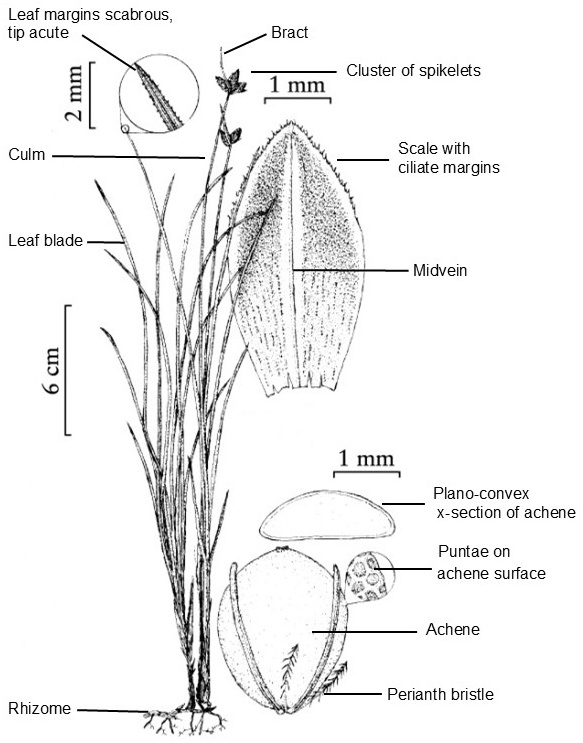
See Figure 2.
Amphiscirpus nevadensis
Nevada bulrush
Scirpus nevadensis S. Watson
Perennial; rhizomes robust, horizontal or sometimes vertical; culms solitary to clustered, terete to subterete, lacking internal air cavities, wiry, tough, 1–7 dm tall, up to 2 mm wide.
5–10, basal; sheaths persistent, the lower ones sometimes bladeless and often disintegrating to fibers; ligules ciliolate; blades 5–10, C-shaped to subcylindric or flat, thick, wiry, sparsely scabrous along the margins, apex acute, lacking internal air cavities, 3–30 cm long, 0.5–2 mm wide; distal blades exceed their sheaths.
1–3; proximal bract spreading to erect, leaflike, green, 1–15 cm long, resembling a continuation of the culm and exceeding the inflorescence; distal bracts reddish, resembling enlarged spikelet scales.
Sessile, capitate, terminal on the culms but often appearing lateral; spikelets 1–6 (10), sessile, ovoid to lanceolate, not flattened, 5–20 mm long, 3–5 mm wide.
30–60, spirally arranged, oval, smooth, shiny, pale to red-brown with pale, hyaline, sometimes ciliolate margins, the apex not notched; the proximal 1 or 2 scales with awn-like blades to 15 mm long resembling involucral bracts; other lower scales ovate, papery to tough and hard, prominently 9-veined, apex rounded, midribs not prolonged, 4 mm long, 3 mm wide.
Perfect, solitary in the scale axils; perianth bristles 1–6, unequal, straight, retrorsely spinulose, pale brown, shorter than the achene and attached to its base; stamens 3; styles bifid, the base not enlarged into a tubercle, deciduous.
Obovoid, plano-convex or biconvex, smooth to minutely punctate, greenish to orange-brown, apex rounded and lacking a beak, 2–2.5 mm long, 1.5–1.7 mm wide.
Fruiting: summer.Seasonally wet saline and often alkaline places to 2400 m elevation. Interior western North America from British Columbia to western North Dakota and south to eastern California and central, western and southern Colorado, also in southern South America.
Amphiscirpus nevadensis plants are similar to small Schoenoplectus pungens plants and sometimes grow with them. S. pungens is distinguished by its three-angled culms and leaf blades, spikelet scales with bifid apices and awned midribs, and its beaked achenes.
Bolboschoenus
Tuberous bulrush
Plants perennial, robust, forming large colonies from long, scaly rhizomes; culms cormose at the base, solitary or clumping, sharply 3-angled, smooth, internally solid without evident air cavities; leaves about 10, basal and cauline; sheaths tubular; ligules absent; blades flat or V-shaped and prominently keeled; inflorescences open, capitate or umbel-like clusters or sometimes solitary, surpassed by one or more spreading to erect involucral bracts that resemble leaf blades; spikelets (1) 2–80, ovoid, not laterally flattened; scales spirally arranged, ovate, membranous, finely pubescent, apex prominently notched (notches often lacking in older specimens), midrib prolonged into a prominent apical awn; flowers perfect, borne singly in the scale axils; perianth bristles 3–6, retrorsely spinulose, shorter to longer than the achene, persistent on the achene or detaching separately (and thus apparently lacking); stamens 3; styles bifid or trifid, the base not enlarged into a tubercle; achenes mostly obovoid, lenticular or trigonous, smooth, the apex narrowed to a short beak.
A nearly cosmopolitan genus of 6–15 species (5 in North America), depending on the taxonomic treatment. Bulboschoenus occurs in wet environments where they are often ecologically dominant and provide important wildlife habitat.
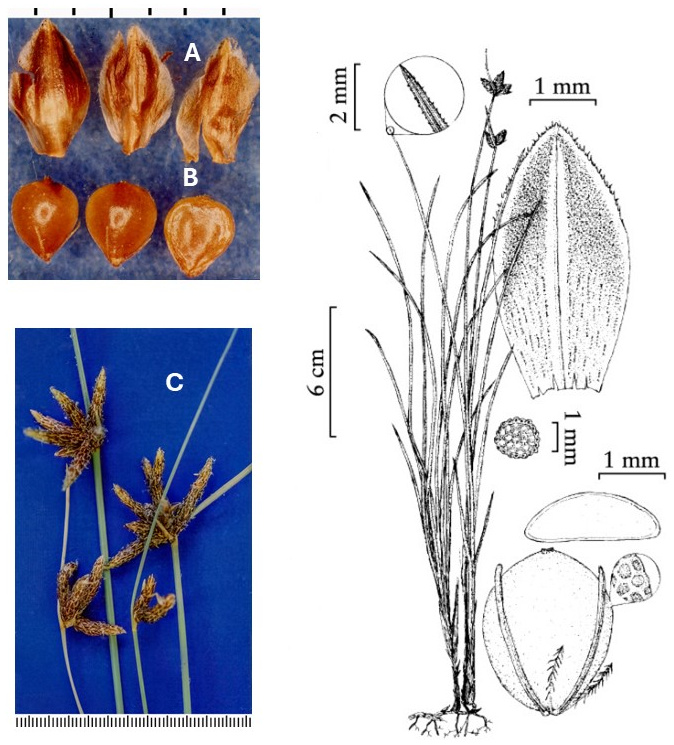
See Figure 4.
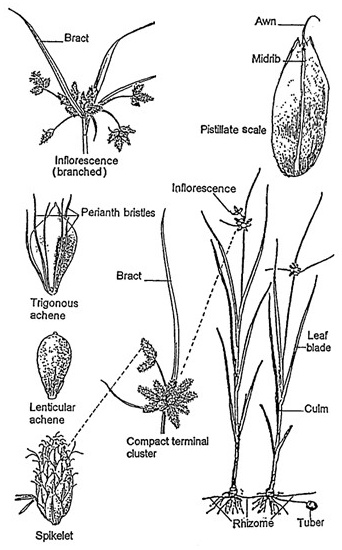
Key to Intermountain Bolboschoenus species
- 1. Mature inflorescences with all spikelets sessile or up to half of the spikelets on branches; styles bifid (rarely trifid); achenes lenticular, rarely compressed trigonous; perianth bristles not persistent on achenes and thus apparently absent; veins at leaf sheath mouth diverging, leaving a triangular membranous and veinless area; widely distributed in brackish to saline or alkaline places.B. maritimus subsp. paludosus
- 1. Mature inflorescences with all or most spikelets on evident, elongated branches; styles mostly trifid; achenes mostly trigonous in cross-section; perianth bristles persistent on achenes; very locally distributed in the Intermountain region.
- 2. Culms 1.5–3 mm thick; widest leaf blade 2–6 mm wide; leaf sheath fronts membranous at the summit, veins there diverge, leaving an acute triangular area lacking veins; spikelets 3–5 mm thick; awns of the scales 0.25 mm wide at the base; achene beak minute.B. glaucus
- 2. Culms 5–15 mm thick; widest leaf blade 7–22 mm wide; veins nearly reach the papery summits of the leaf sheaths; spikelets 5–10 mm thick; awns of the scales 0.5 mm wide at the base; achene beak distinct, to 0.8 mm long.B. fluviatilis
Bolboschoenus fluviatilis
River bulrush
Bolboschoenus maritimus subsp. fluviatilis (Torrey) À. Löve & D. Löve, Schoenoplectus fluviatilis (Torrey) M.T. Strong, Scirpus fluviatilis (Torrey) A. Gray, Scirpus maritimus L. var. fluviatilis Torrey
Stout perennials from horizontal rhizomes thickened at the rooting nodes; culms erect, sharply triangular, often with concave sides, smooth, 1–2 m tall, 5–15 mm thick.
Several, distributed along the culm and shorter than or equal to it; sheaths about half the culm length, fronts of the sheath with veins that nearly reach the papery summit; blades flat with finely scabrous midrib and margins, 7–22 mm wide.
3–6, unequal, the lower ones leaflike, flat, spreading and ascending, exceeding the inflorescence, 20 cm or more long, 4–15 mm wide.
Open, subumbellate (compact when very young); spikelets 10–40, ovoid to lanceolate, tan to brown, 10–25 mm long, 5–10 mm wide, solitary or in clusters of 2–3 (8) on 4–12 flexuous rays up to 10 cm long.
Spirally arranged and loosely imbricate, narrowly oblong with the apex notched, thin, scarious, often lacerate distally, orange-brown or straw-colored, 7–10 mm long, 3–4 mm wide; the midrib excurrent as an awn, 2–3 mm long, 0.5 mm wide, exceeding the notch and often recurved.
Perfect; perianth bristles 6, unequal, retrorsely barbellate, tightly attached to and equaling the achene; stamens 3; styles trifid.
Narrowly obovoid, unequally trigonous, tapered at the base, apiculate at the somewhat rounded apex, minutely cellular-reticulate, dull gray-brown to dark brown, 3.8–5.5 mm long (including the 0.2–0.8 mm beak), 2–2.9 mm wide.
Fruiting: summer.Marshes, shores of lakes and streams to about 2100 m, often emergent in water, not salinity tolerant. Often forms dense, monospecific stands that rarely flower and are therefore often overlooked. In the Intermountain Region known only from northern Utah, southeastern Oregon, and southwestern Idaho. Widespread in most of temperate North America.
Easily confused with the introduced Bolboschoenus glaucus, which has slender culms and leaves with lax inflorescences.
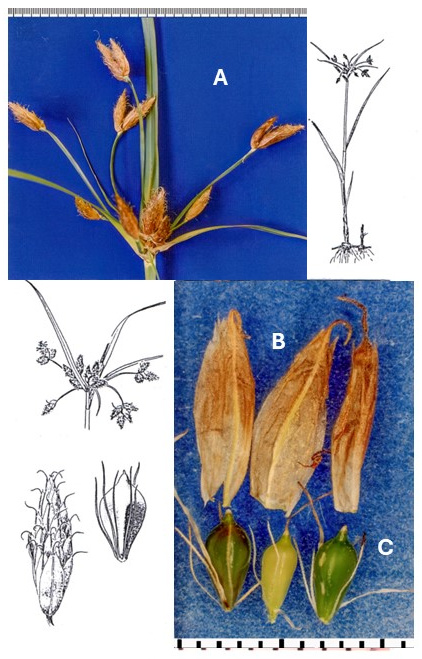
Bolboschoenus glaucus
Tuberous bulrush
Schoenoplectus glaucus (L.) Kartesz, Scirpus glaucus L.
Slender, erect perennials from dark brown rhizomes that bare tubers about 2 cm thick; culms obtusely triangular, smooth, to 1.5 m tall, 1.5–3 mm thick.
Sheaths reach to middle of culm; veins diverge below the membranous summit leaving a triangular area that is veinless; blades 2–6 mm wide.
1–3, leaf-like, elongate, narrow, 2–3 mm wide, flat proximally, scaberulous distally, the lowest longer than the inflorescence.
Open, subumbellate, compact when very young; spikelets 3–30, ovoid to narrowly lanceolate, medium brown to reddish brown, 10–40 mm long, 3–5 mm thick, mostly solitary or in clusters of 2–7 on 3–11 lax rays that are less than 9 cm long.
Loosely imbricate, oblong with the apex mostly lacerate and deeply notched, membranous-hyaline, orange-brown or straw-colored, 5–6 mm long, 2.5 mm wide; the midrib prolonged into a straight or slender, somewhat recurved awn that is 0.25 mm wide at the base.
Perianth bristles 4–6, unequal, minutely retrorsely barbellate, light to medium brown, shorter than to equaling the achene, persisting through dispersal; stamens 3; styles trifid.
Obovoid with a cuneate base and rounded apex, bluntly to obscurely trigonous, pale brown to blackish when mature, 2.5–3.3 mm long (including the minute apiculus), 1.3–2.3 mm wide.
Fruiting: summer.B. glaucus occurs along shores and in waste places from sea level to about 800 m. In California it is a weed of rice fields and managed ponds in wildlife refuges. It is slightly salinity tolerant. In the Intermountain Region it is known only from southwestern Idaho and west-central Oregon. Hybrids with B. maritimus have been reported from Idaho. The species is widespread from the Mediterranean to central Asia and southern Africa. Introduced in North America, it is most abundant in California.
B. glaucus is easily confused with small specimens of the native and more robust B. fluviatilis because of their similar inflorescences and with B. maritimus subsp. paludosus because of hybridization and their similar leaf sheaths and floral scales.
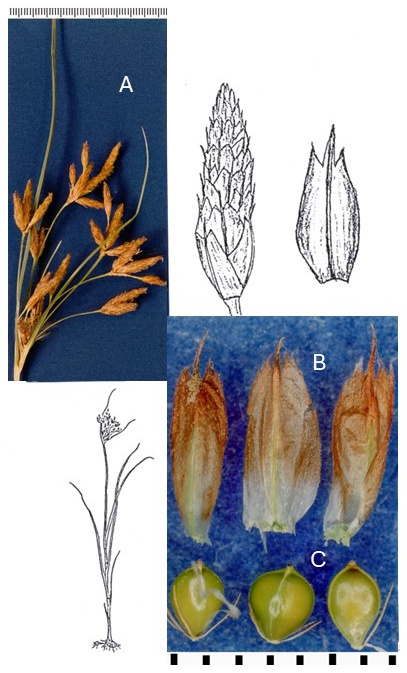
Bolboschoenus maritimus
subsp. paludosus
Alkali bulrush, Bayonet grass, Salt-marsh bulrush
Scirpus campestris Britton; S. maritimus L. var. paludosus (A. Nelson) Kükenthal; S. pacificus Britton ex Parish; S. paludosus A. Nelson
Stout perennial from rhizomes that usually bear firm tubers; culms erect, sharply triquetrous, sides commonly concave, scabrous at the angles, to 1.5 m tall, 1–8 mm thick.
Several, flat or folded, scattered along the stem or all below the middle, 10–40 cm long, up to 1 cm wide; sheaths ventrally membranous at the summit, the veins diverging well below summit leaving a sharply triangular veinless area; the lowest sheaths sometimes bladeless; blades to 12 mm wide.
1-4, very unequal, elongate, green and leafy, surpassing the inflorescence, one much exceeding the others, up to 34 cm long, 1–6 mm wide.
Compact to partly open (compact when very young), unbranched terminal cluster or a simple branched cluster with up to half of the spikelets solitary or in clusters of 2–10 spikelets on 1–4 rays; spikelets (1) 2–40, oblong, with a roughened appearance, brown to stramineous, 7–40 mm long, (4) 7–10 mm thick.
Loosely imbricate, hyaline, lacerate distally and notched, orange-brown or straw- colored or lighter, 5–8 mm long, 3–4 mm wide; awn slender, exceeding the notch, slightly contorted, 1–3 mm long, 0.25 mm wide at the base.
Perianth bristles 6, about half the length of the achene, retrorsely barbellate, usually detaching separately from the achene and thus apparently absent; stamens 3; styles bifid (rarely trifid).
Obovoid to orbicular, mostly lenticular, tapered or cuneate at the base, rounded to truncate and apiculate at the apex, smooth, shiny, bright brown to straw-colored or pale, 2.3–4 mm long, 1.9–2.8 mm wide.
Fruiting: spring—fall.Saline, brackish, or alkaline shores and marshes to about 2900 m. Often found in roadside ditches with other halophytes due to roadside salting. Distributed nearly worldwide, widespread in suitable habitats in the Intermountain Region. Hybrids with B. glaucus known from Idaho.
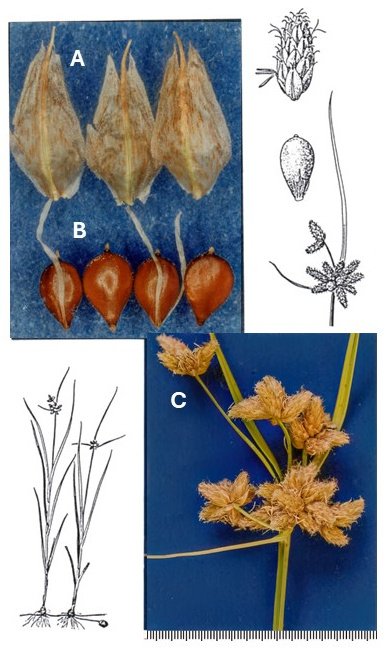
Cladium
Sawgrass, Marisque, Twig-rush
Leafy rhizomatous or stoloniferous perennials; culms solitary or clumped, rounded to rounded-trigonous, hollow, often more than 70 cm tall, 5–10 mm thick; leaves cauline with flat to involute blades; ligules absent; inflorescences one or more, terminal and axillary, capitate to panicle-like, highly branched (to 3rd or rarely 4th order), subtended by 3–4 spreading, leafy involucral bracts; spikelets numerous (100–1,000+), rounded, each with 5-6 spirally arranged scales, the lowest empty, the upper 3–4 each subtending a flower; flowers lack a perianth, lower flowers staminate, upper flowers perfect; stamens 2–3; styles linear, trifid or bifid with a somewhat thickened base; achenes terete with a truncate base; the style base may persist as a tubercle.
A genus of about four species of marshes and other wetlands distributed worldwide, particularly in Australia. Uncommon in the Intermountain Region.
See Figure 8.
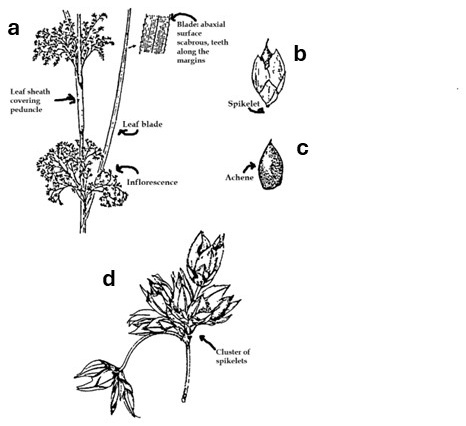
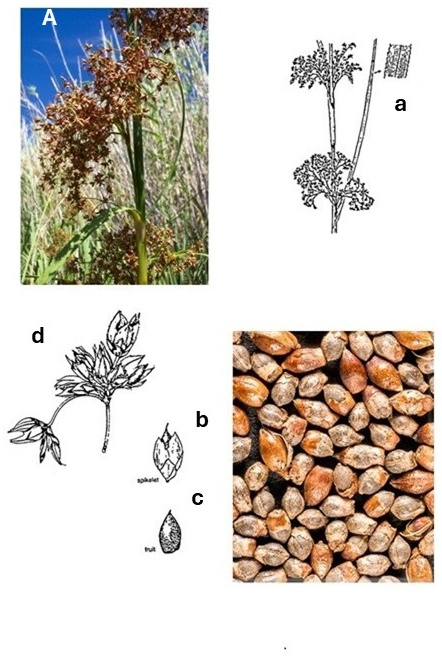
Cladium californicum
California sawgrass, Sawgrass
Cladium mariscus (L.) Pohl var. californicum S. Watson, Mariscus californicus (S. Watson) Fernald
Coarse perennial forming dense clumps; rhizomes stout, 20 cm long, 10 mm in diameter; culms subterete to subtriangular, 1–2 m tall, 5–10 mm thick.
Cauline; ligules absent, blades flat to broadly V-shaped, serrated with cartilaginous teeth along the margins and abaxial side of the midvein, 1–2 m long, 7–10 mm wide.
Three or more, leaf-like, spreading.
Terminal and lateral, panicle-like, purplish brown, 30–50 cm long with flexuous branches (to 3rd and sometimes 4th order); peduncles at least partially covered by the leaf sheaths; spikelets numerous, mostly in groups of (3) 4–6, ellipsoid to lanceolate with acute apices, reddish brown, to 3 mm long.
Few, spirally arranged, ovate to oblong-lanceolate with a distinct midvein, reddish-brown, 2.5–3 mm long, 2 mm wide, lowest scale empty, middle scale empty or subtending staminate flowers, terminal scale subtending a perfect flower.
Perfect and staminate; perianth lacking; stamens 2, anthers 2 mm long, connective apices 0.1 mm; styles trifid, 1–1.5 mm long; stigmas 1–1.5 mm long.
Ovoid, barely trigonous, the base truncate and the apex acute, smooth or irregularly rugulose, glossy purplish brown, 1.5–2 mm long, 1 mm wide; the persistent style base forms a beak 0.2 mm long.
Fruiting: spring—summer.Alkaline marshes, swamps, and springs from sea level to 2000 m elevation. Rare in the Intermountain Region. Occurs in Arizona, California, southern Nevada, southern Utah, Texas, and Mexico. Most Utah populations were inundated by Lake Powell.
Cyperus
Flatsedge, Nutgrass, Umbrella sedge
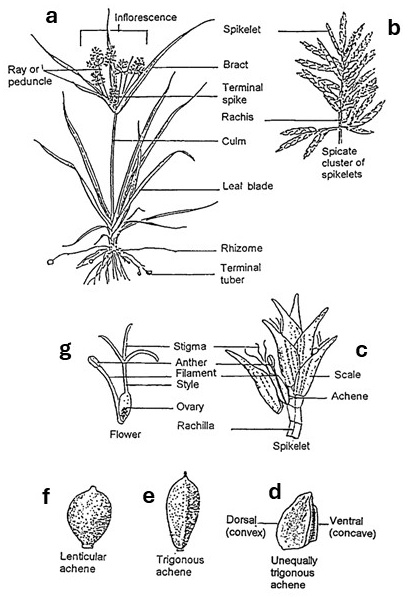
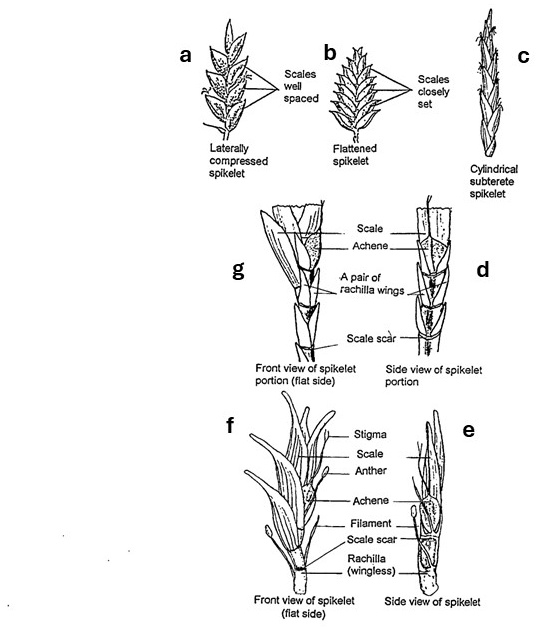
Grasslike rhizomatous, stoloniferous, or rarely tuberous perennials or annuals; culms to 1 m tall, cespitose or solitary, triangular or sometimes terete, solid, smooth or with prickles; leaves grasslike, usually basal with closed sheaths; ligules absent, blades elongate, flat or V-shaped, keeled abaxially or absent; involucral bracts 1-10, leaflike, sheathless, spirally arranged, spreading to erect from the culm apex, 1–50 cm long, exceeding the inflorescence; inflorescence capitate, spicate, or subumbellate clusters; terminal clusters usually sessile; others on unequal rays from axils of the involucral bracts; spikelets 1–150, flat to subterete, many-flowered, deciduous or persistent and the scales deciduous; rachilla straight, offset, or zigzag, often with decurrent bases of the scales forming wings; scales distichous, keeled, each subtending a single flower or the lower ones empty and modified; flowers perfect, perianth absent; stamens (1–2) 3; style bifid or trifid, the base deciduous or persistent; achene flattened, lenticular, or trigonous.
A large genus of about 600 species found predominantly in tropical and warm temperate regions.
Species characteristics are often variable, and mature fruit is needed for identification. Annual flatsedges are frequently abundant on sandbars or riverbanks in years when rivers are lower than usual.
Key to Intermountain Cyperus species
- 1. Stamens 1 (except in C. difformis); stigmas 3; tufted annuals; culms usually not tuberous-thickened at the base.
- 2. Scales awn-tipped, recurved (especially when dry), 5–9 nerved; spikelets in loose to dense capitate clusters.C. squarrosus
- 2. Scales not awn-tipped, 3-nerved; spikelets in dense capitate clusters.
- 3. Scales ovate-lanceolate, acuminate; tip straight or slightly recurved.C. acuminatus
- 3. Scales orbicular; tips obtuse.C. difformis
- 1. Stamens 2 or 3; plants mostly tufted, annual or perennial, tuberous or thickened at the base (except C. bipartitus).
- 4. Rachilla wingless; annual; stamens 2; style bifid; achene lenticular, biconvex; scales anthocyanic except for the pale or greenish midrib.C. bipartitus
- 4. Rachilla winged; stamens 3; style trifid; achene trigonous or terete; scales mostly yellowish brown to straw-colored.
- 5. Plants annual; scales rounded or blunt apically, mucronate with a wide green midvein and a minutely excurrent keel; achene mucronate.C. erythrorhizos
- 5. Plants perennial (seldom annual, except C. bipartitus); scales mostly not mucronate and without a wide green midvein (except C. schweinitzii); achenes obtuse or mucronate.
- 6. Rachilla disarticulating above the two lowest sterile scales; spikelets spreading at right angles to the rachis; plants without rhizomes; rachilla wing clasps the achene toward the base.C. strigosus
- 6. Rachilla persistent; scales deciduous; spikelets not spreading at right angles to the rachis, plants rhizomatous, rachilla wings not clasping the achene.
- 7. Spikelets linear, loosely clustered; scales not conspicuouly nerved and midrib not excurrent; rhizomes slender and elongate, often terminating in small tubers; plants not tufted.C. esculentus
- 7. Spikelet clusters oblong, somewhat closely clustered, rachilla narrowly or scarcely winged; scales conspicuously nerved and midrib excurrent; rhizomes short, without tubers; plants tufted.C. schweinitzii
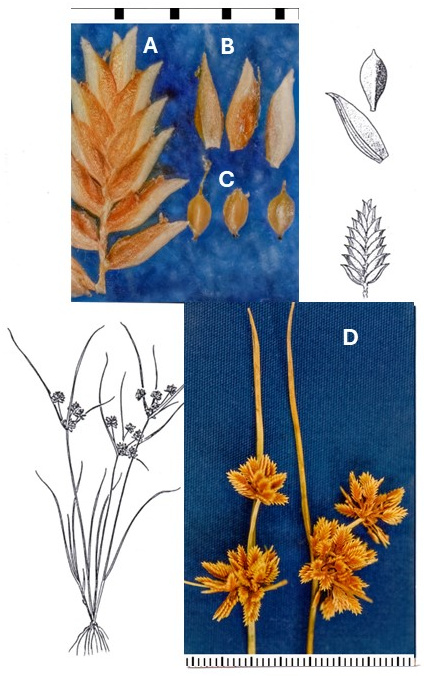
Cyperus acuminatus
Tapertip flatsedge, Short-pointed flatsedge
Tufted annual with fibrous roots; culms slender, roundly trigonous or subcompressed, multistriated, distil half glabrous or rarely scabridulous, sometimes thickened at the base, 0.5–4.5 dm tall, 0.4–1.2 mm thick.
Few, 2–6 to a culm, borne near the base, slender, elongate, flat or V—shaped, light green, scaberulous on the margins, shorter than or about equal to the culm, 8–12 cm long, 1–3 mm wide; sheaths often reddish at the base.
3–6, erect to ascending or somewhat spreading, elongate, unequal, some or all of them much longer than the inflorescence, 3–12 cm long, 1–2.5 mm wide.
Umbels with 2–5 very short (0.2–3 cm), unequal rays terminating in dense globose clusters of 8–60 spikelets 5–18 mm wide; spikelets ovate-oblong, strongly flattened, pale green becoming light to reddish brown, 3–7 mm long, 2.5–3.5 mm wide.
Straight, wingless, persistent; scales deciduous.
8–25, 2-ranked, closely set and overlapping, the tip of each scale surpassing the one beneath it, ovate-lanceolate, somewhat hyaline and cellular-reticulate, prominently 2-keeled, shortly recurved-acuminate at the tip, yellowish to light brown or reddish brown with a lighter or greenish nerved center, 1.5–2.5 mm long, 0.5–1.4 mm wide, deciduous at maturity.
Perfect; perianth lacking; stamen 1, anther 0.5 mm; style trifid.
Obovoid-elliptic or oblong, trigonous, abruptly contracted at the base, slenderly stipitate, smooth, brown, 0.6–1.1 mm long, 0.3–0.6 mm wide with a short apiculate beak formed from the style base.
Fruiting: June–October.Drying shores, mudflats, disturbed seasonal wetlands, and other wet places, usually in sandy soils, 0 to 1500 m. Tolerant of alkali. Uncommon in the Intermountain Region where it is reported from locations in west-central Nevada and central and southern Utah and northern and central Colorado. Washington to New Hampshire and south from California to Alabama; Mexico.
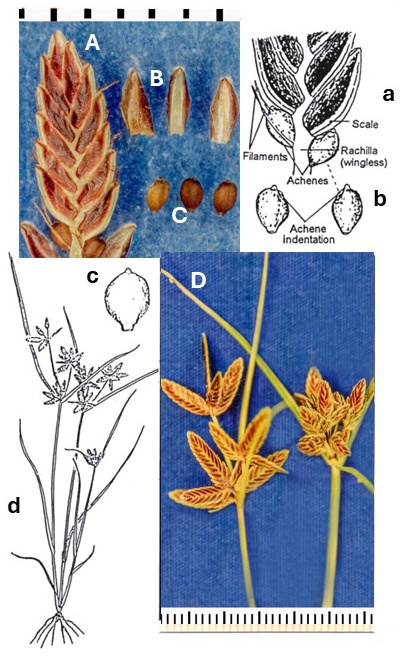
Cyperus bipartitus
Slender flatsedge, Streamside flatsedge
Cyperus niger Ruiz & Pav. var. rivularis (Kunth) V.E. Grant, C. rivularis Kunth, Pycreus rivularis (Kunth) Palla
Small, densely tufted annual with fibrous roots; culms slender, triangular to rounded, smooth, multistriate, 0.5–3 dm tall, 0.3–1.4 mm thick, sometimes thickened at the base.
Few, 1–3 to a culm, all borne near the base, slender, flat to V-shaped, margins smooth, becoming scaberulous distally; shorter to longer than the culms, 1-8 cm long, 0.5–2 mm wide; lower basal sheath brown or reddish brown.
2–4, leaflike, horizontal to mostly ascending, V-shaped to flat, unequal, 1–12 cm long, 0.5–1.5 mm wide; the longest bract much surpassing the inflorescence; others reduced, spreading.
One to several capitate clusters of ascending to spreading spikelets aggregated at a point; clusters are 7-14 mm long, 9-14 mm wide, the primary or terminal cluster sessile at the top of the peduncle; others (if present) with 1-10 spikelets on 1-4 slender rays 2–3 cm long; spikelets lanceolate to ovate, flat with thinner edges, mostly reddish purple, 3–12 mm long, 2–3 mm wide.
Persistent, wingless or minutely winged, slightly angular-twisted, about 0.5 mm wide.
Floral scales 6–24 per spikelet, ovate to lanceolate, obtuse at the tip, prominently 2–3-ribbed medially, 2-keeled, pale greenish to yellowish along the midrib, strongly splotched anthocyanic and somewhat shiny along the margins, 2–2.7 mm long, 0.75–2.3 mm wide, very closely set, strongly overlapping and giving the spikelets a smooth outline, deciduous from the rachilla at maturity.
Perfect; perianth absent; stamens 2 (rarely 3); anthers 0.5 mm long; style deeply bifid, stigmas 2.
Broadly ovoid, lenticular, olive to blackish or dull brown, becoming minutely roughened or cross-ridged at maturity, sometimes with prominent indentations on the upper half of the angle (ventrally) next to the rachilla, 1.0–1.9 mm long, 0.6–0.9 mm wide.
Fruiting: June–August.Exposed shorelines, ditches, disturbed wetlands, sandy streambanks from sea level to 1500 m, tolerant of alkali. Uncommon in the Intermountain Region. Collections have been made in southeastern Oregon, southwestern Idaho, and central and northeastern Utah. More frequent eastward across the United States, also in southern Canada, and the mountains of Mexico and Central and South America.
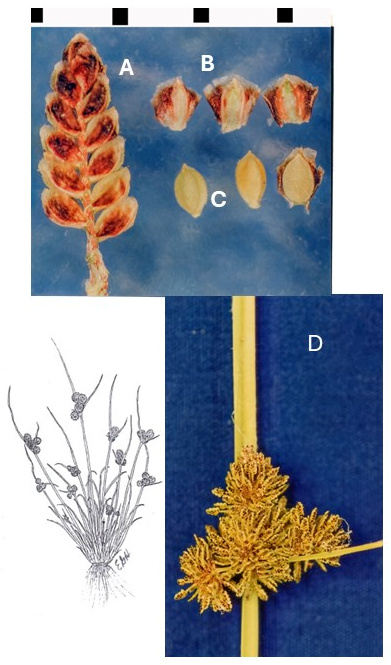
Cyperus difformis
Variable flatsedge
Cyperus lateriflorus Torrey
Small, tufted annuals; roots fibrous, reddish; culms 1–15, sharply triangular, narrowly winged on the angles, smooth, soft, 1–3 dm tall, 1.5–2.5 mm thick.
2–7, borne toward the base, flat, keeled, 2–22 cm long, 2–4 mm wide, shorter than the culms; lower sheath with reddish venation at the base and reddish speckles toward the hyaline mouth.
2–4, flat, keeled, margins and keel slightly scabridulous (especially near the tip), 1–22 cm long, up to 3.5 mm wide, sometimes wider than the culms; the largest bract erect, appearing as a continuation of the culm; other bracts reduced and spreading.
Very tight clusters of 30–120 spikelets forming globose (7–17 mm diameter) to irregular lobate heads (2–32 mm diameter); the central cluster sessile; the lateral (0) 1–5 on short rays less than 3 cm long; spikelets oblong, flat or compressed, yellowish to reddish purple, about 3 mm long, 1.1 mm wide.
Obscurely winged, persistent, not angular-twisted or only obscurely so, not flattened.
6–20, 2-ranked, 3-nerved, closely spaced, orbicular, apex obtuse with a small mucro, greenish to pale, 3-nerved medially, margins hyaline to transparent, very small, about 0.7–1 mm long, 0.5–1 mm wide, deciduous.
Perfect; perianth lacking; stamens 1–2; anthers broadly oval, about 0.1 mm long; styles bifid or trifid.
Broadly oblong with a cuneate base, unequally trigonous, ventrally concave, apex short apiculate, surface papillose and finely reticulate, pale brown to yellowish brown at maturity, 0.5–0.8 mm long (about equaling the subtending scale), about 0.3–0.5 mm wide.
Fruiting: July–November.A common weed of moist to wet sandy or muddy soils in disturbed areas. Occurs along ditches, roadsides, ponds, streambanks, shores, and rice fields from sea level to 1000 m. In the Intermountain Region known from banks of the Boise River in Canyon County, Idaho. Native to the Eastern Hemisphere and widely introduced in the Western Hemisphere.
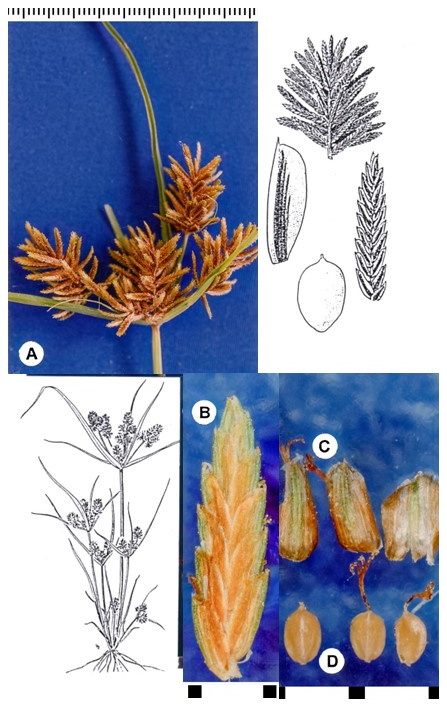
Cyperus erythrorhizos
Redroot flatsedge, Redroot nutgrass
Cyperus cupreus J. Presl & C. Presl, C. halei Torrey ex Britton, C. occidentalis Torrey, C. washingtonensis Gandoger
Annual; roots reddish, fibrous; culms tufted or occasionally arising singly or few together, sharply triangular to rounded, rather stout, smooth, (0.5) 1–7 (10) dm tall, 1–4 mm wide.
Several, crowded toward the base, lower leaves reddish; sheaths loosely envelope the culm; blades flat to an inverse W shape, elongate, scaberulous along the midrib and margins, shorter to longer than the culm, 5–25 (90) cm long, 2–10 mm wide.
4–10, leaflike with scaberulous margins, horizontal to ascending, unequal, up to 40 cm long, the larger ones sometimes wider than the leaves and longer than the inflorescence.
1-3 (6) cylindric to ovoid spikes 1-4 cm long bearing 40–80 loosely clustered spikelets spirally arranged on an elongate rachis; the terminal cluster sessile; the lateral clusters on rays 8 cm long or longer; spikelets quadrangular, reddish brown, 3–12 mm long, 1–1.5 mm wide.
Persistent, slightly angular-twisted with narrowly hyaline, readily deciduous wings at the nodes.
6–20 per spikelet, closely set, the broadly rounded tip of each scale surpassing the one below it by 0.4–0.7 mm, oblong-lanceolate or oblong-obovate, inconspicuously 3–5 nerved, greenish along the scarcely excurrent keeled midrib, satiny and golden brown to reddish brown along the margins, 1–1.5 mm long, 0.5–1 mm wide, eventually deciduous.
Perfect; perianth lacking; stamens 3; anthers short, about 1 mm long; style trifid for up to half its length.
Sessile, broadly oblong, unequally trigonous, concave on the ventral side, side angles acute, apex rounded and mucronate, smooth, shining, pale brown or grayish, (0.4) 0.7–2.0 mm long, about 0.5 mm wide.
Fruiting: July–October.Emergent shorelines of ponds, lakes, rivers, marshes, and other wet places from sea level to 1800 m. Weedy in cultivated areas. Occurs at Utah Lake, along the Rio Grande River, and other scattered locations in the Intermountain Region. Native in the United States, southern Canada, and Mexico.
Cyperus esculentus
Yellow nutsedge, Chufa flatsedge, Yellow nutgrass
Highly polymorphic, non-tufted perennial, producing many slender, spongy stolons that terminate with small, edible tubers; culms arise singly, stout, sharply triquetrous, smooth, 1–7 (10) dm tall, 0.6–5 mm wide.
Few to many, sweet-scented, clustered at the base; sheaths pale or reddish brown at the base; blades firm, flat to V-shaped with smooth margins that are scaberulous distally, shorter to longer than the culms, mostly 2–8 mm wide.
3–6, unequal, leaf-like, bright green, V-shaped to V-shaped and flanged, sometimes slightly wider than the lower leaf blades, spreading to ascending, shorter to much exceeding the inflorescence.
Clustered cylindric spikes, 1–4 cm long, 18–35 mm wide; terminal cluster sessile, others single or in groups on 5–10 rays up to 12 cm long; spikelets numerous, spirally arranged on the elongate (4–17 mm long) rachis, divaricate, slender, linear, flattened, reddish to golden brown, 10–20 mm long, 1–3 mm wide.
Persistent with narrow hyaline wings 0.3–0.5 mm wide, the scales disarticulate from it.
6–34 per spikelet, ovate to elliptic, laterally 3–5 nerved, medially 3-ribbed, obscurely mucronulate, pale to greenish along the center, scarious, yellowish brown to reddish brown along the margins, 2–4 mm long (the lowest one shorter), much overlapping laterally, the tip of each scale only slightly exceeding the one below it, deciduous at maturity.
Perfect; perianth lacking; stamens 3; anthers about 1 mm long or longer; style trifid for one-fourth to one-half its length, stigmas 3.
Seldom maturing, sessile, ellipsoid, unequally trigonous, angles acute or obtuse, puncticulate, shiny, brown, 1.3–2 mm long, 0.3–0.8 mm wide; style somewhat persistent.
Fruiting: June–October.Moist and disturbed soil along streams and ditches, lakes, and sandbars. A difficult weed in cropland. Distributed worldwide, but generally lacking in cold temperate regions. Uncommon in the Intermountain Region where collections of C. e. var. leptosctachyus and C. e. var. heermannii are reported from southwestern Idaho, northeastern and east-central Utah, west-central Nevada and southeastern Oregon.
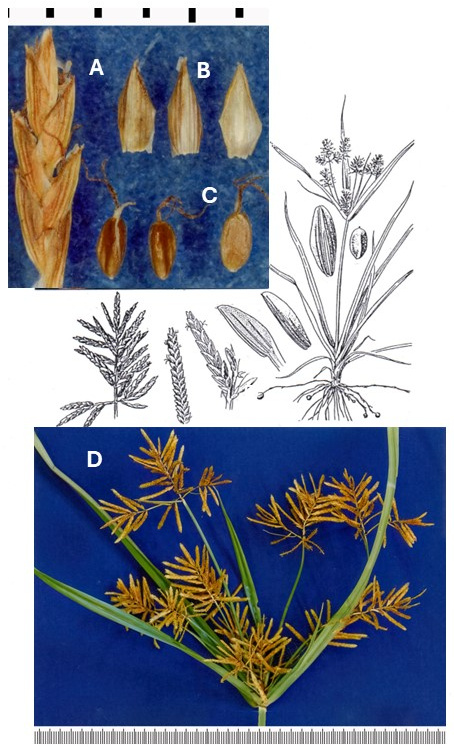
Cyperus schweinitzii
Schweinitz cyperus, Rough sand sedge, Schweinitz flatsedge
Cyperus alterniflorus Schweinitz, Mariscus schweinitzii (Torrey) T. Koyama,
C. schweinitzii Torrey var. uberior Kük.
Tufted perennial from short, irregularly thickened rhizomes; culms bulbous at the base, triquetrous, glabrous or often antrorsely scabrous distally, 1–7 dm tall, 1.5–2 mm thick.
3–5 to a culm, crowded toward the base; sheaths papery, 1-4 cm long, brownish or yellowish proximally, lowest sheaths bladeless; blades well developed, elongate, flat to V-shaped, keeled, rough margined, (2) 7–35 cm long, 1–6 mm wide.
Leaflike, 3–7, erect to ascending, narrow but sometimes slightly wider than the leaves, unequal, up to 10 cm long; the longest 2–4 times longer than the inflorescence.
1-several, umbellate to ovoid, unequal spikes, the terminal spike sessile, others on rays up to 8 cm long; spikelets linear-oblong, laterally compressed, pale brown, 0.5–2.5 cm long, mostly 2–4 mm wide.
Narrowly or obscurely winged, wings sometimes scarious but scarcely hyaline, more or less deciduous.
5–10, broadly ovate, apex rounded and erose, convex on the dorsal side, mucronate with the midrib excurrent as a short point, straitly 9–15 nerved, centers green when fresh, margins straw-colored, whitish, or red spotted, (2.3) 3–4 mm long, the lowest ones shorter, 2–3.2 mm wide, well-spaced, spreading, the tip of each scale surpassing the scale below it by about half its length, deciduous at maturity.
Perfect; perianth lacking; stamens 3; style trifid almost to the base.
Ovoid or elliptical or infrequently obovoid, equally trigonous, cuneate to stipelike at the base, apex obtuse, surface papillose, dark brown or blackish, 2–2.5 mm long, 0.9–2.6 mm wide; style somewhat persistent.
Fruiting: early spring—early summer.Lakeshores, streambanks, sandy openings in woods, dunes and sandy soils, from sea level to 2000 m elevation. In the Intermountain region reported from Kane County, Utah. Washington to Alberta and east to southern Quebec, south to Arizona, Texas, and Mexico. Not reported for the southeastern United States.
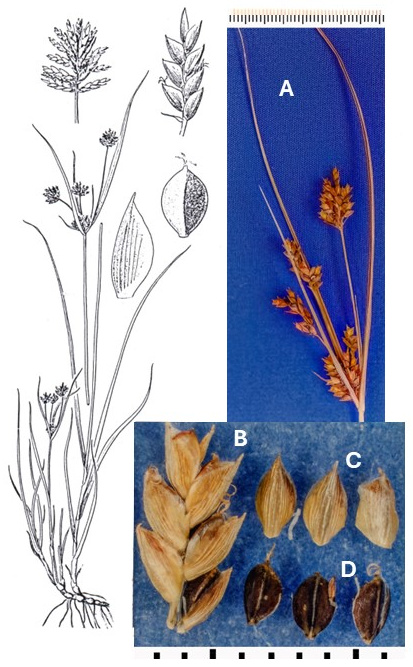
Cyperus squarrosus
Bearded flatsedge, Awned flatsedge, Bearded nutgrass
Cyperus aristatus Rottb., C. inflexus Muhlenberg
Very small tufted annual with fibrous roots; fresh herbage sweet, celery-scented; dry herbage clover scented; culms 1–20, slender, sharply triangular, smooth, unequally ribbed or striated, 0.3–1.5 dm tall, 0.5–2 mm wide.
Few, all borne near the base, flat to V-shaped, keeled distally, light green, shorter to longer than the culms, 2–10 cm long, 0.5–2.5 mm wide; sheaths of older leaves reddish brown.
Leaflike, 1–6, elongate, unequal, 1–15 cm long, some or all surpassing the inflorescence.
1–4 capitate clusters of spikelets, 5–15 mm wide; terminal cluster sessile, others (if present) on slender rays up to 3 cm long; spikelets 1–30 in a cluster, lanceolate to oblong, somewhat compressed, greenish, yellowish, or reddish brown, 4–10 mm long, 1–2.2 mm wide.
Straight, wingless, persistent.
4–20 per spikelet, somewhat closely set, oblong-lanceolate, 5–11 nerved (prominent when dry), slenderly bristle tipped, prominently spreading or recurved (prominent when dry), greenish or yellowish to reddish brown, midrib commonly greenish or paler, 1–2 mm long including the awn, 0.4–0.8 mm wide, deciduous.
Perfect; perianth lacking; stamens 1; style trifid.
Narrowly obovoid or oblong, trigonous, obtusely angled, papillose, stipitate, apex truncate and apiculate, light brown or reddish brown to blackish, 0.6–1.0 mm long, 0.3–0.5 mm wide; stipe 0.06–1.0 mm.
Fruiting: June–November.Seeps, springs, disturbed areas in wet meadows and wetlands, flood plains, drying margins of ponds and lakes, and river sandbars from sea level to 2500 m elevation. Occurs throughout much of the continental United States and Mexico, including scattered locations across the Intermountain Region.
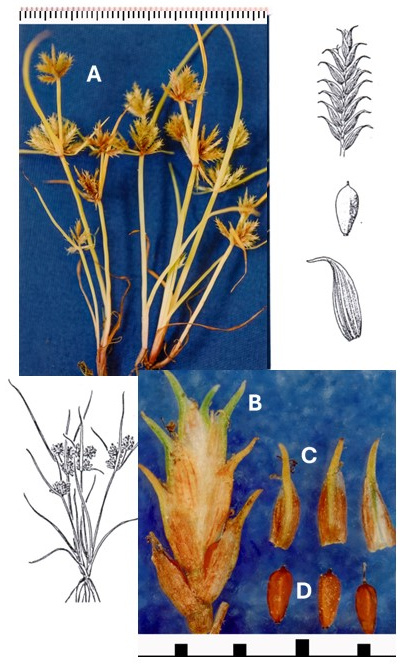
Cyperus strigosus
Strawcolored flatsedge, False nutsedge, Strawcolored nutgrass
Cyperus stenolepis Torrey, C. hansenii Britton, Mariscus stenolepis (Torrey) C.B. Clarke, M. strigosus (L.) C.B. Clarke.
Short-lived perennial; culms few or solitary, erect, mostly stout, trigonous, smooth, swollen, and cormlike at the base, 1–9 dm tall, 1–6 mm thick; often flowers the first year.
One to several, crowded toward the base, flat, glabrous or scaberulous at the margins and midrib and becoming more so distally, light green to yellowish green, longer or shorter than the culms, 10–40 cm long, 2–8 (15) mm wide; lower sheaths brown.
Leaflike, 3–6 (10), flat, scaberulous on the margins, lax and spreading, cross ribs may be conspicuous; longer bracts are 1–2 times longer than the inflorescence and up to 5 mm wide.
Umbellate with up to 10 spikelike or headlike clusters, some (or all) clusters sessile, others on elongate, unequal rays to 7 (20) cm long. Spikelets 10–30 flat, elongate, 6–25(50) mm long, 1–2 mm wide, spreading to perpendicular to the elongate rachis.
Somewhat zigzag shaped, slightly angular twisted, broadly hyaline-winged (0.4–0.5 mm wide) at each node, wings clasping the lower part of each achene, sometimes disarticulating at the node just above the lowermost pair of scales.
3–11 per spikelet, 2-ranked, appressed, each scale overlapping the lower half of the next scale, oblong to obovate with a somewhat acute apex, 7–11 nerved, margins stramineous to yellowish or golden brown and narrowly hyaline distally, greenish or paler along the midrib, 3–6 mm long, 1–1.8 mm wide, persistent on the rachilla or deciduous.
10–16, perfect, perianth lacking, stamens 3; anthers 0.5 mm long or less; style deeply trifid, exerted beyond the scale.
Linear-oblong, unequally trigonous, puncticulate, somewhat less stipitate, mucronate, dark purplish brown, 0.3–0.5 mm wide, 3–4 times as long as wide; style somewhat persistent.
Fruiting: July–October.Disturbed soil in wet areas, marshy ground, emergent shorelines, and sandy gravel areas along streams at elevations from sea level to 1600 m. A weed in garden and croplands. Uncommon in the Intermountain Region with collections reported from southwestern Idaho, central and southern Nevada, and Utah. Widespread elsewhere in the United States and southern Canada.
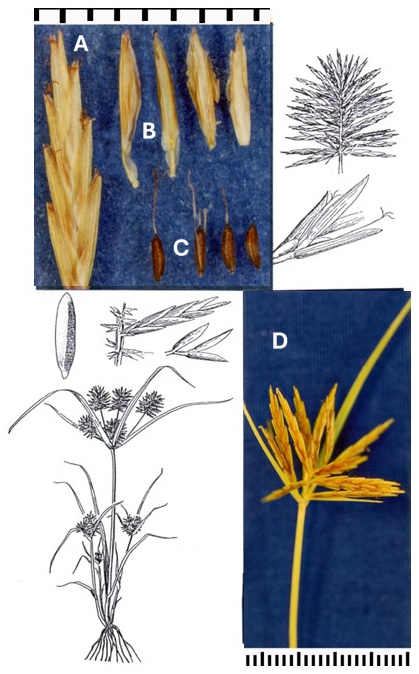
Dulichium
Dulichium
Grasslike perennials with horizontal rhizomes, cespitose or spreading; culms tall, terete to obtusely triangular, jointed with hollow internodes; leaves numerous, 3-ranked, well distributed along the culms, ligulate; lower leaves bladeless; upper leaves with short, flat, well-developed blades; inflorescences consist of spikes borne in the sheath axils of the bract-like upper leaves; spikelets 3–10 per spike, 2-ranked, appressed to ascending, linear, flat or compressed, jointed, deciduous; scales 4-8, 2-ranked, green with gold-hyaline margins, decurrent on the joints; flowers perfect, 2-4 ranked, borne singly in the scale axils; perianth bristles 6–9, well developed, stiff, retrorsely barbellate, slightly longer than the achene; stamens 3, exceeding the bristles; stigmas 2; achene lenticular, stipitate, light brown; the style base persistent on the achene.
A North American genus of a single species with two varieties.
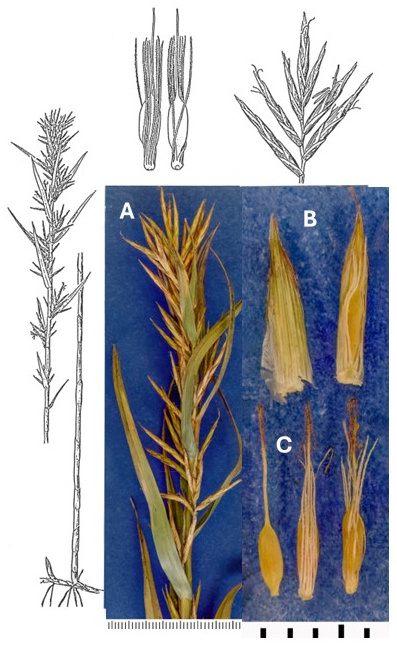
See Figure 20.
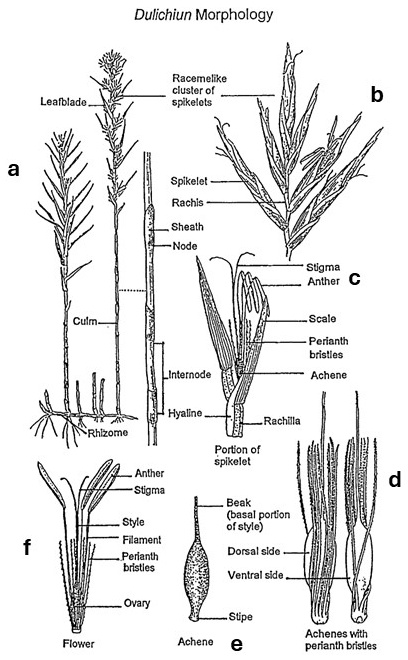
Dulichium arundinaceum
var. arundinaceum
Three-way sedge
Cyperus arundinaceus L.
Perennial; rhizomes long, 3–5 mm thick; culms 2–14, arising singly, stout, erect, cylindric, stout, jointed with hollow internodes, leafy, 2–10 dm tall, 4 mm thick.
Numerous, well distributed along the stem; lower 2–14 leaves firm, bladeless, green sheaths with brown, hyaline margins at the mouth, sheaths not splitting; upper 3-15 leaves spreading or ascending with flat, leathery, glabrous 3-ranked grasslike blades with acute tips, 4–15 cm long, (1.5) 3.5–8 mm wide; distal 5–20 leaves are bracts.
6–30 cm long, consisting of 1-17 spikes, about 2-5 cm long in sheath axils; spikelets 5-20 per spike, 2-ranked, flat, ascending to spreading, linear-lanceolate, greenish to brownish, 15–30 mm long, 1.2–2.5 mm wide; rachilla hyaline winged, readily disarticulating with the scale at maturity.
4–8 per spike, 2-ranked, decurrent, lanceolate, acute to acuminate, prominently many-nerved, light green becoming pale, hyaline along the margins, spongy at the base, (3) 5–9.5 mm long, about 2 mm wide.
Perfect, sessile, borne singly in the scale axils; perianth bristles 6–9, rigid, retrorsely barbellate, about 4–8 mm long, from shorter than the achene to much longer; stamens 3, longer than the perianth bristles; anthers 3-4 mm; stigmas 2, deeply branched, much exerted from the scale.
Narrowly ellipsoid, flattened or somewhat planoconvex with a short, stout stipe, yellowish brown, 2.5–4 mm long (excluding the 1 mm style base), about 1 mm wide; the persistent, undivided basal portion of the style forms a linear beak.
Fruiting: July–October.Marshy shores, wet meadows, bogs, pond margins, and ditch banks from sea level to 700 m. Distributed from southwestern British Columbia to California and in eastern North America. Rare in the Intermountain Region, known from Valley County, Idaho and east central California.
Eleocharis
Spikerush, Spikesedge
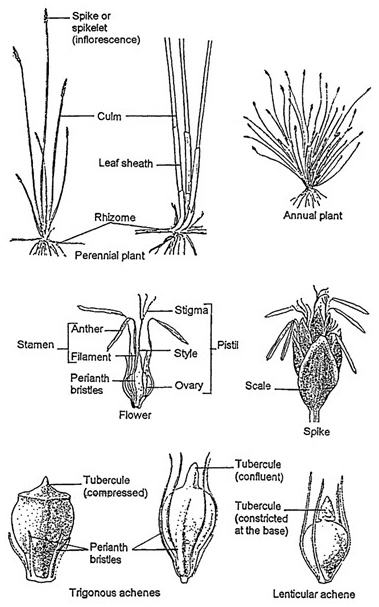
Mostly perennials forming mats or tufts; rhizomes long and horizontal, short and ascending, absent, or not evident; some with stolons, tubers, or bulbs; culms angular or cylindrical, ridged or smooth, spongy, not hollow; leaves usually 2, basal, sheaths well-developed, blades absent or sometimes present as a mucro (tooth) less than 1 mm long; ligule absent; inflorescence terminal; spikelet 1, erect, not laterally flattened; involucral bracts absent; scales spirally arranged, ovate or lanceolate, dark brown to straw-colored, the apex not notched, midrib not apically prolonged; proximal scales often empty; the lowest scale may resemble a short bract; flowers perfect, solitary in the scale axils; perianth bristles (0) 3–6 (8), attached to achene base, retrorsely spinulose (rarely smooth), up to twice as long as the achene; stamens 1–3; styles bifid or trifid, style base usually enlarged into a persistent tubercle distinct from or merging with the achene apex; achenes mostly obovoid, trigonous or lenticular to sometimes nearly circular in cross section, ribbed or smooth, yellowish to dark brown, the apex sometimes narrowed into a short tubercle or beak.
Notes: Descriptions of the genus and species are based on specimens from the Intermountain Region as much as possible. Achene measurements given for the species do not include the tubercle, which is technically the base of the style and not part of the achene.
A cosmopolitan genus of about 200 species growing in wet soil or emergent or submerged in water. Most common in tropical and warm temperate regions.
See Figure 22.
Key to Intermountain Eleocharis species
- 1. Tufted annuals without evident rhizomes.
- 2. Lowest scale of spikelet with a flower; achenes with longitudinal ribs connected by fine horizontal bars; plants 1–7 cm tall.E. bella (in part)
- 2. Lowest scale of spikelet without (or rarely with) a flower; achenes smooth, without longitudinal ribs or horizontal bars; plants 2–90 cm tall.
- 3. Achenes brown ripening to black; tubercles not markedly compressed dorsiventrally; spikelet scales membranous to tough and hard (cartilaginous); leaf sheath without an apical tooth.E. geniculata (under E. obtusa)
- 3. Achenes brown when ripe; tubercles markedly compressed dorsiventrally; spikelet scales membranous; leaf sheath often with an apical tooth to 0.3 mm long.
- 4. Achene with bristles absent or not reaching much beyond the tubercle; tubercles low, 0.1–0.4 times as high as wide and not more than 0.25 times as high as the achene.E. engelmannii
- 4. Achene with bristles present and reaching markedly beyond tubercle; tubercle 0.3 times to fully as high as wide and at least 0.25 the height of the achene.
- 5. Tubercles 0.5–0.8 mm wide.E. obtusa
- 5. Tubercles 0.3–0.5 mm wide.E. ovata (described under E. obtusa)
- 1. Perennials forming mats from long horizontal rhizomes or from culms arching over and rooting at their tips or forming dense clumps from short, ascending or vertical rhizomes.
- 6. Some culms arching over and rooting at their tips; long horizontal rhizomes absent; achenes usually with a narrow beak; tubercle merges with the achene in color, texture, and form.E. rostellata
- 6. Culms arching over and rooting at the tips lacking (but see E. pachycarpa description under E. bolanderi); long horizontal rhizomes present or absent; achene apex and tubercle various.
- 7. Leaf sheaths transparent, very delicate, or not evident; culms to 0.7 mm thick.
- 8. Proximal scale with a flower; achenes with longitudinal ribs and horizontal bars.
- 9. Scales 1–1.5 mm long, narrowly acute; achenes to 0.75 mm long; anthers to 0.5 mm long.E. bella
- 9. Scales 1.5–3.5 mm long, blunt to acute; anthers exceed 0.7 mm long.E. acicularis
- 8. Proximal scale empty; achenes without ribs or bars.
- 10. Stigmas 2; achenes 2-angled, tubercle clearly distinguished from the achene; tubers absent.E. flavescens var. flavescens
- 10. Stigmas 3; achenes 3-angled, tubercle often not clearly distinguished from the achene summit; tubers often present on rhizomes or at culm bases.E. coloradoensis
- 7. Leaf sheaths usually opaque, firm, evident; culms 0.2–3.5 mm thick (rarely thicker).
- 11. Stigmas 2; achenes 2-angled; rhizomes long and horizontal.
- 12. All spikelets with the lowest scale clasping the entire culm.
- 13. The second scale of all spikelets with a flower.
- 14. Spikelets with scales to 1.7 mm wide.E. erythropoda
- 14. Spikelets with scales at least 2 mm wide.E. uniglumis (under E. erythropoda)
- 13. The second scale of all spikelets with or sometimes without a flower.E. macrostachya
- 12. Some spikelets with the lowest scale not clasping the entire culm.
- 15. Spikelets with the lowest scale clasping about 2/3 to 3/4 of the culm, the second scale always without a flower.E. palustris
- 15. Spikelets with the lowest scale clasping 3/4 or more of the culm, at least some spikelets with a flower in the second scale.E. macrostachya
- 11. Stigmas 3; achenes 3-angled; rhizomes long and horizontal or short and ascending.
- 16. Distal leaf sheath summits on some or all culms with a distinct tooth-like projection; rhizomes long and horizontal.E. parishii
- 16. Distal leaf summits lacking a distinct tooth-like projection; rhizomes long and horizontal or short and ascending.
- 17. Culms sharply 4-angled, not flattened, to 0.5 mm wide; tubercle bases 3-lobed; spikelets often proliferating to form plantlets; plants densely tufted; rhizomes short and ascending.E. pachycarpa (under E. bolanderi)
- 17. Culms not 4-angled, sometimes flattened, to 1 mm wide; tubercle bases 3-lobed or not; spikelets never proliferating to form plantlets; plants forming mats from long horizontal rhizomes or sometimes densely tufted from short, ascending rhizomes.
- 18. Achenes less than 1.3 mm long, apex not narrowed to a beak; scales 8–40, 1.5–3 mm long; bulbs absent; plants forming mats from long horizontal rhizomes or dense clumps from short ascending rhizomes.
- 19. Spikelets narrowly lanceolate, plants forming mats; rhizomes long and horizontal; tubercles at least as high as wide.E. parishii
- 19. Spikelets ovate; plants forming dense clumps from short ascending rhizomes; tubercles lower than wide.E. bolanderi
- 18. Achenes at least 1.6 mm long, apex usually narrowed to a distinct beak; scales 3–12, 2.5–6 mm long; bulbs on rhizomes or at culm bases present or not; plants forming mats from long, horizontal rhizomes.
- 20. Lowest scale of some or all spikelets without a flower (rarely all without a flower); culms to 0.5 mm wide (rarely to 0.9 mm); culm bases often swollen; bulbs often present on rhizomes or at culm bases.E. quinqueflora
- 20. Lowest scale of all spikelets with a flower (rarely a few with a flower); culms 0.5–1.5 mm wide; culm bases never swollen; bulbs absent.E. suksdorfiana
Eleocharis acicularis
Needle spikerush, Needle spikesedge, Slender spikerush
Scirpus acicularis L.
Small, slender perennial, 1–60 cm tall, often forming large, rooted mats or floating masses from slender rhizomes 0.25–0.5 mm thick with 5–15 mm internodes; culms sometimes arching, filiform, more-or-less cylindric or sometimes flattened, smooth or with 3–12 angles or ridges, soft or firm, 0.2–0.5 mm thick. Culms of submerged plants are terete, smooth, soft, and translucent with the air cavity partitions visible. Phenotypic plasticity, often associated with water depth, complicates identification.
Usually solitary, needle-like, tightly sheathing to loose and inflated distally; proximally purplish, distally delicately membranous, with the apex rounded to acute, usually disintegrating; tooth absent.
Absent.
One, 3–15 (25) flowered, ovoid to lanceolate, nearly cylindric, apex acute, purplish brown with a greenish midrib when fresh, 2–8 mm long, 1–2 mm thick. Submerged and floating plants often lack spikelets.
4–25; 4–6 per mm of rachilla; ovate-lanceolate, purplish or pale, midrib region prominent and green with hyaline margins, apex obtuse to acute, 1.5–3.5 mm long, 1–1.5 mm wide; lowest scale completely clasps the culm and includes a flower.
Perianth bristles generally absent, uncommonly 2-4, slender, shorter than to equaling or sometimes exceeding the achenes; stamens 3; anthers 0.7–1.3 mm long; styles trifid.
Obovoid or ovoid-oblong, obscurely 3-angled to nearly terete with 8–12 longitudinal ribs and 30–60 very fine horizontal bars, whitish to pale gray or faintly yellowish, 0.7–1.1 mm long, 0.4–0.6 mm wide; tubercles distinct, conic to triangular and ribbed, basally constricted, 0.1–0.2 mm high, 0.15–0.25 mm wide. Achenes often absent in submerged, non-flowering submerged plants, complicating identification.
Fruiting: spring—fall.Freshwater lakes, streams, drying soil, bogs, wet meadows, vernal pools, and disturbed areas from sea level to 3300 m. Often submerged. Common throughout the Intermountain Region and most of North America and Eurasia, local in Central and South America and Australia.
Terrestrial plants of E. acicularis are easily confused with E. bella, a closely related species. E. bella is apparently annual with scales 1–1.5 mm long, apex acute to acuminate and usually slightly recurved, anthers 0.5 mm, and achenes less than 0.8 mm long. E. acicularis may also be confused with the diminutive, unrelated E. coloradoensis, which lacks a flower in the axil of the lowest spikelet scale and produces very different achenes and tubercles. Submerged vegetative plants of E. acicularis often have very long, filiform culms similar to those of Schoenoplectus subterminalis.
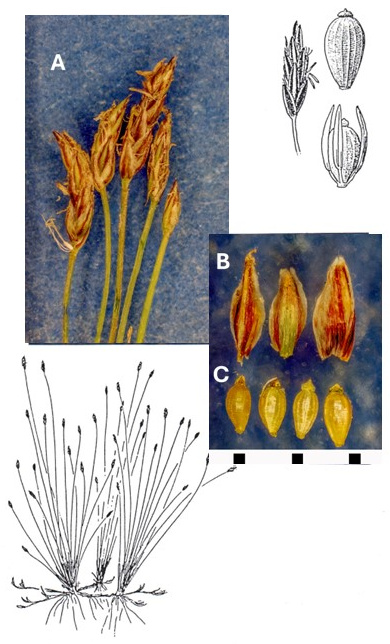
Eleocharis bella
Pretty spikerush, Beautiful spikerush, Delicate spikerush
Eleocharis acicularis (L.) Roemer & Schultes var. bella Piper, E. acicularis (L.) var. minima Torrey ex Britton
Very slender annual (rarely perennial) 1–7 cm tall, forming small, dense, rounded tufts; rhizomes usually absent; culms ascending or spreading, filiform, four-angled or more-or-less cylindric, furrowed, soft to firm, 1–8 cm tall, 0.2–0.3 mm thick.
Usually solitary, straw-colored, apex acute, tooth absent; upper sheath delicately membranous, slightly inflated distally, often disintegrating.
None.
3–10 (15) flowered, ovoid to ovoid-oblong, terete, apex acute to obtuse, greenish-red to reddish-brown, 1.5–4 mm long, 0.8–2 mm thick.
4–15, 8 per mm of rachilla, oblong-ovate, apex acute to acuminate and slightly recurved, midrib obscure to somewhat keeled, midstripe greenish or pale, its margins variably hyaline and somewhat reddish-brown, 1–1.5 mm long, 0.5–0.7 mm wide; lowest scale with a flower and completely clasping the culm.
Perianth bristles absent; stamens 3, anthers 0.3–0.5 mm; styles trifid.
Obovoid, obscurely 3-angled to nearly terete with 6–10 longitudinal ridges (3 ridges prominent), 2–30 very fine horizontal bars, apex blunt, whitish to pale brown or slightly yellowish, 0.6–0.8 mm long, 0.3–0.4 mm wide; tubercles distinct, short and broad, grayish, 0.1–0.2 mm high, 0.1–0.25 mm wide.
Fruiting: spring—summer.Bare, often drying soil along streams, lake shores, and in wet meadows from 100 to 2900 m. Locally common in the western states from Washington and Montana south to California, Arizona, New Mexico, and adjacent Mexico. Intermountain collections are from the Reno area, northeastern Nevada, southeastern Oregon, southwestern and northern Idaho, northeastern and east-central Utah.
Eleocharis bella is easily confused with the closely related E. acicularis, a rhizomatous perennial with scales exceeding 1.5 mm long, apex blunt to acute, anthers and achenes exceeding 0.7 mm in length.
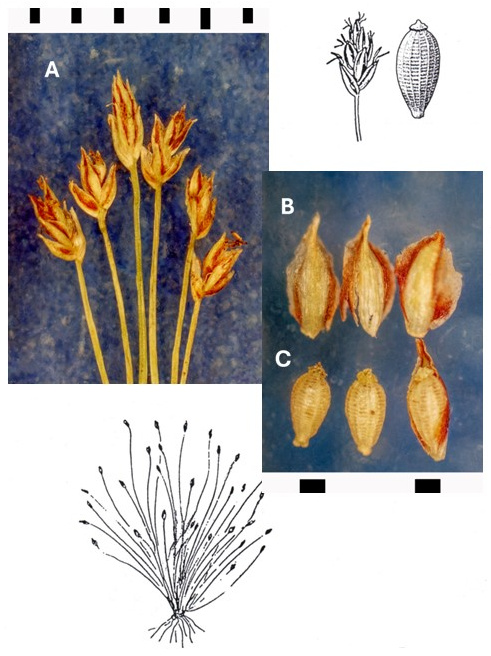
Eleocharis bolanderi
Bolander’s spikerush
Eleocharis montevidensis Kunth var. bolanderi (A. Gray) V.E. Grant
Perennial, 10–30 (50) cm tall, forming densely clustered tussocks from short ascending rhizomes 1.5–4 mm thick and mostly hidden by culms and roots; culms numerous, wiry, cylindric to angled, firm, spongy, striated with 10–18 blunt ridges when dry, 0.2–0.3 (0.5) mm thick. Debris from previous year’s growth persists at the base.
1-2, distal sheaths persistent, rarely splitting, commonly purplish to brownish at the base becoming stramineous to spotted purple distally, loosely sheathing and papery upward, papery; apex obtuse to truncate, sometimes cartilaginous; tooth absent.
None.
Solitary, 10–25 flowered, 4–5 per mm of rachilla, ovoid to ellipsoid, 3–8 mm long, 2–3 mm thick, dark brown or blackish, apex obtuse to acute.
8–30, ovate to orbicular, membranous, apex acute to obtuse, blackish brown with a paler tip and no midstripe, 2–3 mm long, 1.5 mm wide; lowest scale broad, orbicular, lacking a flower, completely clasping the culm.
Perianth bristles 3–6, often unequal, minutely retrorsely barbellate, reddish-brown or whitish, up to half as long as the achene; stamens 3; styles trifid.
Obovoid, unequally trigonous and prominently 3-angled or rarely 2-angled, short stipitate, finely rugulose or reticulate, greenish yellow becoming straw-colored or rarely dark brown to black, apex truncate, 0.9–1.2 mm long, 0.6–0.8 mm wide, deciduous with the scales; tubercles variable, usually distinct, sessile on achene, often 3 lobed, very low and broad, white to brown, to 0.3 mm high, 0.4–0.7 mm wide.
Fruiting: late spring—summer.Fresh, often summer-dry springs, seeps, wet meadows, and stream margins from 1000 to 3400 m. In summer masses of dry culms can be found in dry stream beds. Oregon and California east to Colorado. In the Intermountain Region known from southwestern Idaho, northwestern, northeastern and east central Nevada, and the Uinta Mountains and Zion National Park in Utah.
In the Intermountain Region, E. bolanderi might be confused with the introduced E. pachycarpa because of their similar achenes and tussock-forming habits. Eleocharis pachycarpa differs by its sharply 4-angled culms, pale spikelet scales, and tendency to proliferate from spikelets (see key and E. rostellata). It is also easily confused with E. decumbens, known only from the mountains of California and southwestern Oregon and distinguished by its mostly thicker rhizomes (3–4 mm thick), wider culms (0.3–2 mm wide), and longer spikelet scales (3–3.5 mm long).
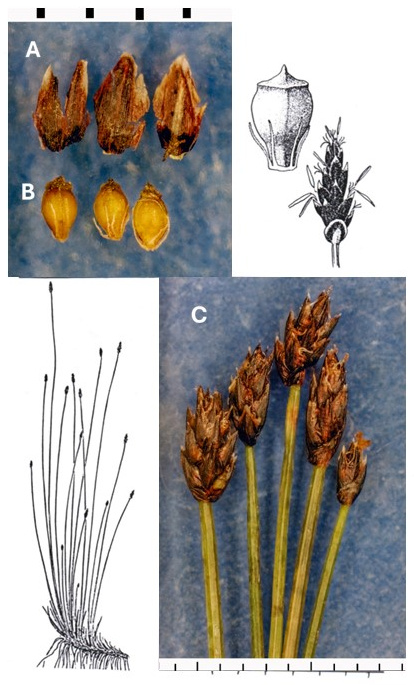
Eleocharis coloradoensis
Colorado spikerush, Dwarf spikerush
Eleocharis parvula (R. & S.) Link x Bluff, Nees & Shauer var. anachaeta (Torrey) Svenson, E. p. var. coloradoensis (Britton) Beetle, Scirpus coloradoensis Britton
Dwarf tufted perennial, 2–9 cm tall, forming mats from short, slender, horizontal rhizomes up to 1.5 mm diameter that are often terminated by broadly oblong to orbicular tubers to 4 mm long; culms cylindric, very soft, 0.2–0.5 mm thick.
Generally solitary near the culm base and tightly clasping it; upper sheath thinly membranous, often disintegrating, reddish basally, apex rounded or acute; tooth absent.
Solitary, 4–6 flowered, ovoid or oblong-cylindric, base usually cuneate, apex acuminate, 3–8 mm long, 1–1.5 mm thick; floral scale tips appressed, giving the spikelet a smooth outline.
6–25, ovate to lanceolate, bright orange to brown, midstripe green to pale, margins purplish, apex obtuse to acute, 1.7–2.5 mm long; lowest scale completely clasping the culm, one-half or less of the spikelet length, lacking a flower.
Perfect; perianth bristles mostly absent, seldom 5, very unequal, when present coarsely barbellate, to one-half the achene length; stamens 2–3, anthers .05—.08 mm; styles trifid.
Obovoid, subtriangular, prominently 3-angled or sometimes 2-angled, finely roughened, medium to dark brown, apex truncate, 0.5–1.1 mm long, 0.5–0.7 mm thick; tubercles about 0.1 mm high, often indistinct and merging with the achene summit in color, form, and texture.
Fruiting: summer.Drying margins of fresh or brackish lakes and ponds, streams, and vernal pools. Generally inland to 2100 m. In the Intermountain Region occurs locally in Idaho, Nevada, Oregon, and Utah. Distributed from Oregon to Alberta and Saskatchewan and south from California to Mississippi and Mexico.
Eleocharis coloradoensis is similar in habit to E. acicularis, which has a flower in the lowest spikelet scale, very different achenes, and lacks tubers.
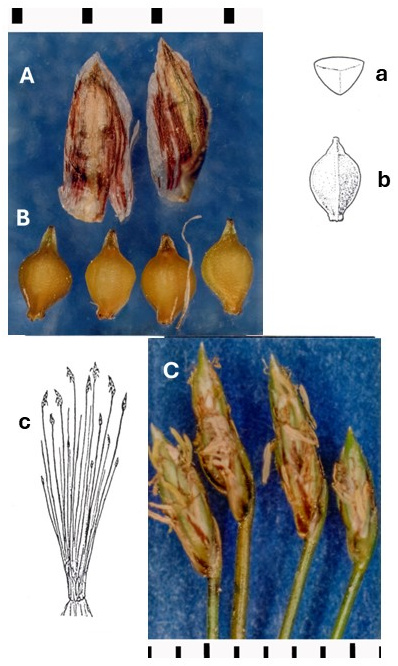
Eleocharis engelmannii
Engelmann’s spikerush
Eleocharis engelmannii var. detonsa A. Gray, E. e. var. monticola (Fernald) Svenson, E. monticola Fernald, E. monticola Fernald var. leviseta Fernald
Annuals with few stems or forming dense clumps; rhizomes absent; culms erect or ascending, cylindric, ribbed, firm to soft, dark green, up to 40 cm tall, 0.5–1.5 mm thick.
1 or 2, basal, extending to 4.5 cm up the culm, upper sheath membranous, persistent, fragile to somewhat firm, pale brown, apex obtuse to acute; tooth often present and up to 0.3 mm long.
None.
Solitary with more than 40 tightly clustered flowers, erect, lanceolate to ovoid or subcylindric, reddish brown to brown, apex obtuse or acute, 5–10 (20) mm long, 2–3 (4) mm thick.
25–100 (200), 8–12 per mm of rachilla, orbicular to ovate-oblong, membranous, margins reddish-brown or hyaline, midstripe pale or greenish keeled, apex obtuse to acute, 2–2.5 mm long, about 1 mm wide; lowest scale clasping about two-thirds of the culm and without a flower.
Perfect, perianth bristles (0) 5–8, stout, brown, from rudimentary to reaching the tubercle summit; stamens 3; anthers yellow-brown, 0.3–0.8 mm long; styles trifid or some bifid in the same spikelet.
Broadly ovate, lenticular, smooth, shiny, straw-colored ripening to dark brown, 0.9–1.1 mm long, 0.7–1.1 mm wide; tubercles distinct, sessile on the achene summit, much lower than wide, one-fourth or less as high as the achene.
Fruiting: spring—fall.Wet shores, marshes, and disturbed places to 2400 m. Local in the Intermountain Region occurring in southeastern Oregon, west-central Idaho, northwestern Nevada, and southern Utah. Southernmost British Columbia east to Ontario and Maine and south to California, Texas and Mississippi.
Eleocharis engelmannii is easily confused with closely related E. obtusa and E. ovata (see under E. obtusa), which differ mainly in their tubercle widths as indicated in the key. Specimens in which the perianth bristles are absent or rudimentary may deserve taxonomic recognition as E. engelmannii var. detonsa A. Gray (=E. monticola Fernald var. leviseta Fernald).
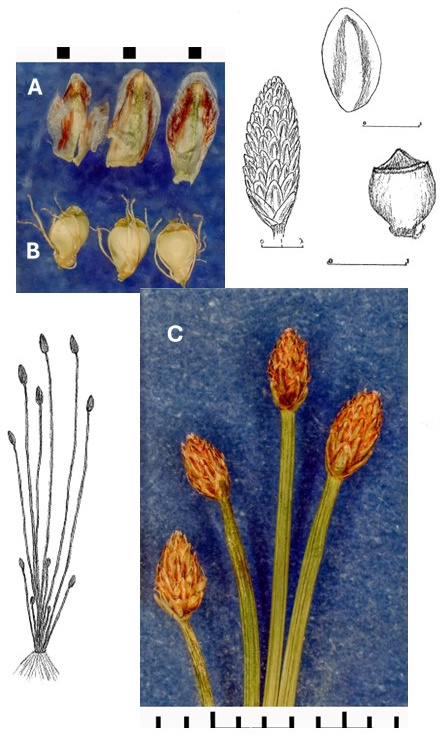
Eleocharis erythropoda
Bald spikerush, Redrooted spikerush, Spikesedge
Eleocharis calva Torrey, Scirpus glaucus Torrey, Trichophorum palustre (L.) Farw. var. calvum (Torrey) House
Perennial, 8–80 cm tall, forming mats from long, thin, horizontal rhizomes, 0.5–1.5 mm thick; culms somewhat cylindric, often with blunt ridges when dry, firm to soft, internally spongy, 0.3–1.4 mm thick.
Distal sheaths persistent, not splitting, usually inflated, membranous to papery, often callose, red to golden basally, green to golden distally, apex obtuse to subacute; tooth absent or only 0.1 mm long.
Solitary, ovoid to lanceolate to subcylindric, brown to reddish brown, apex acute, 0.3–18 mm long, 2–3 (4) mm thick.
15–50, 4–5 per mm of rachilla, often spreading in fruit, not prominently tapered, membranous, medium brown without a distinct pale midstripe, apex rounded to subacute, 2–3.5 mm long, about 1.5 mm wide; lowest scale completely clasping the culm and lacking a flower; subproximal scale with a flower; lower scales ovate, distal scales more lanceolate.
Perfect; perianth bristles 0 or 4, usually equal, as long or slightly longer than the achene and tubercle; stamens 3, anthers dark yellow, over 1 mm long; styles deeply bifid.
Broadly oblong-ovoid, lenticular, slightly tapered toward the base and apex, surface smooth or faintly rugulose, straw-colored to brown, 0.9–1.6 mm long, 0.7–1.2 mm thick, deciduous; tubercles distinct, to about 0.6 mm high.
Fruiting: summer.Fresh springs, calcareous or brackish water, fens, wet meadows, stream margins, and marshes from sea level to 2300 m. More common in Utah with scattered populations in eastern Oregon and southern Idaho in the Intermountain Region. Widely distributed and often abundant in temperate eastern North America except the far southeastern area.
Eleocharis erythropoda is easily confused with the closely related E. macrostachya and E. uniglumis, which differ chiefly in the spikelet scale widths as indicated in the key. These three species and E. palustris belong to a circumboreal complex in which intermediates are common. Many authors prefer to treat most of this complex as a single highly variable species. Eleocharis uniglumis (Link) Schultes differs from E. erythropoda in its wider floral scales (1.8–2.5 mm) that are often darker brown and more loosely placed on the spikelet axis.
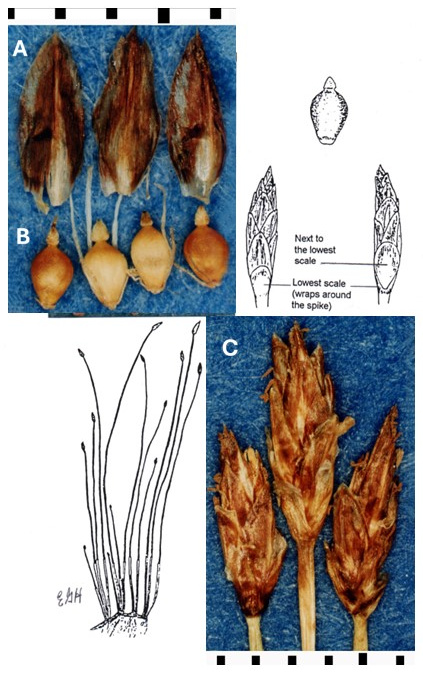
Eleocharis flavescens
var. flavescens
Yellow spikerush, Pale spikerush
Eleocharis flavescens var. thermalis (Rydberg) Cronquist, E. thermalis Rydberg, Scirpus flavescens Poiret
Tufted and mat-forming perennials with long, slender, horizontal rhizomes; culms of taller plants erect, cylindric to somewhat flattened, grooved, soft, bright green, 3–42 cm tall, 0.3–0.6 mm thick. Dry leaves and culms accumulate at the base.
1–2, basal; upper sheath inflated distally, loosely wrapping the stem, thinly membranous and often disintegrating, scarious, wrinkled, white; tooth absent.
None.
Solitary, 4–16 (20) flowered, ellipsoid or ovoid, pale to light green, apex acute, 1.5–4 (9) mm long, 1–3.5 mm thick.
Up to 65, 5-7 per mm of rachis, loosely appressed to appressed, elliptic or ovate, membranous, straw-colored to brown with a broad greenish to reddish-brown midstrip, margins hyaline scarious, apex obtuse or acute, 1–3 mm long, 0.4–1.6 mm wide; lowest scale without a flower and not amplexicaulis.
Perfect; perianth bristles (0) 5–8, spinulose, rudimentary to slightly exceeding the achene, white to straw-colored; stamens 3; styles bifid, rarely trifid.
Obovoid, lenticular to roundish, rarely trigonous, smooth to finely reticulate, shiny, reddish brown to blackish brown when ripe, 0.4–0.8 (1.0) mm long, 0.3–0.6 mm wide; tubercles distinct, conical, pale, 0.2–0.5 mm high, 0.2–0.4 mm wide.
Fruiting: spring—summer.Brackish wet places, creeks, dunes, hot springs, and salt marshes from sea level to 1600 m elevation. In the Intermountain region known from Cache County, Utah, and around hot springs in Yellowstone Park. In the United States from Montana to California, Arizona, and Texas in the West; Arkansas to Virginia and south to Louisiana and Florida in the East; South America and the Caribbean Islands. Spring—summer.
See Eleocharis geniculata (last paragraph of E. obtusa).
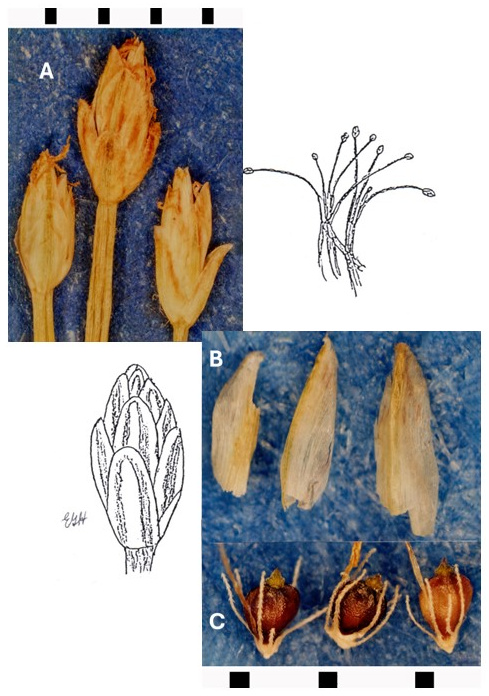
Eleocharis macrostachya
Pale spikerush, Confusing spikerush
E. perlonga Fernald & Brackett, E. xyridiformis Fernald & Brackett
Perennial forming mats from long horizontal rhizomes; culms cylindric to flattened, irregularly shallowly ribbed, firm to soft, spongy, light green, 10–100 cm tall, 0.5–2.5 (3.5) mm thick.
Distal sheaths persistent, loosely sheathing, rarely splitting abaxially, thickly membranous, basally reddish purple, distally green or straw-colored, apex truncate to obtuse; tooth absent or less than 1 mm long.
None.
Solitary, 10-many flowered, narrowly lanceolate to ovoid, brown, apex usually acute, 5–40 mm long, slightly wider than the stem.
30–80, 3–5 per mm of rachilla, ovate to oblong, slightly tapered, apex acute to obtuse, membranous, medium to reddish or dark chestnut brown with a straw-colored to green midrib, 2–3.5 mm long, about 1.5 mm wide, often spreading in fruit; lowest scale variable, clasping three-fourths to all of the culm, lacking a flower; subproximal scale with or without a flower; upper scales all with a flower.
Perfect, perianth bristles 4–5 or sometimes rudimentary or absent, unequal, slender to stout, brown, retrorsely barbed, much shorter than the achene to equaling the tubercle; stamens 3; styles bifid.
Ovoid, lenticular, surface smooth to faintly rugulose, straw-colored when young, maturing to dark brown, 1.1–1.9 mm long, 0.8–1.5 mm thick; tubercles distinct, conical with a constricted base, white to brown, to about 0.7 mm high.
Fruiting: spring—summer.Fresh to slightly brackish or alkaline shores, stream beds, vernal pools, wet meadows, marshes, artificial ponds, and ditches from sea level to 2500 m elevation. Common at low to medium elevations throughout most of the West and eastward to southern Manitoba and Mississippi; Mexico and South America. Scattered throughout the Intermountain region.
Eleocharis macrostachya is highly variable and difficult to separate from the closely related species E palustris, E. erythropoda and E. uniglumis (see under E. erythropoda), which differ in the degree that the lowest scale of the spikelet clasps the culm and the presence of a flower in the axil of the subproximal scale as indicated in the key and under E. palustris.
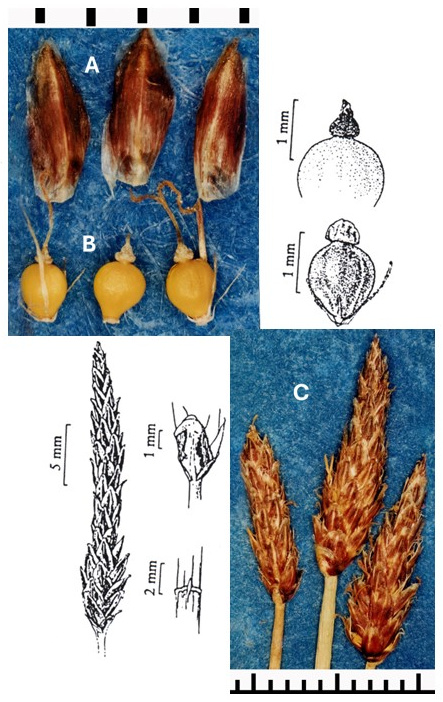
Eleocharis obtusa
Blunt spikerush, Blunt spikesedge
Eleocharis obtusa var. ellipsoidalis Fernald ex Svenson, E. o. var. gigantea Fernald, E. o. var. jejuna Fernald, Scirpus obtusus Willdenow
Densely tufted annual to 50 (90) cm tall; rhizomes absent or not evident; culms cylindric, erect to ascending, slender, firm to soft, spongy, 0.2–2 mm thick.
Usually 2, upper sheath persistent, loosely enveloping the culm, firm, entire, obliquely truncate, purplish at the base, greenish to stramineous distally and slightly thickened at the rim; tooth often present, to 0.3 mm long.
None.
Solitary, erect, many-flowered, broadly ovoid to ellipsoid or lanceolate, apex obtuse, brownish, (2) 5–13 mm long, (2) 3–4 mm thick; achenes and scales deciduous.
15–150, 8–20 per mm of rachilla, ovate-oblong to suborbicular, membranous, margins scarious, midrib seldom keeled, apex obtuse to broadly rounded, brownish orange with paler midstripe, 1–2.5 mm long, 1–1.5 mm wide; lowest scale clasping about 2/3 of the culm, without a flower.
Perfect; perianth bristles 5–8, present or rarely absent, coarse, retrorsely barbed, brownish, slightly to usually greatly exceeding the tubercle; stamens (2) 3; styles usually trifid and bifid in the same spikelet.
Ovoid to broadly ovoid, lenticular, smooth, shiny, straw-colored ripening to dark brown, 0.9–1.3 mm long, 0.7–0.9 mm wide; tubercles distinct, sessile on achene, compressed, lamellate-deltoid, the base not narrowed, 0.3–0.5 mm high, 0.5–0.8 mm wide.
Fruiting: summer—fall.Fresh wet shores, marshes, and disturbed places to 1600 m. In the Intermountain Region reported from southern Idaho, west-central Nevada, and southwestern Utah. Southern British Columbia to Prince Edward Island south to northern California, Colorado, Texas, and Georgia; Hawaii and other Pacific Islands.
Eleocharis obtusa is easily confused with the closely related E. engelmannii, E. geniculata, and E. ovata, which differ as indicated in the key (see also E. engelmannii). E. geniculata is known from southern Nevada and southeastern Utah in the Intermountain Region. It is distributed in the southern states from California to Florida and in most northeastern states. The species also occurs south to South America and in Africa, Asia and the Pacific Islands. Eleocharis ovata (Roth) R. & S. closely resembles E. obtusa, from which it differs mainly in its smaller tubercles that are 0.3–0.5 mm wide. Plants, spikelets, and achenes of E. ovata are also usually smaller. E. ovata is known from British Columbia to Labrador and south to Oregon, Oklahoma, and Virginia, with an isolated locality in Arizona.
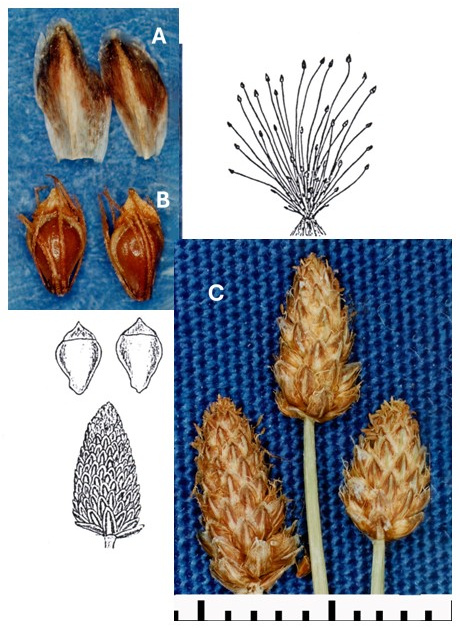
Eleocharis palustris
Common spikerush, Creeping spikerush, Spikesedge
E. smallii Britton, Scirpus paulustris L.
Perennial with culms arising singly or densely clustered, forming mats from long horizontal rhizomes; culms cylindric, terete or oval in cross section, slender to stout, striated, firm to soft, spongy, pale green to dark green, 30–115 cm tall, 0.5–2.5(5) mm wide.
Usually 2 basal; distal portion of the sheaths extend 2–15 cm on the culm, loosely sheathing, firm, membranous to papery, not inflated or callose, apex broadly obtuse to acute, red to black proximally, green to red distally, persistent or sometimes disintegrating or splitting; tooth absent or mucronate.
None.
Solitary, several to many flowered, erect, lanceolate to lanceolate, cylindric, light to dark brown, apex acute to obtuse, 5–25 mm long, 3–7 mm thick.
Lowest scale clasping about 2/3 (to 3/4) of the culm, entire, orbicular, lacking a flower; subproximal 2–3 scales without flowers; upper scales 30–100, 4–8 per mm of rachilla, spreading in fruit, oblong with acute tips, brown, midrib area straw-colored to green, margins hyaline, 2–3.5 mm long, about 1.5 mm wide.
Perianth bristles (0) 4 (5–6), brown, retrorsely barbellate, much shorter than achene to equaling tubercle, rarely twice as long; stamens 2 or 3; anthers 1.3–2.5 mm long; styles bifid.
Obovoid, lenticular, rounded at the apex, surface smooth or faintly rugulose, straw-colored to dark brown or yellowish, 1.1–2.5 mm long, 1–1.5 mm wide; tubercles distinct, constricted at the base, to about 0.7 mm high, at least as high as wide.
Fruiting: May–August.In many plant communities on recently exposed shores, stream beds, and marshes from sea level to 3200 m elevation throughout the Intermountain region. Somewhat alkali tolerant. Widely distributed and common throughout North America but absent from Georgia and Florida. Widespread in temperate North America, Mexico, Eurasia, and New Zealand.
Eleocharis palustris belongs to a highly variable and taxonomically difficult circumboreal species complex well known only in northern Europe. Members of this complex in the Intermountain Region are E. palustris, E. macrostachya, and E. erythropoda. These three species differ mainly in the amount that the lowest scale of the spikelet clasps the culm and in the presence of a flower in the subproximal scale of many spikelets.
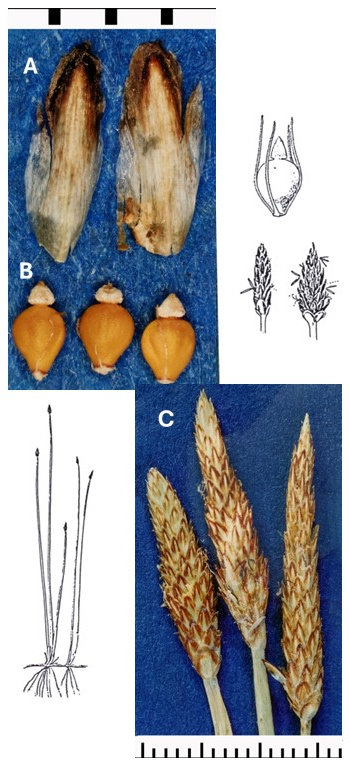
Eleocharis parishii
Parish’s spikerush
Eleocharis disciformis Parish, E. montevidensis Kunth var. disciformis (Parish) V.E. Grant, E. m. var. parishii (Britton) V.E. Grant
Perennial arising singly or forming mats from long horizontal rhizomes; culms slender, cylindric to elliptic, 6-8 ribbed when dry, firm to soft, minutely reddish spotted, 10–50 cm tall, 0.2–0.7 (1) mm thick.
Usually 2, basal; upper portion of the sheaths thickly membranous to thinly papery, persistent, not splitting, often reddish brown becoming stramineous, apex subtruncate to obtuse; tooth to 1 mm long, present on leaves of all or some culms.
None.
Solitary, erect, much wider than the stem, narrowly lanceolate, purplish to reddish brown, apex acute to acuminate, 3–20 mm long, 1.5–2.5 mm thick, 2–7 times longer than wide.
Lowest scale completely clasping the culm, entire, lacking a flower; subproximal scale with a flower or empty; upper scales 15–40, fertile, 3–4 per mm of rachilla, appressed or spreading in fruit, ovate-lanceolate, orange-brown with greenish midstripe and a pale, purplish to brownish hyaline apex and margins, 2–3 mm long, 1 mm wide; lower ones shorter, broader with an obtuse apex; upper scales acute, membranous, keeled.
Perfect; perianth bristles 3–7, rarely absent to rudimentary, often unequal, retrosely barbellate, straw-colored or whitish, to slightly exceeding the tubercle; stamens 3; styles trifid.
Often falling with the scales, obovoid, planoconvex or unequally trigonous, smooth, yellow brown to dark brown, 0.8–1.4 mm long, 0.5–0.7 mm wide; tubercles distinct, pyramidal-conic to about 0.3 mm high, not noticeably constricted at the base, often higher than wide.
Fruiting: spring—fall.Fresh to brackish water, springs, shores, and stream margins to 2700 m. In the Intermountain Region found in Nevada, Utah, and southern Idaho. It is locally common from southern California east to New Mexico, Texas, and Kansas.
Eleocharis parishii is easily confused with the closely related E. montevidensis which is more southern in distribution and differs mainly in its narrow lanceolate spikelets, scale tips that are broadly rounded, often horizontally wrinkled, and curved outward. They often co-occur.
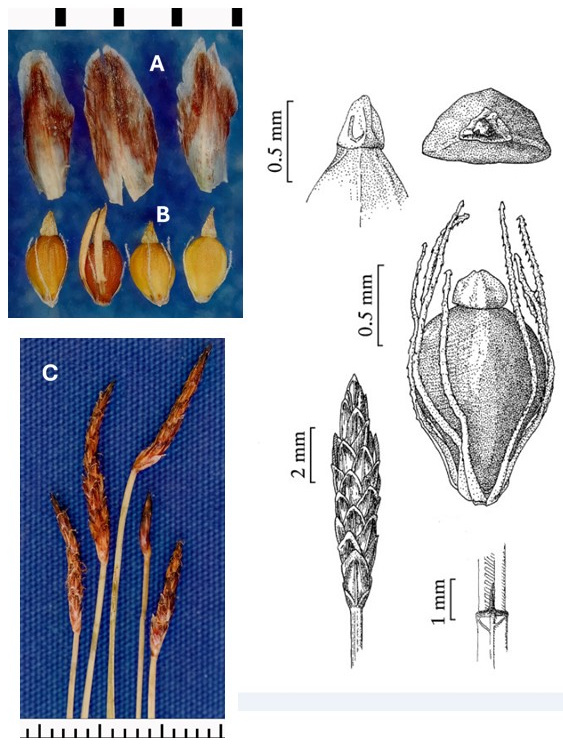
Eleocharis quinqueflora
Few-flowered spikerush, Fewflowered spikesedge
Eleocharis fernaldii (Svenson) Á. Löve, E. pauciflora (Lightfoot) Link, E. p. var. fernaldii Svenson, E. quinqueflora (Hartmann) O. Schwarz subsp. fernaldii (Svenson) Hultén, Scirpus pauciflorus Lightfoot, S. quinqueflorus Hartmann
Perennial, occurring singly or forming mats from fairly long, filiform, horizontal rhizomes; small bulbs (“resting buds”) often present on the rhizomes or culm bases; culms erect, cylindric to elliptic, somewhat ridged when dry, hard to soft, 5–35 cm tall, 0.2–0.5 (1) mm thick; culm bases often swollen, bulb-like, and covered with papery scales.
1-2, basal; sheaths 1-2, extending up to 3 cm on the culm, upper portion of sheaths membranous to papery, reddish becoming stramineous distally, apex subtruncate to acute; tooth absent.
Absent.
Solitary, erect, 3–9 flowered, ovoid or oblong, reddish brown, apex acute, 3–8 mm long, 1.5–4 mm thick.
3–10 per spikelet, broadly ovate, membranous, purplish to blackish with hyaline margins, often lacking a paler midstripe, apex obtuse, 2.5–6 mm long, 1.5–2.5 mm wide; lowest scale completely clasping the culm and with (seldom without) a flower; second scale with a flower; lowest 2–3 scales are at least half as long as the spikelet or sometimes reduced.
Perfect; perianth bristles (0) 3–6, often unequal, slender, finely retrosely barbellate, rudimentary to equaling the tubercle; stamens 3; styles trifid or trifid and bifid in same spikelet.
Obovoid, broadest above the middle, unequally trigonous or rarely lenticular, smooth or with fine longitudinal ridges, straw-colored to medium brown or gray-brown, usually narrowed to a distinct beak, 1.6–2.3 mm long, 0.7–1.3 mm wide; tubercles rarely absent, usually merging with achene summit, higher than wide, about 0.3 mm high, 0.2–0.3 mm wide.
Fruiting: spring—summer.Boggy streams, fens, wet meadows, seeps, springs, and hot springs from sea level to 3600 m elevation, sometimes occurring above timberline. Tolerant of salinity and alkali. Locally distributed in all Intermountain states. Occurs across most of North America, except for the Southeast; Eurasia. Circumboreal.
Eleocharis quinqueflora is easily confused with the closely related E. suksdorfiana, which is more robust. See the characteristics given in the key.
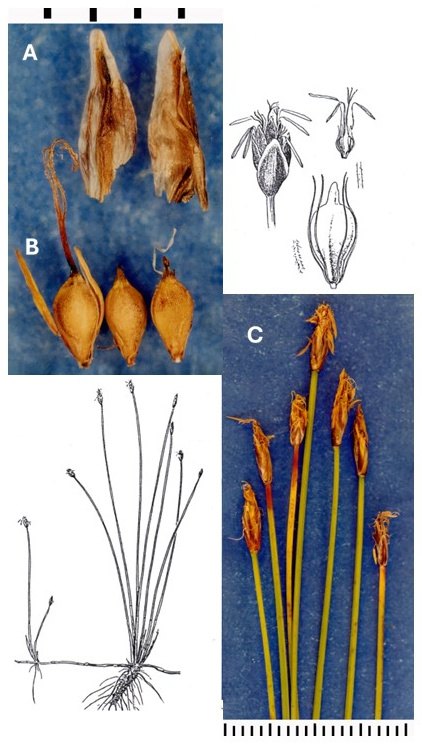
Eleocharis rostellata
Beaked spikerush, Torrey’s spikerush, Walking sedge
Eleocharis rostellata (Torrey) Torrey var. congdonii Jeps., E. r. (Torrey) Torrey var. occidentalis S. Watson, Scirpus rostellatus Torrey
Perennial, loosely clustered or in dense tussocks from short ascending rhizomes (mostly hidden by the crowded culms) or mats from rooting culm tips; culms erect, firm, wiry, flattened, 1.5–3 times as wide as thick; fruiting culms 10–50 cm tall, 0.3–2 mm thick; sterile culms longer (to 1 m or more), arching over or decumbent and rooting at the tips.
Usually 2, basal, leaf sheaths brownish, greenish or reddish purplish, extending up to 8 cm on the culm; upper sheath firm or papery, apex obtuse to subacute and reddish; tooth absent.
Absent.
Solitary, (5) 10–20 (35) flowered, erect, ovoid or oblong, wider than the stem, brownish to blackish-purplish, apex acute, 5–17 mm long, 2.5–5 mm thick; spikelets on stolons rudimentary and non-flowering.
Lowest scale ovate, without a flower and completely clasping the culm, 2–4 mm long, longer than the other scales, but rarely more than half the spikelet length; subproximal scale with a flower; upper floral scales 10–40, ovate-lanceolate, membranous to cartilaginous, apex obtuse to acute, straw-colored to medium brown with broad pale hyaline margins, midrib may be paler, purplish to blackish-purple spots sometimes present, 3.5–6 mm long, 2–3 mm wide.
Perfect; perianth bristles (0) 4–6 (8), unequal, stout, retrorsely barbellate, olive to brown, equaling the achene or tubercle; stamens 3, anthers about 2 mm long; styles trifid or trifid and bifid.
Variable, obovoid, trigonous to lenticular, rugulose to finely reticulate or smooth and shiny, medium brown to dark brown or olive green, abruptly tapered to a distinct beak, 0.9–2.8 mm long, 2–3 mm wide; tubercles absent or obscure to prominent, conic, often merging with the achene in form, color, and texture, 0.15–0.3 mm high, 0.5 mm thick.
Fruiting: summer-fall.Very wet brackish to fresh fens, springs, hot springs, and shores to 2400 m. Indicator of saline or calcareous soils. Locally distributed in Idaho, Nevada, Utah and Wyoming; Found across most of the United States. Newfoundland to Vancouver, Canada, south through Central and South America to northern Argentina; Europe. Very competitive and forms large monospecific colonies.
The introduced Eleocharis pachycarpa is similar to E. rostellata in forming tussocks from short, ascending rhizomes and sometimes proliferating spikelets. It differs in its slender, sharply 4-angled culms, different achenes, and the proliferating culms that are not greatly elongating or mat forming (see key herein and E. bolanderi).
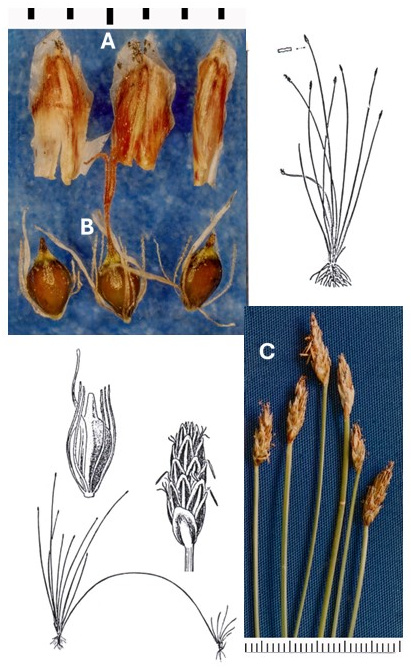
Eleocharis suksdorfiana
Suksdorf’s spikerush
Eleocharis pauciflora (Lightfoot) Link var. suksdorfiana (Beauverd) Hultén, E. quinqueflora (Hartmann) O. Schwarz var. suksdorfiana (Beauverd) J.T. Howell
Perennials forming mats from long horizontal rhizomes 0.5–1.5 mm thick; bulbs (“resting buds”) unknown; culms erect, cylindric to slightly flattened, twice as wide as thick, firm to hard, bluntly ridged when dry, not swollen (bulb-like) at the base, 12–40 cm tall, 0.5–1.2 mm thick.
Usually 2, basal; distal leaf sheath straw-colored to brown or reddish proximally and green to reddish distally; apex subtruncate to obtuse; tooth absent.
Absent.
Solitary, erect, ovoid or oblong, 4–10 mm long, 2-–4 mm thick.
Floral scales 8–12 per spikelet, lanceolate to ovate, membranous, 3.5–5 mm long, 2–2.5 mm wide; lowest scale completely clasps the culm and lacks (seldom with) a flower, 3–5 mm long, half or more as long as the spikelet; second scale with a flower.
Perfect; perianth bristles 6, about equal, slender, spinules dense, the longest bristle equaling the achene to exceeding the tubercle; stamens 3; styles trifid or trifid and bifid in same spikelet.
Trigonous, some lenticular, apically narrowed to a distinct straw-colored beak, smooth or with fine longitudinal ridges, medium to dark brown or gray, 2–2.7 mm long, 0.7–1.3 mm wide; tubercles to about 0.5 mm high, often not distinct, usually merging with achene summit in form, texture and color.
Fruiting: late spring—summer.Fens, bogs, wet meadows, seeps, springs, and ponds from (0) 1100 to 3300 m elevation. Locally distributed in Nevada, Oregon, and southern Idaho. Southern British Columbia to California and east to Alberta and Colorado.
Eleocharis suksdorfiana is easily confused with the closely related E. quinqueflora, within which it has usually been placed. These species differ as given in the key. E. suksdorfiana has long horizontal rhizomes, lacks stoloniferous culms, and produces achenes that are finely ridged longitudinally.
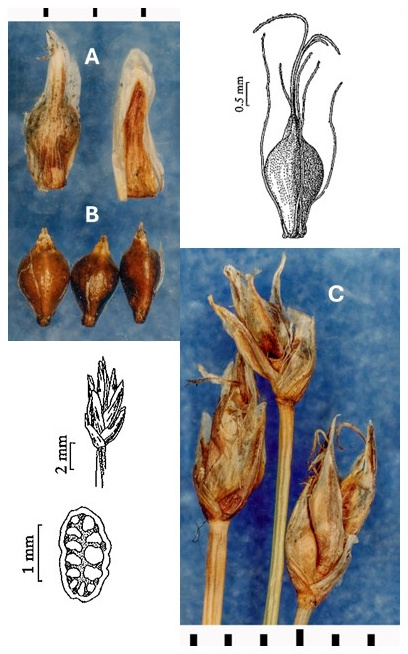
Eriophorum
Cottongrass, Cottonsedge
Rhizomatous perennials; culms solitary or clumped, terete or obscurely triangular, mostly solid; leaves basal and cauline; sheaths closed, ligulate; blades grasslike, flat with a narrow apex, smooth, up to 25 cm long, 2.5–4 mm wide; cauline leaves sometimes bladeless; inflorescences terminal; spikelets terete, solitary and erect or multiple (2–10 [30]) in a terminal cluster; involucral bracts 1-several, scalelike or elongate and leafy; scales spirally arranged, mostly thin and scarious, greenish or blackish, not awned; flowers perfect with a conspicuous perianth of numerous persistent, smooth, white to rufous, filiform bristles much exerted from the scales and obscuring them at maturity so that the fruiting spikelet forms a dense cottony mass commonly 2–4 cm long; stamens 3; styles rather long, trifid, deciduous; achenes oblong or oblanceolate, unequally trigonous, medium to dark brown at maturity, often with a short, slender stylar apiculus.
A mostly boreal genus of about 25 species. Plants of cool, wet places in temperate, alpine, and arctic regions of the Northern Hemisphere.
See Figure 37.
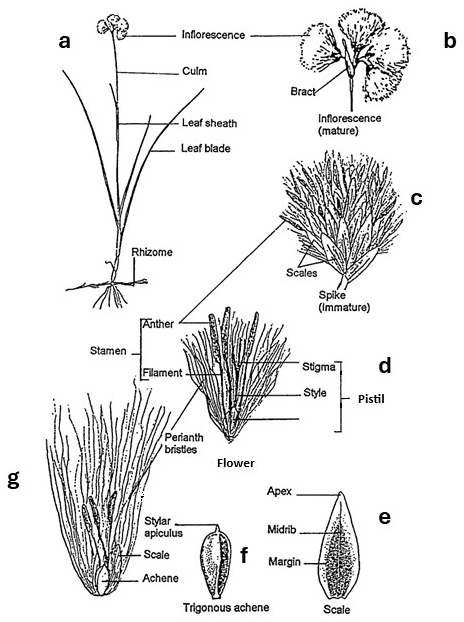
Key to Intermountain Eriophorum species
- 1. Spikelet solitary, terminal, erect; leaves few, reduced or lacking, dark-tipped and bladeless; uppermost leaves borne at about the middle of the culm; proximal spikelet scales generally empty.
- 2. Perianth bristles bright white; spikelets broadly obovoid to subglobose in fruit; fertile scales narrow, tapering, up to 1 mm wide; anthers mostly 0.5–1 mm.E. scheuchzeri
- 2. Perianth bristles reddish-brown to white; spikelets globose in fruit; fertile scales broader and more blunt; anthers 1–2.5 mm or longer.E. chamissonis
- 1. Spikelets two or more in a subumbellate inflorescence, subtended by one or more usually blade-bearing involucral bracts; proximal scales usually subtend flowers; leaves few, distal leaves with blades at least 1 cm long.
- 3. One inflorescence bract blade-bearing; leaf blades channeled in cross-section; peduncles slender, subterete but not compressed, hirtellous-pubescent; perianth bristles do not easily disarticulate from the achene.E. gracile
- 3. Inflorescence with 1 (2–5) blade-bearing bracts, leaf blades flat; peduncles compressed, smooth or minutely scabrous-hirtellous; perianth bristles easily disarticulate from the achene.
- 4. Scales blackish green or purplish green, thin with hyaline margins; midrib slender, attenuated distally and not reaching the tip.E. angustifolium subsp. angustifolium
- 4. Scales consistently dark green to gray, firm with inconspicuous hyaline margins; midrib wider, green or paler, expanding distally and reaching the tip, sometimes excurrent.E. viridicarinatum
Eriophorum angustifolium
subsp. angustifolium
Tall cottongrass, Many-spiked cottongrass, Narrowleaf cottonsedge
Eriophorum polystachion L.
Robust colonial perennials; culms mostly arising singly from long creeping rhizomes, subterete or obtusely angled, smooth, 2–10 dm tall, 1–1.2 mm thick distally.
Basal and cauline; sheaths with a small area of hyaline tissue near the mouth ventrally, rims may be darker; blades well developed, elongate, mostly flat proximally, tapering distally, apex triangular and channeled, 40 cm long, 1.5–6 (8) mm wide, shorter than the culms; distal blade much longer than the sheath. Blades will stain red when crushed.
Several, blade-bearing, unequal, the lowest leaflike, green to dark purple or black toward the base; longest bract to 2.5–5.5 (12) cm, shorter to equaling or surpassing the inflorescence; upper bracts reduced.
2–10 spreading or pendent spikelets in a compact or open umbelliform cyme; lateral spikelets with slender, compressed, smooth or more commonly minutely scabrous-hirtellous peduncles 0.5–2.5 cm long, central spikelets may be sessile; mature inflorescence cotton-like, 10–20 mm long in flower, 20–50 mm long in fruit.
Spirally arranged, ovate or lanceolate, brown to greenish, blackish or purplish green on the lower half, paler and very thin with broad white margins distally, 5–10 mm long 2–3 mm wide, midrib attenuated distally, not reaching the acute to obtuse tip; proximal scales lack lateral ribs; fertile scales concealed by the long cottony bristles at fruiting.
Perfect; perianth bristles numerous, long, smooth, usually white to pale yellow brown, 1.5–4 cm long, forming cottonlike tufts; stamens 3; anthers 2–5 mm long; stigmas trifid, slender.
Broadly oblanceolate to obovoid with a blunt tip, unequally trigonous, blackish with somewhat paler angles, 2–3.5 (5) mm long, 1–1.5 mm wide, 2–3 times as along as wide; achenes disarticulate readily from the perianth bristles.
Fruiting: July–August.Bogs, swamps, fens, marshes, and wet meadows from sea level to 1100 m. Uniform stands appear reddish due to red leaf tips. Known from northeastern Utah and eastern Idaho in the Intermountain Region. Circumboreal at high latitudes, extending south in North America to New York, Indiana, Illinois, Iowa, Nebraska, New Mexico, Idaho, and northwestern Oregon.
E. gracile: Leaf blades channeled; peduncles hairy and not compressed; perianth bristles not readily disarticulating from the achene; achene stramineous, 3–4 times as long as wide. E. viridicarinatum scale midrib is pale green and expands distally, extending to the tip.
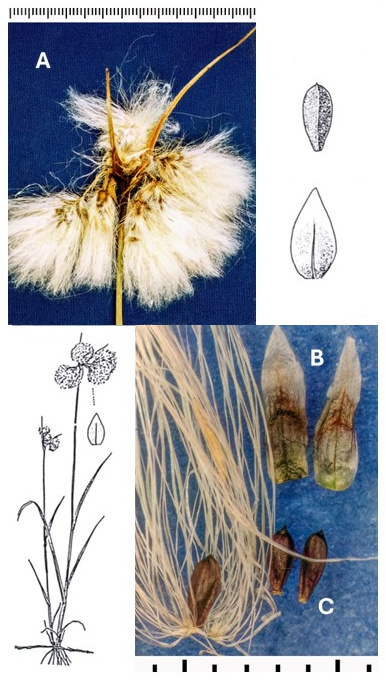
Eriophorum chamissonis
Russett (Rusty) cotton-grass, Chamisso’s cottongrass
Eriophorum altaicum Meinshausen var. neogeum Raymond, E. chamassonis C.A. Meyer var. aquatile (Norman) Fernald, E. russolum Fr. ex Hartm. subsp. rufescens (E.S. Anderson) Hyl., Scirpus chamissonis C.A. Meyer
Perennials forming extensive colonies from long creeping rhizomes; culms solitary or few together, stout, somewhat trigonous, 20–80 cm tall, 1.5–4 mm thick at the base.
Few, borne mostly near the base; basal sheaths persistent, septate-nodulose, brown; blades filiform, trigonous-channeled, smooth, 2–10 cm long, 1–2 mm wide; 1–2 leaf sheaths near the middle of the culm are bladeless and inflated.
Absent.
Spikelet solitary, terminal, erect, globose, broader at the base in fruit, 1.5–4 cm wide.
Spirally arranged, black to purplish brown; proximal scales (up to 7) empty, slightly sheathing at the base, obovate or obovate-trigonous with a blunt apex, margins white, conspicuous, 4–20 mm long; distal scales fertile, ovate-lanceolate, 1 mm wide or more, blackish green with the tip and distal margins paler and hyaline.
Perfect; perianth bristles many, smooth, reddish-brown to white, 20–40 mm long; stamens 3; anthers mostly 1.5–3 mm long; stigmas 3.
Oblong-obovoid, unequally trigonous, dark, apex apiculate, 2–2.7 mm long and as wide.
Fruiting: May–August.Found in peat, bogs, fens, marshes, swamps, and other wet places from sea level to 3000 m elevation. Circumboreal. In the Western Hemisphere from Greenland to Alaska and south to Washington, Oregon, northern and central Idaho, the Uinta Mountains of northeastern Utah, Montana, Wyoming, Colorado, North Dakota, Nebraska, Minnesota, and Wisconsin. The complex exhibits continuous variation with many intermediates.
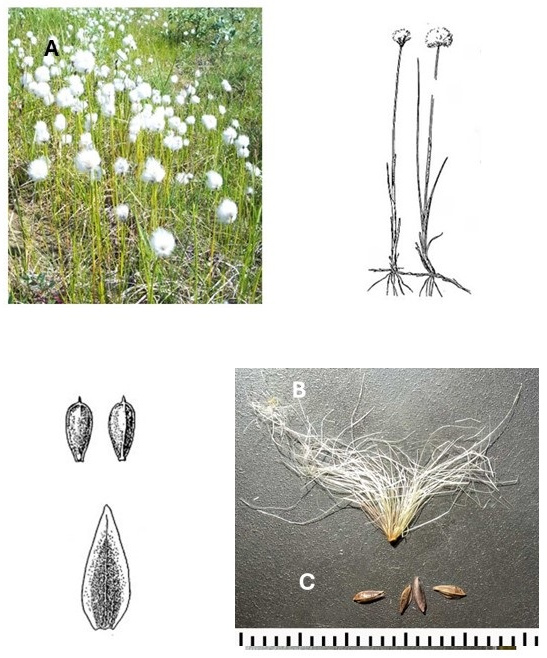
Eriophorum gracile
Slender cottongrass, Slender cottonsedge
Scirpus ardea T. Koyama
Colonial perennials with long, slender rhizomes; culms slender, subterete below, distally triangular and straited to unequally ribbed, 2–6 dm tall, 0.5–0.8 mm wide.
Few, mostly borne toward the base; basal leaves well developed; sheaths septate dorsally, straited, hyaline and brown dotted ventrally; blades narrow and elongate, deeply channeled or triangular distally, 2–30 cm long, 1–2 mm wide; uppermost cauline leaf with reduced blade, 1–4 cm long, 1–1.5 mm wide, usually shorter than its 3.5–5.5 cm long sheath.
Proximal bract similar to the distal leaf but not prominently triangular distally, somewhat spongy, green or brownish, 0.6–2 cm long, usually shorter than the inflorescence; distal bracts reduced, lacking blades, gray or black.
Subumbels of 2–5 spikelets in an umbelliform cyme; spikelets narrowly ovoid, 7–10 mm in flower, 15–25 mm in fruit; lateral spikelets short hirtellous-pubescent with slender, subterete (not compressed), peduncles 3–30 mm long; central spikelets subsessile or short pedunculate.
Spirally arranged, lanceolate to broadly ovate, 5–9 ribbed, scarious, pale near the base, upper portion blackish-green, margins very narrow, apex black and subacute to obtuse, the midrib slender and firm, distally dilated, pale, terminates just below the apex, 3–4 mm long, 1.5–2.3 mm wide, 1.5–2 times longer than wide.
Perfect; perianth bristles numerous, smooth, and mostly white, 10–15 mm long, concealing the fertile scales; stamens 3; anthers 1–3 mm; stigmas deeply trifid.
Narrowly elliptic oblong to narrowly oblanceolate, unequally trigonous (flat side widest), the angles prominent, apex blunt, stramineous to light brown, 1.5–3.5 mm long, 1–1.2 mm wide, 3–4.5 times as long as wide; bristles do not readily disarticulate from the achenes.
Fruiting: May–August.Meadows, bogs, and other wet places from sea level to 4000 m, usually in peaty, acidic substrates. Circumboreal, extending south in North America to Pennsylvania, Iowa, Colorado, central and northern Idaho, central California, and reportedly to eastern Oregon, western Wyoming, Nevada, and Utah.
E. angustifolium: Stouter plants, 2–6 (9) dm tall; leaves flat; blade-bearing bracts 4–5; floral scales 3–4 times longer than wide; peduncles compressed and not hairy; achene 2–3 times as long as wide; mature achenes disarticulate easily from the bristles.
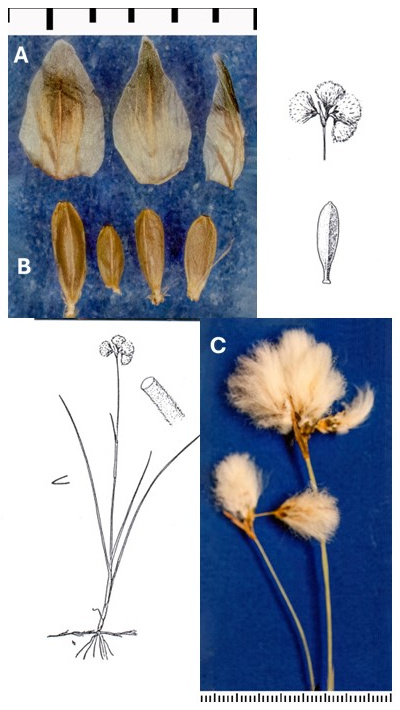
Eriophorum scheuchzeri
White cottongrass, Dense cottongrass, Scheuchzer’s cottongrass, Shealted cottongrass
Eriophorum leucocephalum Boeck., Scirpus leucocephalus T. Koyama, S. scheuchzeri (Hoppe) Vitman
Perennials forming large colonies from long, slender, creeping rhizomes; culms mostly arising singly or in small groups, erect, subterete, somewhat trigonous, smooth, evenly straited, reddish tinged, 1–4 (7) dm tall, about 1 mm wide at the base.
Few, most borne toward the base, slender, smooth; basal sheaths well-developed, septate-nodulose, brown to reddish, persistent; blades slender, channeled or triangular, up to 12 cm long, 1 mm wide, shorter than the culms, sometimes reduced or lacking; distal leaves borne at about the mid-culm are dark tipped and bladeless.
Spikelet solitary, terminal and erect.
Spirally arranged. Numerous, closely clustered; sterile scales proximal, several (7 or fewer), gray to blackish or blackish-purple with inconspicuous midribs not reaching the apex, 4–10 mm long; fertile scales distal, narrowly oblong, very thin, less than 1 mm wide, tapering gradually to an acute or obtuse tip, upper half blackish-green with broad to narrow white hyaline margins, paler toward the base, the inconspicuous midrib reaching to about one-half to two-thirds the scale length.
Perfect; perianth bristles numerous, smooth, straight, soft, mostly white to reddish tinged, 1.5—-3.5 cm long, forming a cotton-like tuft that conceals the fertile scales; stamens 3 with short anthers (0.5–1.0 mm); stigmas trifid, slender.
Oblanceolate, unequally trigonous with blunt angles, brown or blackish, 0.4–2.5 mm long, 0.5–1 mm wide with a short, dark, slender beak.
Fruiting: July–August.Cold, wet places, tundra, meadows, margins of lakes, marshes, and wet peatlands from sea level to 3800 m elevation. Circumboreal and southward in the United States to isolated mountainous areas of Montana, Wyoming, Utah (Duchesne, Summit, Uintah, and Wasatch Counties), Colorado, and New Mexico.
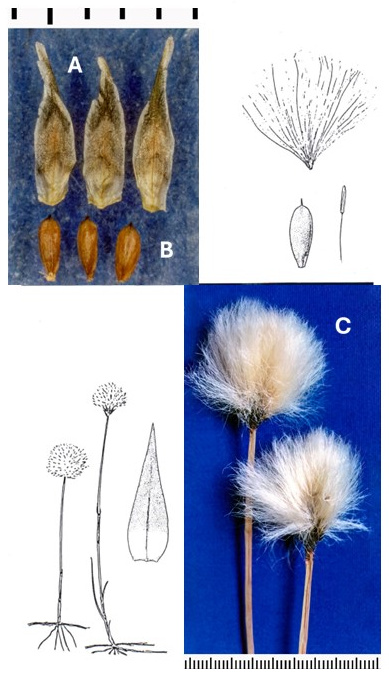
Eriophorum viridicarinatum
Thinleaf cottonsedge, Green-keeled cottongrass, Tassel cotton-grass
Eriophorum latifolium Hoppe var. viridicarinatum Engelmann
Perennials from creeping rhizomes; culms tufted or sometimes solitary, not sharply trigonous, glabrous, finely striated, up to 10 dm tall, 0.9–1.2 mm wide distally.
Several, basal and cauline; lower leaf sheaths overlapping, bases persistent; ventral sheath of cauline leaves veined except for a small hyaline area next to the concave mouth; blades elongate, flat, distally trigonous, minutely scabrous, up to 30 cm long, 2–6 mm wide; uppermost blade much exceeding the sheath.
2-4 blade-bearing bracts, foliaceous, flat, coarsely ribbed toward the base, triangular distally, minutely scabrous, green; lowest bract erect, equaling or exceeding the inflorescence; upper bracts reduced, brownish throughout.
Subumbels of 3–30 many-flowered, oblong to ovoid, terete spikelets, 6–10 mm long in flower, 15–30 mm long in fruit, most on slender, lax, minutely hairy, scabrous peduncles up to 6 cm long in mature inflorescences.
Spirally arranged, ovate-lanceolate, several nerved, pale to gray proximally, greenish or blackish-green distally, 4–6 mm long, 2.5 mm wide at the base; margins narrow, hyaline, scarious; prominent pale to green midrib expanded distally and extending to the blunt or acute tip or sometimes excurrent.
Perfect; perianth bristles numerous, straight, smooth, white to cream or buff, 15–25 mm long; stamens 3, anthers 0.8–2 mm long; stigmas 3-branched.
Narrowly obovoid, unequally trigonous, tapered toward the base, apex rounded, brown or reddish brown, about 3 mm long and 1.5 mm wide.
Fruiting: June–July.Cold, wet, especially peaty places in swamps, bogs, fens, and wet woods from sea level to 3000 m elevation. A North American species distributed from Alaska to Newfoundland and south from Washington to Colorado, North Dakota, Iowa, Illinois and east to Delaware. Peripheral to the Intermountain Region, occurring in Fremont and Teton Counties in southeastern Idaho, and possibly in Park and Teton counties in northwestern Utah.
Fertile scales of E. angustifolium are very thin and not consistently greenish black, the basal portion purplish brown, the midvein not expanded distally and does not reach the tip.
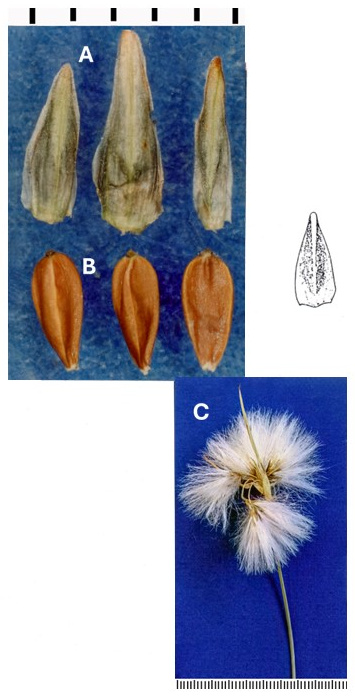
Fimbristylis
Fimbry, Fimbristyle
Annual or perennial, generally tufted, to 15 dm tall, rhizomatous or not; culms sometimes solitary, erect, scapose, slender (< 2 mm thick), ridged or grooved, terete, triangular, or compressed; leaves several, grasslike, borne near the base in two or more rows, shorter than the culms; sheaths open apically, margins wide and scarious, much shorter than the blades; ligules of erect short hairs or lacking; blades flat, folded, terete, or sulcate, not keeled ventrally, 2–4 mm wide; inflorescences of several to many ovoid to cylindric or compressed spikelets in terminal, simple or compound umbelliform cymes subtended by 2–5 sheathless, leafy or scalelike involucral bracts that are shorter than to exceeding the inflorescence; scales 8–100 or more, arranged spirally, imbricate, ovoid, 2 mm long or more; proximal 1–2 scales often empty; fertile scales ridged, the midrib often excurrent; flowers borne singly in the axils of upper scales, perfect, perianth lacking, protandrous, stamens 1–3; style bifid or occasionally trifid, generally fringed below the branched stigmas, enlarged toward the base, completely deciduous at maturity; achene lenticular, trigonous or terete, brown at maturity, surface cells somewhat square or horizontally elongate at high magnification.
The genus is distributed worldwide and includes more than 100 species, mainly tropical or subtropical plants in open, wet places. Occurs in the Nevada and Utah portions of the Intermountain Region.
See Figure 43.
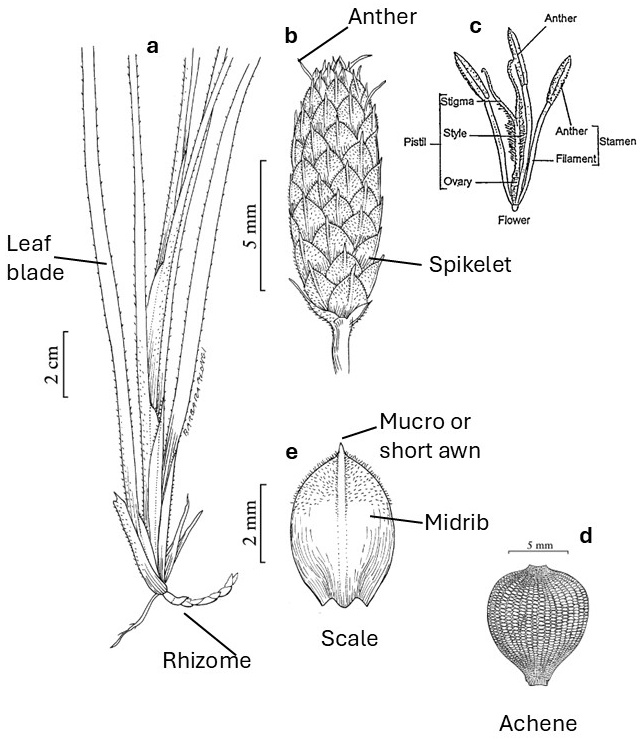
Key to Intermountain Fimbristylis species
- 1. Ligule present or absent, complete or incomplete; spikelet ovoid to lance-ovoid; fertile scales with abaxial surface lustrous, glabrous or puberulent apically with, apex rounded, midrib excurrent as a mucro.F. puberula
- 1. Ligule of short hairs present, complete; spikelet lance-ovoid to cylindric; fertile scales with abaxial surface dull, uniformly puberulent, apex broadly acute.F. thermalis
Fimbristylis puberula
Hairy fimbry
Scirpus puberulus Michaux
Robust perennial to 15 dm tall with swollen bases forming small tufts from short, slender, scaly or knotty, contorted rhizomes; culms sometimes solitary, narrow, somewhat triangular distally, striated, glabrous to sparsely pubescent, 1.2–2 mm wide.
Few, borne near the base, ascending, shorter than to equaling the culms; sheaths closed, apically ciliate, ventral side membranous, green to brown, often with minute brownish or reddish spots; ligules absent or present on rhizomatous plants, incomplete or complete; blades narrow, elongate, involute, glabrous to short hairy, 1–2 (4) mm wide, exceeding the sheaths.
2 or more, sheathless, unequal, elongate, scaberulous, ascending, shorter to longer than the inflorescence.
Usually a compound umbelliform cyme, but occasionally a simple umbel, broad, branching, ascending; terminal spikelet sessile and subtended by an involucre of several rays or peduncles 1–7 cm long, each with a terminal spikelet which may be subtended by an involucel with one or more secondary rays with terminal spikelets; spikelets many-flowered, ovoid to lance-ovoid, elliptic-cylindric, red-brown, 5–10 mm long, 3–5 mm thick.
Numerous, spirally arranged, ovate to oblong, apex rounded, lustrous, reddish brown or grayish, lower surface glabrous to puberulent, 2.5–3.5 mm long; midrib lighter, raised dorsally and prolonged into a mucro or short awn.
Perfect; perianth lacking; stamens 3; style bifid above the middle, somewhat flattened and fringed below the branched stigmas, about 2 mm long.
Broadly obovoid, biconvex, finely ribbed and lightly cross-rugulose at high magnification, shiny, yellow to dark brown, 1.5 mm long, about 1 mm wide.
Fruiting: July–August.Moist stream sides, prairie swales, pinelands, sandy or clay soils from sea level to 1000 m. Uncommon in the Intermountain Region, occurrences have been noted for Utah and Nevada. Primarily a midwestern species in the United States.
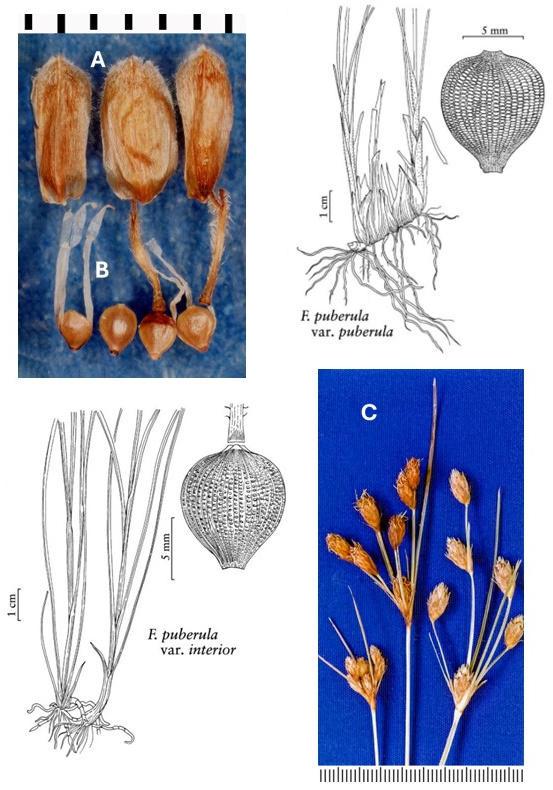
Fimbristylis thermalis
Hot springs fimbry, Hot springs fimbristylis
Fimbristylis spadicea (L.) Vahl, Scirpus spadiceus L.
Robust perennial, 0.5–1.5 dm tall; rhizomes long, slender, scaly; culms solitary or cespitose, terete but flat distally, grooved.
All near the culm base, spreading to ascending, one-half the length of the culms; sheaths smooth to puberulent on the backs, margins entire, ligules of short hairs; blades narrow, flat, margins scabrid-ciliate, proximally pubescent or not, 1–3.5 (4) mm wide.
Few, narrow, short, longest bract shorter than the inflorescence.
Simple or usually compound, elongate cymose corymbs, scapes narrow with scabrid ribs, up to 6 cm long; spikelets numerous, ovoid to cylindric-ellipsoid, pale dull brown, 8–15 mm long, 3–4 mm wide.
Fertile scales ovate, ciliate, apex broadly acute, pale brown, 3.5–4 mm long; midrib greenish and excurrent as an acute mucro.
Perfect; stamens 3; styles bifid, flat, fimbriate, especially distally.
Ovoid, biconvex, dark gray to brown, shiny, sides with 20 or more rows of pits, 1.5 mm long, mucronate.
Fruiting: spring—fall.Wet alkaline soils, seeps, hanging gardens, marshes, pond and lake margins, often near hot springs from 100 to 1350 m elevation. Utah, Nevada, Arizona, California, and Mexico. In the Intermountain Region this species occurs in scattered locations in Nevada and is uncommon in Utah. It may occur in the northeastern portion of California within the region.
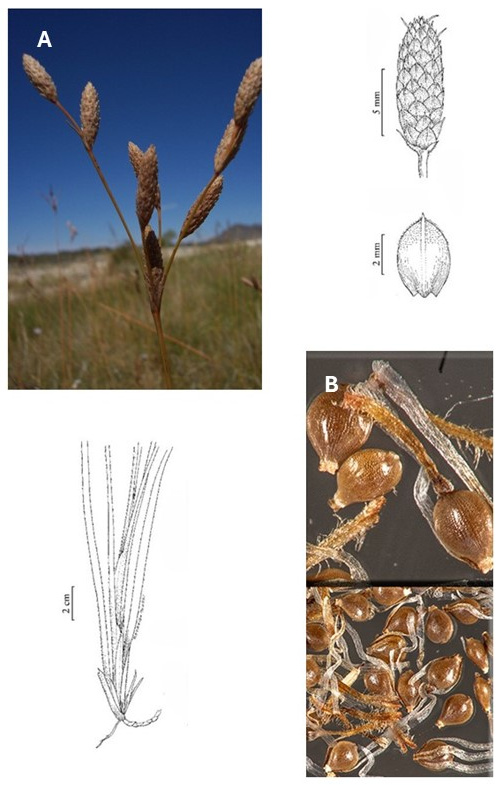
Kobresia
Bog sedge, Kobresia
Densely cespitose, grasslike perennials; rhizomes short or absent; culms solid, obtusely-trigonous or terete, especially toward the base, usually less than 35 cm tall; leaves basal and cauline, ligulate; leaf sheaths closed, basal sheaths persistent; blades well-developed, narrow to involute; inflorescence a solitary terminal spike or simple or compound panicle; involucral bracts leaflike or scalelike if present; spikelets 10–30, spirally arranged, each subtended by a scarious, scalelike bract on the axis of the spike; distal and terminal spikelets one-flowered and staminate; proximal spikelets one-flowered and pistillate or 2–4 flowered with a proximal pistillate flower and one or more distal staminate flowers; flowers unisexual, perianths lacking; stamens 3; styles trifid; achene unequally trigonous, dark brown, shiny; the apex with a persistent apiculate stylar base; the inner scale subtending each flower wraps around the achene (and the spikelet) and is homologous with the perigynium of Carex, but remains open, with the achene exposed.
A genus of about 30 species, found mostly in mountainous areas of Asia. A few circumboreal or boreal species in North America extending south in high elevation mountainous regions of the western United States.
See Figure 46.
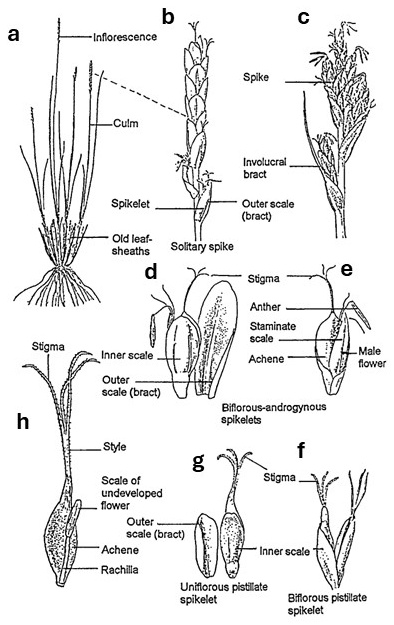
Key to Intermountain Kobresia species
- 1. Inflorescence usually a simple spike 2–3 mm wide; basal sheaths persistent, glossy, bladeless; plants 5–20 cm tall; in the Intermountain region on dry rocky slopes or alpine tundra, often above timberline.K. myosuroides
- 1. Inflorescence usually compound, 3–8 mm wide with 3–12 spikes; basal sheaths persistent, dull with remains of blades attached; plants 25–35 cm tall; in the Intermountain region in boggy, usually calcareous meadows and ponds at high elevations.K. simplicuiscula
Kobresia myosuroides
Bellardi bog sedge, Bellardi kobresia
Carex myosuroides Villars, Elyna bellardii (Allioni) C. Koch, Kobresia bellardii (Allioni) Degland
Densely tufted perennial; culms slender, smooth, terete, (0.5) 1–2 (5) dm tall, 1 mm wide, longer or shorter than the leaves.
Few, mostly basal; cauline leaves on the lower stem, wiry; old sheaths persistent, bladeless, glossy, brown; blades slender, flat to tightly involute or channeled, glabrous but sometimes scabrous along the margins, 2–20 cm long, 0.3–0.8 mm wide.
None.
Spike solitary, terminal, slender, stramineous to brownish, 1–3 cm long, about 2–3 mm thick; spikelets 8–20, small, spirally arranged.
Outer floral scale larger than the inner scale, 3–4 mm long, mostly scarious with hyaline margins, the midrib distinct nearly to the acute to obtuse tip; the inner floral scale brown to hyaline, smooth, equaling the achene, margins free to the base, 2–3.5 mm long.
Those in proximal spikelets mostly androgynous (a staminate flower above a pistillate flower, but occasionally only a pistillate flower); the distil spikelets staminate, stamens 3, anthers 1–1.5 mm, styles trifid.
Broadly oblong, unequally trigonous with blunt greenish angles when fresh, shiny dark brown with a darker persistent apiculate stylar base, short stipitate, approximately 2.5 mm long, 1 mm wide.
Fruiting: June–August.Alpine tundra communities, rock stripes and talus, open dry or somewhat moist places from sea level to 3500 m elevation. Circumboreal, extending south irregularly in the United States in high elevation areas, often above timberline in Washington, southeastern Idaho, northeastern Utah, southeastern Oregon, California, and the Rocky Mountains south to New Mexico.
Carex elynoides: achene is wrapped in a closed perigynium (See Hurd et al. (1998)).
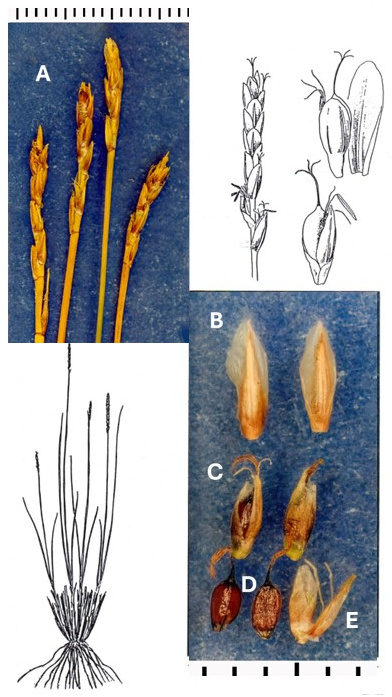
Kobresia simpliciuscula
Simple bog sedge, Simple kobresia
Carex bipartita Allioni, C. simpliciuscula Wahlenberg,
Kobresia bipartita (Allioni) Dalla Torre
Perennial, densely cespitose, lacking rhizomes; culms erect, terete to subterete, smooth, 0.5–3.5 (5) dm tall, longer than the leaves.
Few, borne on the lower fifth of the stem; sheaths very thin ventrally and soon breaking open, margins scarious; leaf sheaths brownish with bases of some dry blades persistent; blades flat or strongly folded, somewhat channeled, triangular and scabrous towards the tip, 2–20 cm long, 0.5–1.2 (2) mm wide.
Ovate to oblong-ovate, brown with hyaline margins; lowest bract elongate and leaflike, equaling or shorter than the inflorescence; upper bracts reduced.
Compound, 1.5–4 cm long with 3–12 spikes, each subtended by a scarious bract; spikelets few flowered; proximal spikelets 2-flowered and androgynous or 1-flowered and pistillate; distil spikelets 1-flowered, staminate.
Outer floral scale ovate to oblong with a conspicuous midrib reaching nearly to the tip, largely scarious, brownish, 2–4 mm long, 1–1.8 mm wide; inner scale thinner, lacking the conspicuous midrib, partially enclosing the achene with the margins free to the base.
Perianth lacking; stamens 3, styles trifid.
Elliptical, unequally trigonous, brown with a darker stylar base, 2–3 mm long, 1 mm wide.
Fruiting: June–August.Bogs, fens, tundra, calcareous meadows, gravels, rocky areas, edges of beaver ponds and other wet, usually calcareous places from sea level to 3500 m elevation. Circumboreal. South irregularly in western North America in high-elevation locations of northeastern Oregon, central and southeastern Idaho, Utah, and the Rocky Mountains to northern New Mexico.
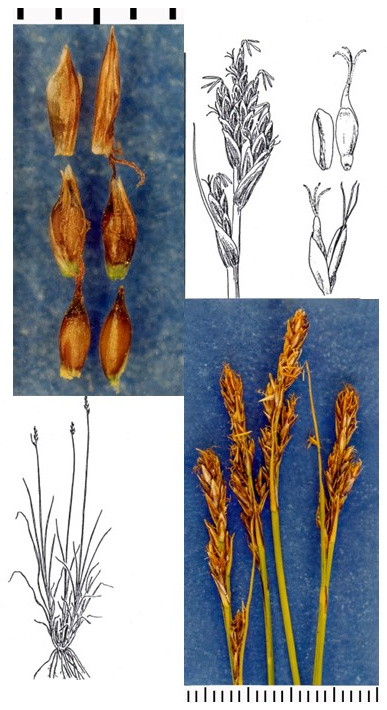
Lipocarpha
Halfchaff sedge, Hemicarpha
Densely cespitose annuals with fibrous roots; culms clustered or solitary, erect to spreading, delicate, terete or compressed, glabrous, striated, nodeless, up to 2 dm tall, 0.2–0.5 mm wide; leaves few, basal; sheaths closed, purplish or brownish; the lower sheath bladeless; ligules absent; blades of distal sheaths filiform, flat to involute, glabrous to setaceous, up to 10 cm long, 0.5–2.5 mm wide; inflorescence a spherical or cylindrical cluster of one to several sessile spikes, terminal or appearing lateral, subtended by 1 to 4 unequal, leaflike involucral bracts, the longest of which resembles a continuation of the stem and exceeds the inflorescence; shorter bracts divergent; spikes compound, sessile with numerous ([20] 50–150) spirally arranged, sessile spikelets; spikelets imbricate, each with a single perfect flower subtended by a well-developed, awned outer scale that is brown with 1–11 lighter veins, and a smaller, very thin, hyaline, often much reduced or obsolete inner scale between the flower and the axis of the spikelet; perianth otherwise lacking; flowers perfect, stamens 1–3; style deeply bifid or trifid with elongate stigmas, deciduous at maturity, sometimes leaving a small mucro at the top of the achene; achene brown, dorsiventrally somewhat compressed, obovoid, terete or trigonous, the surface minutely papillate.
A genus of about 35 species, chiefly in tropical and warm temperate regions globally. Six species are native in the United States.
See Figure 49.
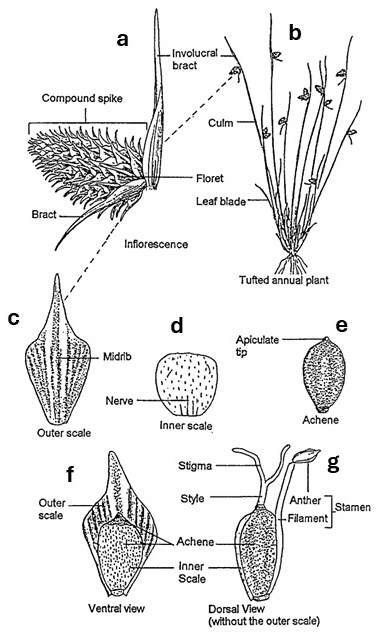
Lipocarpha micrantha
Smallflower halfchaff sedge, Small-flowered dwarf bulrush, Small-flowered hemicarpha
Hemicarpha micrantha (Vahl) Pax, H. subsquarrosa (Muhlenberg) Nees, Isolepis subsquarrosa (Muhlenberg) Schrader, Scirpus micranthas Vahl, S. subsquarrosus Muhlenberg
Delicate, tufted annuals with fibrous roots; culms slender, terete to compressed, glabrous, ribbed, 3–20 cm tall, 0.3–0.5 mm wide, outer culms recurved-spreading.
1–2, basal, very narrow; 1.5–10 cm long, 0.3–0.5 mm wide; old sheaths present; lower sheath ribbed dorsally, bladeless; upper sheath very thin, hyaline ventrally; blade channeled, lightly ribbed, brownish, sharp pointed at the tip, much shorter than the culms.
2–3, unequal; lowest 2–5 cm long, erect, channeled, lightly ribbed, longer than the others and appearing as a continuation of the stem; upper reduced and spreading.
1–3 clusters of globose to narrowly ovoid spikes, sessile, terminal but appearing lateral on the stem, not bristly, 1–5 mm long, 1–2 mm thick, each with numerous, sessile, spirally arranged spikelets, each with a single perfect flower.
Outer scale obovate, thick, firm, 0.5–1.0 mm long, 0.3–0.4 mm wide, abruptly contracted to a blunt spreading mucro or a short, stout awn tip that is longer on the lower scales, brownish to reddish brown, greenish to pale along the midstripe; inner scale adaxial, inconspicuous, very thin, hyaline, unvasculated or imperfectly vasculated, obtuse-truncate or toothed at the apex, 0.1–0.2 mm long, up to half the length of the achene (but obsolete to exceeding the achene) and partially enclosing its adaxial side, usually disarticulating with the achene.
Perfect; perianth bristles absent; stamens 1 (2); anthers 0.1–0.25 mm; style deeply forked, elongate, deciduous at maturity.
Obovoid, dorsiventrally compressed, short apiculate or with a short mucro, light to dark brown, 0.4–0.7 mm long, 0.2–0.3 mm wide, 1.5–2.5 times as long as wide.
Fruiting: June–September.Wet bottomlands, floodplains, riverbanks, sandbars, tidal marshes, and beaches from sea level to 1500 m elevation. Uncommon in the Intermountain Region. Scattered occurrences in west-central Idaho, northwestern Nevada, and south-central Utah. Tropical regions, Africa, South and Central America, north through the United States, and in eastern and western Canada.
Lipocarpha aristulata (Colville) G. C. Tucker (awned halfchaff sedge) is similar to L. macrantha, differing primarily in the presence of longer inner scales (0.5–0.8 mm long) that may be slightly shorter or longer than the achene; culms (2–15 cm) and leaves (1–6 cm) are slightly shorter and spikes (1–5 [8] mm) and rhomboid outer scales (0.9–1.6 mm) are slightly longer than those of L. macrantha. L. aristulata occurs on sandy soils along pond shores, streambanks, and emergent shorelines in tropical America, north through Midwest and eastern United States. It is uncommon in the western states with scattered occurrences from Arizona and California north to southern Washington and Wyoming.
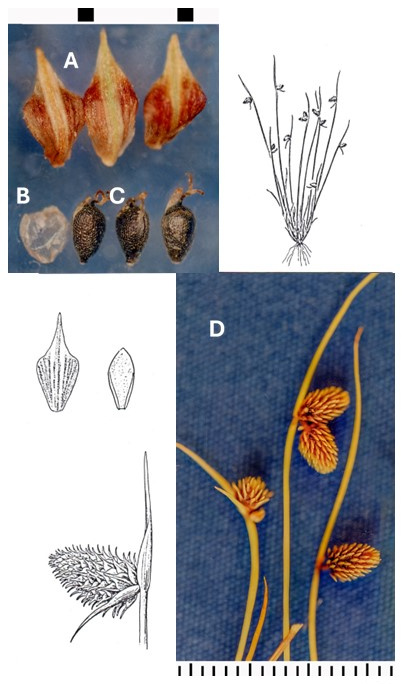
Schoenoplectiella
Bulrush
Plants annual, cespitose; rhizomes short, slender, to 1 mm thick; culms cylindrical; leaves primarily basal; sheaths of basal leaves bladeless; inner sheaths of some plants produce a single female amphicarpic flower, hidden except for the protruding style; cauline blades 1–2, proximally C-shaped in cross section, flat distally; proximal involucral bract erect, resembles the blades, appears as a continuation of the culm and is shorter than to usually exceeding it; inflorescence appearing lateral, capitate, compact, spherical, or with only one spikelet, sometimes with 1–2 branches; scales with prominent midrib, apex entire, awned or with a mucro, veins faint if present; flowers lack perianths, stamens 3; style bifid or trifid; achenes biconvex or sometimes trigonous with wavy transverse ridges; amphicarpic achenes are larger, ovoid or trigonous, and basally inflated.
A nearly cosmopolitan genus of terrestrial to emergent species on wet soils, ponds, lake shores, and other wet places. Rare in the Intermountain Region.
Note: The genus Schoenoplectiella was separated from Schoenoplectus based on its usually annual habit, production of solitary female (amphicarpic) flowers in basal leaf sheaths, and results of molecular analyses. Schoenoplectiella includes three species in North America and about 50 species globally.
Schoenoplectiella saximontana
Rocky Mountain bulrush, Sharpscale bulrush
Schoenoplectus saximontanus (Fernald) J. Raynal, Scirpus bergsonii Schuyler, Scirpus saximontanus Fernald, Scirpus supinus L. var. saximontanus (Fernald) T. Koyama
Tufted annuals with fibrous roots, lacking evident rhizomes (if present, short and 1 mm in diameter); culms cylindric, unequal, erect or often arching, slender and wiry, ridged when dry, 1–60 cm tall, 1 mm thick.
3–4, basal but with 1 (2) on the lower half of the culm; sheaths prominent, splitting, not leaving fibers; blades 1–2, rudimentary to longer than the sheath, 1–200 mm long, 0.2–1 mm wide, proximally C-shaped in section, distally flat, smooth or the margins spinulose near the tip.
Main bract erect or somewhat curved, resembling a continuation of the culm, 5–15 cm long; subsidiary bracts inconspicuous.
Compact heads of 6–20 spreading spikelets, a single spikelet, or with 1–2 branches to 15 mm long with clusters of 4–7 spikelets; spikelets 6–20 mm long, about 3 mm thick.
Broadly ovate, glabrous, margins minutely ciliate, apex rounded and not notched, pale brown to colorless, sometimes with a thick green midrib that is keeled distally, 2.5–3.5 mm long, 1.5–2.5 mm wide; mucro or awn bent outward, not contorted, sparsely spinulose, 0.2–0.5 mm long, longer on basal scale.
Perfect; perianth bristles absent; stamens 3; styles all trifid; solitary pistillate amphicarpic flowers often present in basal leaf sheaths.
Blackish brown, sharply triquetrous, surface with conspicuous, wavy, transverse ridges, 1.3–1.9 mm long (includes 0.1 mm long apiculus), 1–1.4 mm wide; Achenes of amphicarpic flowers are trigonous, transverse ridges less evident, 2.2–3 mm long with a tapered beak (0.3 mm).
Fruiting: summer.On wet and often sandy soil or emergent in freshwater swales, shores, ponds, ditches, and disturbed areas from ssea level to 2200 elevation. Rare and local in the Intermountain Region. British Columbia and California east to Ohio and Texas, mostly in the Great Plains from North Dakota to Texas; Mexico. Known only from Millard, Salt Lake, and Uintah Counties in Utah and Klamath County, Oregon.
Schoenoplectus subterminalis is perennial with a single erect spikelet, and smooth achenes. It forms mats of long, slender rhizomes that are often vegetative and submerged.
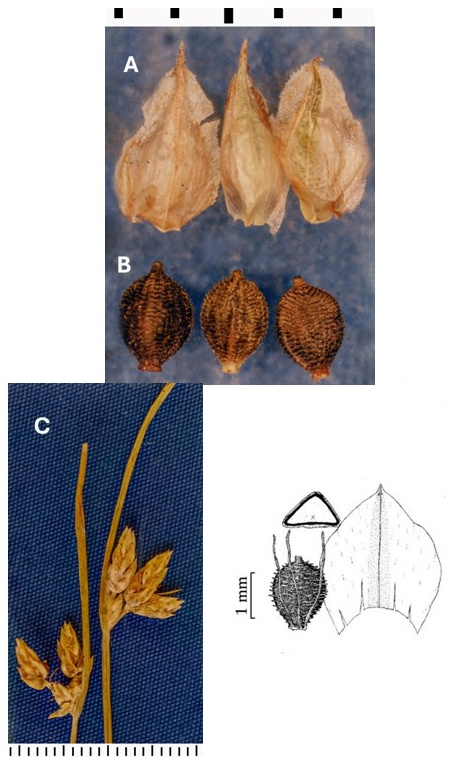
Schoenoplectus
Synonym: Scirpus L. subg. Schoenoplectus Reichenbach
Naked-stemmed bulrush, Bulrush, Threesquare
Perennial herbs, generally erect, spreading from long scaly rhizomes, or annual and forming small tufts without evident rhizomes (rare in the Intermountain Region). Culms cylindric or triangular, smooth, spongy with internal air cavities, not hollow. Leaves few, all basal or very rarely one or two cauline; sheaths closed, smooth; blades present (in the Intermountain Region), at least on the uppermost sheath (often absent in S. californicus); ligules present, glabrous; involucral bracts one or more; lowest bract usually resembling the leaf blades and sometimes resembling a continuation of the culm; other bracts often scalelike; inflorescences terminal, sessile or paniculate, branches often scabrous; spikelets in dense clusters of up to 100 or rarely solitary, ovoid, not laterally flattened; scales spirally arranged, ovate, membranous, sparsely to rarely densely scabrous or rarely smooth, margins usually ciliate, brown, often with numerous bright brown streaks on a paler background; apex usually notched, midrib usually prolonged (excurrent) into an apical mucro or short awn; flowers perfect, borne singly in the scale axils, proximal scale may be empty; perianth bristles (0) 2–6 (8), straight to curved and shorter to longer than the achene and strongly attached to it, brown or rarely reddish with retrorse spinulose hairs (hairs blunt in S. californicus); stamens 2–3; styles bifid or trifid, deciduous, base not enlarged into a tubercle; achenes brown when mature (blackish in S. saximonanus), mostly obovoid, lenticular or trigonous, smooth or (rarely in the Intermountain Region) with fine wavy transverse ridges, the apex narrowed into a short beak or minute apiculus.
A cosmopolitan genus of about 77 species of wet habitats in temperate and tropical regions. Common throughout the Intermountain Region. They are often community dominants and provide habitat for many organisms.
See Figure 52.
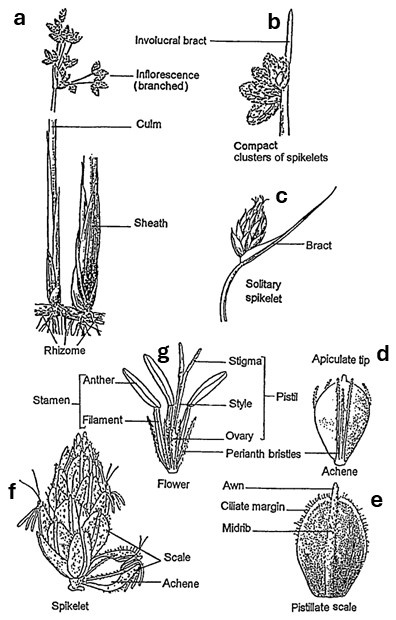
Key to Intermountain Schoenoplectus species
- 1. Culms triangular, at least distally (angles blunt in S. californicus).
- 2. Inflorescences branched, panicle-like, with 25–100+ spikelets; 2-4 soft-hairy perianth bristles; culms 4–10 mm thick, cylindric proximally; plants 1–4 m tall.S. californicus
- 2. Inflorescences unbranched, with 1–20 spikelets; perianth bristles with spinulose hairs; culms 1–10 mm thick, sharply triangular; plants 0.1–2.5 m tall.
- 3. Uppermost leaf blade much shorter than to about equaling its sheath (rarely to 1.5 times longer); spikelets with scale apices notched 0.1–0.4 mm deep, the awn (mucro) 0.2–0.6 mm long.S. americanus
- 3. Uppermost leaf blade (1) 2–5 times longer than its sheath (rarely about equaling sheath); spikelets with scale apices notched (0.3) 0.5–1 mm deep, awn 0.5–2.5 mm long.S. pungens var. longispicatus
- 1. Culms cylindric.
- 4. Culms 0.2–1.5 mm thick; inflorescences with one erect spikelet or rarely with 1–2 short branches; scale apices not notched; plants to 1.5 m long; rare species, usually aquatic and mat-forming with leaf tips floating.S. subterminalis
- 4. Culms 2–10 mm thick; inflorescences branched with 3–100 or more spikelets; scale apices notched; plants to 3 (4) m tall; common or rare species.
- 5. At least some scales with excurrent midribs (awns) markedly contorted, 0.5–2 mm long (often broken off late in season); many scales very scabrous; culms firm; inflorescences with spikelets never all solitary, some or all spikelets in clusters of 2–8; styles all bifid or bifid and trifid in the same spikelet; achenes all lenticular or some obscurely trigonous and dorsally keeled.S. acutus
- 5. Excurrent midribs (awns) of the scales straight to irregularly bent, not markedly contorted, 0.2–0.8 mm long; scales usually nearly smooth (rarely very scabrous); culms soft; inflorescences with spikelets usually with some or all spikelets in clusters of 2–4 (7); styles either all bifid or sometimes a few trifid in the same spikelet, achenes lenticular.S. tabernaemontani
Schoenoplectus acutus
Hardstem bulrush, Common tule
Scirpus acutus var. Muhlenberg ex Bigelow
Stout perennials 1–3 (4) m tall, forming large colonies from thick rootstocks and robust, brown rhizomes; culms stout, cylindric, usually firm, largest air cavities about 0.5–1.5 mm wide, 1–4 m tall, 2–10 (30) mm thick.
3–4, all basal; sheaths prominent, strongly veined, reddish tinged basally, ventrally hyaline and splitting leaving fibers, dorsally septate-nodulose; ligules glabrous; blades 1–2, poorly developed, C-shaped to flat in cross section, smooth or margins minutely spinulose, 1–12 cm long and 3–7 mm wide, shorter than the sheaths.
Main bract erect to divergent, usually green, 1–9 cm long, sometimes resembling a continuation of the culm, shorter or longer than the inflorescence; subsidiary bracts small, chaffy, brownish, margins sometime scabridulous.
Open to compact, 2–3 times branched, branches 6 (18) cm long, sometimes drooping; spikelets 3–100 or more, ovoid, in sessile clusters of 2–8 at the ends of rather erect branches or many (never all) solitary, mostly grayish brown to stramineous, 6–24 mm long, 3–4 mm thick.
Thin, most very scabrous, margins prominently lacerate and ciliate with long contorted hairs, wholly reddish to orange-brown to partly or wholly straw-colored, often with numerous reddish raised cells, 3–4 mm long, 2–3 mm wide; the apex notched 0.3–0.5 mm deep; midrib firm, scabrous, excurrent as a 0.5–2 mm long awn that is straight, irregularly bent, or some in the same spikelet markedly contorted. Note: The marginal cilia and awns are often worn off late in the season.
Perfect; perianth bristles (4) 6 (8), retrorsely spinulose, brown, equal to much shorter than the achene; stamens 2–3; styles all bifid or bifid and trifid in the same spikelet.
2-angled or some in same spikelet obscurely trigonous and dorsally keeled, smooth, shiny, gray-brown to dark brown, 2–3 mm long (including the 0.2–0.4 mm-long apiculus), 1.2–1.7 mm wide, more or less hidden by the scale when mature.
Fruiting: June–September.Marshes, shores, fens, springs, washes, and floodplains from sea level to 2680 m elevation. Often emergent in water to 1 m deep, usually growing with Typha spp. Tolerant of salts and alkali. Locally common in the Intermountain Region. Distributed from southern Alaska to Nova Scotia, south to California, Texas, and North Carolina, Mexico, and east Pacific islands.
Schoenoplectus acutus is easily confused with S. tabernaemontani and S. heterochaetus. In addition to the differences given in the key, S. tabernaemontani differs in that the scales of its spikelets are usually less scabrous, more often uniformly orangish brown,
usually without minute reddish raised cells, and its inflorescences are sometimes with all spikelets solitary. S. heterochaetus differs in that its spikelets are all solitary, styles all trifid, achenes all prominently 3-angled (in the Intermountain Region some achenes of S. acutus are dorsally keeled but not prominently 3-angled), and perianth bristles 4 (rarely 5). Probable interspecific hybrids among S. acutus, S. tabernaemontani, and S. heterochaetus are common in eastern North America but rare in the Intermountain Region. Schoenoplectus acutus also can be mistaken for S. californicus, which has only 2–4 perianth bristles that are dark red-brown, strap-like, and with blunt (not sharp-pointed) hairs.
S. acutus var. occidentalis has bifid and trifid styles in the same spikelet, some often obscurely 3-angled (dorsally keeled) achenes. It is widespread in western North America. S. a. var. acutus, with styles all bifid and achenes all 2-angled, occurs in midwestern and northeastern North America and in Washington.
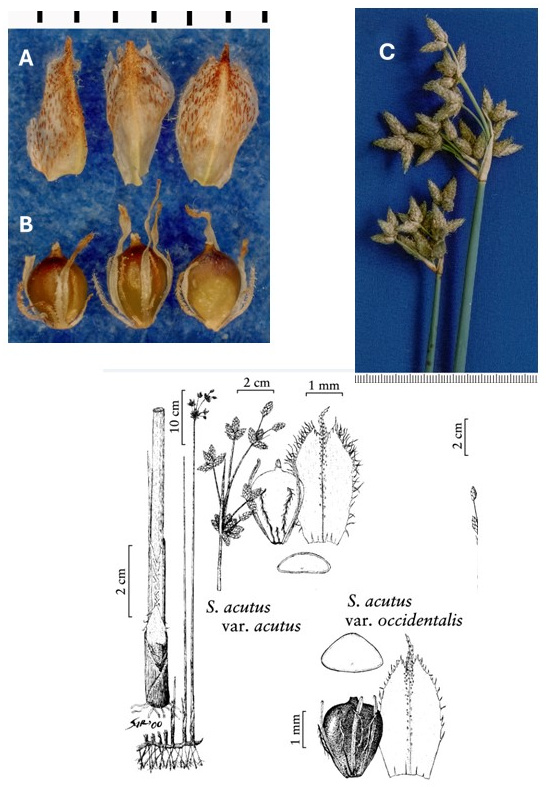
Schoenoplectus americanus
Olney’s three-square bulrush, American bulrush, Chairmaker’s bulrush
Scirpus americanus Persoon, S. chilensis Nees & Meyen ex Kunth, S. olneyi A. Gray
Stout perennials, forming colonies of scattered culms from long rhizomes; culms erect or arched, sharply triangular, sides usually deeply concave throughout, rarely nearly flat, usually very soft, dark green, 0.4–2.5 m tall, 3–10 mm thick.
1-4, all basal, not crowded, less than half the culm length; sheaths not ventrally splitting or leaving fibers, lower sheaths bladeless; blades 1–3, V-shaped near the base, mostly triangular and laterally flattened distally, smooth, the uppermost much shorter than to about equaling its sheath (rarely 1.5 times longer), 2–20 cm long, 2–8 mm wide.
Proximal bract, erect, V-shaped, acute at the tip, green, appearing as a continuation of the culm, about one-third as long as the inflorescence, 1–6 (10) cm long; distal bracts 1–2, scale-like, inconspicuous.
Compact head, sessile, appearing lateral on the culm; spikelets 2–20, ovoid or oblong, acute to obtuse apically, 5–15 mm long, 3–5 mm thick.
Broadly ovate, 3–4 mm long, 2–3 mm wide, thin, smooth, hyaline, orangish red to purple-brown or straw-colored, often with linear spots, margins often minutely ciliate; apex shallowly notched 0.1–0.4 mm deep; mucro or awn sparsely spinulose, straight to bent, not contorted, longer or shorter than the notch.
Perfect; perianth bristles (2) 5–6 (7), often unequal, retrorsely spinulose, brown, one-half to about equaling the achene; stamens 3; styles bifid or bifid and trifid in the same spikelet.
Obovoid, lenticular or obscurely trigonous, smooth, brown at maturity, 1.8–2.8 mm long including the 0.1–0.3 mm beak, 1.3–2 mm wide.
Fruiting: June–September.Mineral-rich or brackish marshes, shores, fens, and springs from sea level to 2200 m elevation. Often emergent in water and alkali tolerant. Widespread but less common than S. pungens throughout the Intermountain Region. Southern British Columbia to Nova Scotia, south to California, and Florida; Mexico to South America.
Schoenoplectus pungens: Besides the differences given in the key, the culms of S. pungens often have nearly flat sides, the inflorescence has up to 5 (rarely 10) spikelets, leaf blades and involucral bracts are longer, scale tips are more deeply notched and the excurrent midribs longer.
Schoenoplectus americanus was long called Scirpus olneyi. Probable hybrids of S. americanus and S. pungens occasionally occur.
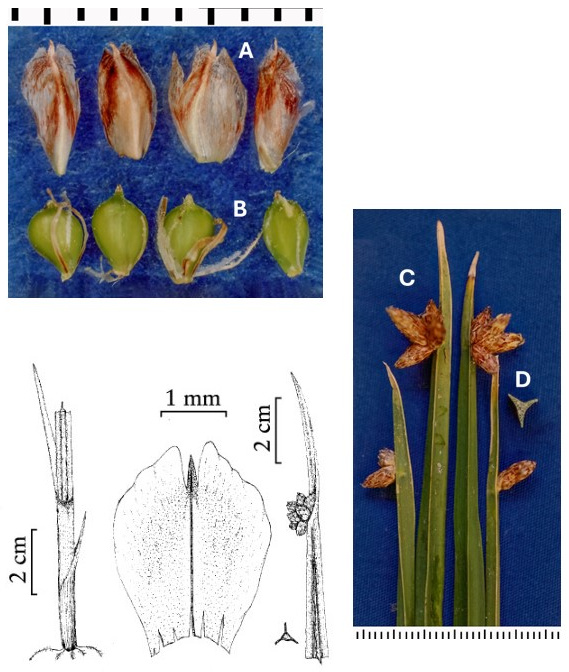
Schoenoplectus californicus
California bulrush, Giant bulrush, Tule
Scirpus californicus (C.A. Meyer) Steudel
Stout perennial, forming large colonies from long, robust rhizomes 10–15 mm in diameter; culms bluntly triangular throughout, or nearly cylindric and becoming obscurely triangular near the inflorescence, firm and not easily crushed between the fingers, 1–4 m tall, 4–10 mm thick.
3–4, basal; sheaths one-sixth of culm length, fronts ventrally hyaline and splitting leaving coarse fibers; blades 0–1, nearly flat, smooth, up to 2 cm long and 2 mm wide, about half the sheath length.
Main bract usually erect, stiff, margins often scabrous, 1–8 cm long, sometimes resembling a continuation of the culm, shorter than the inflorescence.
Panicle-like and open with third level branching; branches arched and flexible, 21 cm long; spikelets 25–150 or more, solitary or in clusters of 2 or more at the branch tips, 5–11 mm long, about 3 mm thick.
Oval, orangish brown with numerous short, linear reddish spots, 2.5 mm long, 2 mm wide, smooth except for the thick, sparsely scabrous midrib, margins minutely ciliate, apex rounded, shallowly notched 0.1–0.2 mm deep; awn not contorted, bent outward, about 0.3–0.5 mm long.
Perfect: perianth bristles 2–4, strap-shaped or trigonous with blunt tips, edges fringed, dark reddish brown, equaling the achene; stamens 3; styles all bifid.
Ovoid to obovoid, lenticular, smooth, gray-brown, 1.8–2.2 mm long (including the 0.2 mm long beak), 1.3 mm wide.
Fruiting: spring—summer.Fresh to brackish water, marshes and shorelines from sea level to about 1400 m elevation. Often emergent and salinity tolerant. In the Intermountain Region, known only from along the Colorado River in southernmost Nevada. California to Florida; Mexico to South America, West Indies, Pacific Islands.
Easily confused with Schoenoplectus tabernaemontani and S. acutus, both of which have completely cylindric culms and (4) 6–8 perianth bristles with sharp-pointed hairs.
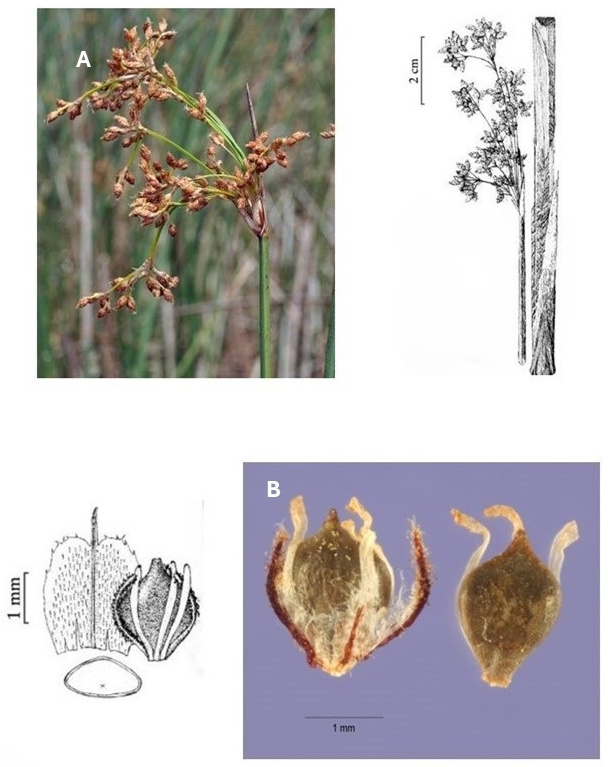
Schoenoplectus pungens
var. longispicatus
Common threesquare, Chairmaker’s rush, Threesquare
Scirpus pungens Vahl
Colonial perennial with somewhat scattered culms from long, scaly, often vertical rhizomes from 1–6 mm in diameter; culms erect to somewhat arching, sharply triangular, smooth, the sides nearly convex to concave proximally, concave to flat distally, dark to yellowish green, 0.1–2 m tall, 1–6 mm thick.
All basal; sheaths fronts membranous, often splitting and leaving fibers, lower sheaths bladeless; ligules bifid; blades 2–6, V-shaped in cross section near the base, trigonous to laterally flattened near the apex, smooth or margins spinulose; the uppermost blade 1–5 times as long as its sheath, 5–75 cm long, 2–9 mm wide.
Main bract erect, trigonous proximally, 1–20 cm long, appearing as a continuation of the culm, 3–7 times as long as the inflorescence; upper 1–2 bracts usually inconspicuous, shorter than the spikelets, resembling enlarged scales with awns one-third of the bract length.
Compact, sessile head or solitary spikelet appearing lateral on the culm; spikelets 1–5 (rarely to 10), 5–23 mm long, 3–5 (7) mm thick.
Broadly ovate, smooth or the lighter midrib with a few spinules, margins minutely ciliate when young, bright (sometimes very dark) brown to straw-colored, often with linear spots, 3.5–6 mm long, 2–3 mm wide; apex notched 0.5–1 mm deep; awn irregularly bent, sparsely spinulose, not contorted, 0.5–2.5 mm long, equaling to exceeding the notch.
Perfect; perianth bristles 4–8 (usually 6), slender to stout, often unequal, retrorsely spinulose, brown, rudimentary to equaling the achene and firmly attached to it; stamens 3; styles all trifid in the Intermountain Region.
Broadly obovoid to ovoid, lenticular or unequally trigonous, smooth, brown when mature, (2) 2.5 (3.5) mm long (includes the 0.1–0.5-mm apiculus or beak), 1.3–2.3 mm wide.
Fruiting: May–August.Fresh or brackish marshes, shores, streams, springs, shallow lakes, and fens from sea level to 2400 m elevation. Often emergent in water and tolerant of alkali. Widespread and common in the Intermountain Region. South-central Alaska to Labrador and south to California and Florida; Mexico, South America, West Indies, Europe, Australia, and New Zealand.
Schoenoplectus pungens was long erroneously called Scirpus americanus. Besides the differences given in the key, S. americanus culm sides are usually deeply concave throughout, and the inflorescence may consist of 20 spikelets. Bolboschoenus maritimus, which often occurs with S. pungens in salty places, has minutely pubescent scales (the hairs often worn off), some leaves attached to the culm above the basal leaves, leaf blades with keeled midribs and often spinulose margins, culms often scabrous on the angles, culm bases with durable corms, ligules absent, and bristles not firmly attached to the achenes.
Plants of Schoenoplectus pungens in the Intermountain Region have styles mostly or all trifid and achenes often obscurely 3-angled and may be called Schoenoplectus pungens (Vahl) Palla var. longispicatus (Pers.) S.G. Smith. Schoenoplectus pungens (Vahl) Palla var. badius (J. Presl & C. Presl) S.G. Smith with dark chestnut scales and trigonous or biconvex achenes has been collected in southeastern Oregon.
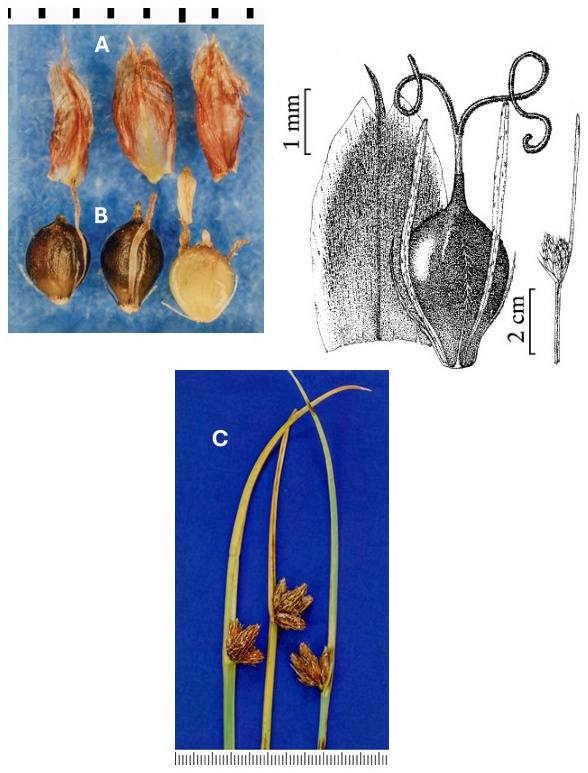
Schoenoplectus subterminalis
Swaying bulrush, Water bulrush, Water clubrush
Scirpus subterminalis Torrey
Slender perennials to about 1 m tall, forming mats from long, slender rhizomes to 1 mm in diameter, tubers sometimes present, plants usually submerged except for emergent inflorescences or entirely submerged and without inflorescences; culms slender, subcylindric, 20–80 (150) cm long and to 1 mm thick, flaccid if submerged with the distil portion floating, or rarely terrestrial with culms firm and erect.
3–20 or more; sheaths smooth, less than half the stem height, fronts sometimes splitting leaving delicate fibers that often separate and resemble the blades; submerged blades flaccid, filiform to narrowly ribbon-like and floating; erect blades firm and C-shaped in cross-section proximally and elliptic distally, 0.2–1 mm wide, 1.5-6 dm long, longer than the sheaths but difficult to distinguish from them.
Solitary, erect, prominent, sheathless, appearing as a continuation of the culm, apex acute, 7–60 mm long, greatly exceeding the inflorescence.
A solitary, erect spikelet, oblong to oblong-cylindric, few to many- flowered, upper slender portion consists of staminate flowers, light brown, 5–15 mm long, 3–7 mm wide.
Ovate to lanceolate, thin and almost hyaline, smooth, pale brown, midrib region firm and greenish when young, margins sometimes minutely cilitate; apex not notched but with a minute mucro, greenish, 4–6 mm long, 1.5 mm wide.
Perfect; perianth bristles 6, retrorsely spinulose, brown, shorter than to about as long as achene (including the beak); stamens 3; styles trifid.
Obovoid, markedly trigonous, smooth, pale to dark brown, 2.5–3.5 mm long (including the prominent 0.3–0.8 mm long beak), 1.5–1.7 mm thick.
Fruiting: July–August.Shallow water in fresh oligotrophic lakes and streams from sea level to 2300 m elevation. Rare or local in most of its range. In the Intermountain Region it is known from Fremont, Valley, and Elmore Counties in Idaho, and from a single Utah report. Collections have also been made in Dolores and San Juan Counties, Colorado, near the southeastern border of Utah. The species is disjunct in western and eastern North America: In the West from southeastern Alaska and British Columbia south to northern Idaho and northern California; in the East from Minnesota to Labrador and south to Missouri, South Carolina and the Florida panhandle.
Eleocharis acicularis (when aquatic, robust, and without inflorescences): Leaf blades absent. Note: In delicate aquatic forms of S. subterminalis, the leaves are often difficult to distinguish from the culms, and in Eleocharis acicularis, the culms may closely resemble leaves.
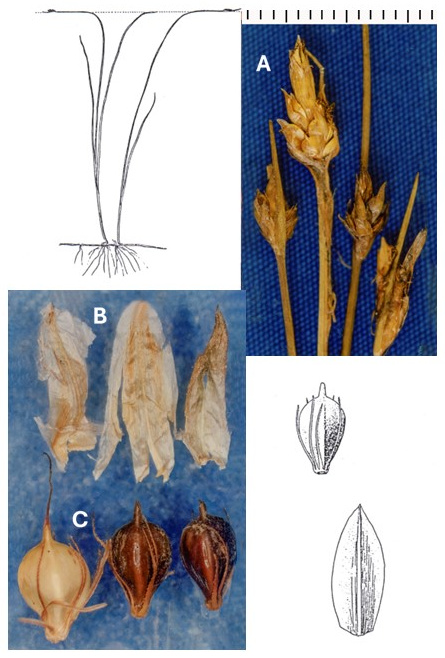
Schoenoplectus tabernaemontani
Softstem bulrush, Great bulrush
Schoenoplectus validus (Vahl) A. Löve & D. Löve, Scirpus lacustris L. subsp. tabernaemontani (C.C. Gmelin) A. Löve & D. Löve, S. tabernaemontani (C.C. Gmelin), S. validus Vahl
Stout perennials that form large, dense colonies from long, robust rhizomes 3–10 mm in diameter; culms cylindric, soft (usually easily crushed between the fingers and flattened when pressed), 0.5–2 (3) m tall, 2–10 mm thick.
3–4, all near the base; sheath fronts hyaline and splitting, often leaving fibers; blades 1–2, C-shaped to flat in cross-section, smooth or the margins minutely scabrous, 2–200 mm long, 1–4 mm wide, shorter than the sheaths.
Main bract usually erect, appearing as a continuation of the culm, C-shaped to subterete, margins sometimes scabridulous, 1–8 (10) cm long.
Panicle-like, open to compact, branched 2–4 times; branches flexible, 15 (25) cm long; spikelets 15–200, usually solitary or in clusters of 2–4 (7), ovoid to oblong ovoid, obtuse to acuminate at the apex, reddish brown, 3–17 mm long, 2.5–4 mm thick.
Oblong-ovate, thin, margins ciliate (woolly) with fairly short, contorted hairs, scabrous on the awn and midrib and sometimes on the flanks, uniformly dark to pale orange-brown, sometimes straw-colored, midrib often paler or green, 2–3.5 mm long and 1.5–2 mm wide; apex notched about 0.3 mm deep, mucro or awn straight or bent, not contorted, 0.2–0.8 mm long.
Perfect; perianth bristles 6, retrorsely spinulose, brownish, about equaling the achene; stamens 3 with straplike filaments; styles bifid or a few trifid in the same spikelet.
Broadly ovoid, plano-convex, lenticular, rounded distally, smooth, brown, 1.5–1.8 mm long (including 0.2–0.4 mm apiculus or short beak), 1.2–1.7 mm wide.
Fruiting: June–August.Fresh to brackish marshes, shores, stream bars, fens, bogs, and disturbed places from sea level to 2400 m elevation. Often emergent in water to 1 m deep. Distributed nearly worldwide, occurs in all North American provinces and states. Widespread in the Intermountain Region.
Schoenoplectus acutus: Besides the differences given in the key, the spikelet scales of S. acutus are usually much less scabrous and the margins have longer cilia. S. heterochaetus: Spikelet scales are mostly longer (3–4 mm) and their apices are more deeply notched (mostly 0.5–1 mm deep).
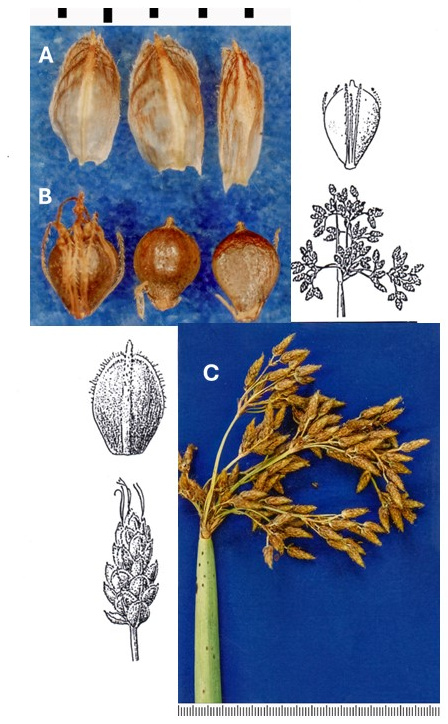
Schoenus
Blackhead sedge, Bogrush
Cespitose perennials, rhizomatous; culms stiff, erect, terete; leaves mostly basal, ligules lacking; blades rolled, cylindrical; involucral bracts 1–2, spreading to erect, leafy, unequal, apex acute, longest to 8 cm; inflorescence terminal, sometimes appearing lateral, capitate; spikelets 10–25, clustered, flattened, purple to black; scales 3–8, 2-ranked, purple to black; basal scales empty; distil scales each subtend a flower; flowers 5–8, perfect and staminate; stamens 3; style trifid, deciduous; bristles 0–6, smooth to scabrous, shorter than to exceeding the achene; achene trigonous, tubercle lacking.
A genus of about 80 species, primarily in tropical and warm temperate regions. Predominantly in Australia and New Zealand. A few species in Africa, Eurasia, and the western Hemisphere; one in North America.
See Figure 59.
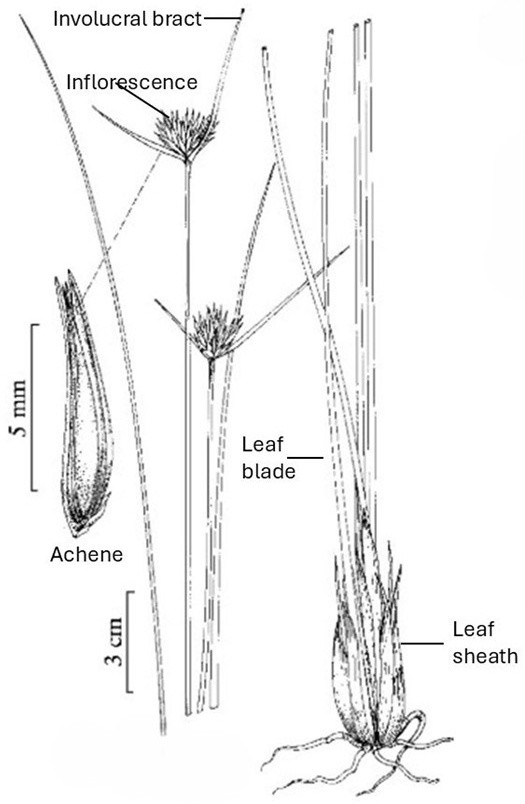
Schoenus nigricans
Black bogrush, Black sedge
Perennial, densely cespitose, wiry; culms stiff, glabrous, terete to rounded-trigonous, hollow to spongy with air cavities, 20–70 cm tall, less than 1 mm wide; rhizomes short or absent.
Basal, erect, stiff, some nearly equaling the culms; sheaths shiny, brown to black, wider than the blades; blades smooth to scabrid, rolled, margins entire to slightly serrate, 10–40 cm long, 1–2 mm wide.
1–2, leaflike, oblique to erect, unequal, stiff, apex acute, green to dark brown, 0-6 (8) cm long, 1–1.5 mm wide.
Terminal, unbranched head, ovoid, dense, 1–2 cm in diameter; spikelets 10–25, flattened, ellipsoid, dark purple or black; rachilla deciduous.
2-ranked; basal scales (2–3) empty; fertile scales (3–8) oblong, somewhat sheathing, acuminate, scabrous distally.
Perfect; perianth bristles 6, plumose, deciduous, exceeding the achene; stamens 3; styles trifid.
Ovoid, somewhat trigonous, apex obtuse, white, glossy, smooth to slightly reticulate, 1–2 mm long, 0.9–1.2 mm wide.
Fruiting: August–September.Uncommon. Grasslands, marshes, peat bogs, and hot springs from sea level to 2000 m, often in alkaline or calcareous soils. Death Valley and southern California Mountains, central and southern Nevada (Clark and Nye Counties), New Mexico, Texas, Florida, Mexico, Eurasia, north Africa, Australia.
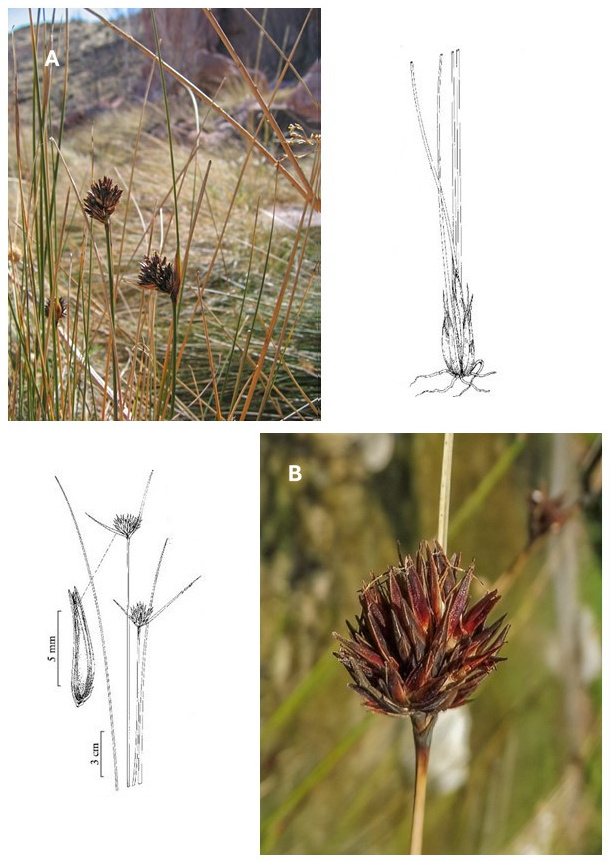
Scirpus
Bulrush, Tule
Plants leafy perennials, rhizomatous or not; culms single or clumped, somewhat trigonous, solid, unbranched, 30–200 cm tall; leaves basal and cauline or strictly cauline, 3-ranked; sheaths closed, mostly ligulate; blades well-developed, flat or V-shaped, smooth, margins and midrib smooth or scabrous, lower surface keeled; involucral bracts usually 3, mostly spreading, leaflike, smooth or with scabrous margins and midribs; inflorescences compound cymes, mostly terminal, sometimes axillary in 1–3 distal leaves; spikelets numerous, oblong or subglobose, small, less than 3.5 (5) mm diameter; scales 10–50, spirally arranged, uniform in length, glabrous, lacking keels, shortly awned or mucronate from an obtuse apex, each subtending a flower, deciduous; flowers perfect; perianth bristles 0–6, straight or curled, smooth or retrorsely barbed, white or brown, 0–8 mm long, shorter to longer than the achene, usually persistent; stamens 1–3; filaments often persist and may be confused with the bristles, but they are thicker and do not taper; styles mostly trifid or rarely bifid, linear, base persistent as the achene beak; achene trigonous, biconvex or plano-convex, minutely papillose, apiculate or short-beaked, mostly pale brown, 0.6–1.8 mm long.
A genus of about 35 species worldwide, primarily in North America, Eurasia, Australia and the Pacific Islands. Widespread in the Intermountain Region. Seeds of these species are easily transported by water and animals, including humans. Interspecific hybrids have elongated inflorescences, low fertility, and the achenes are often empty.
See Figure 61.
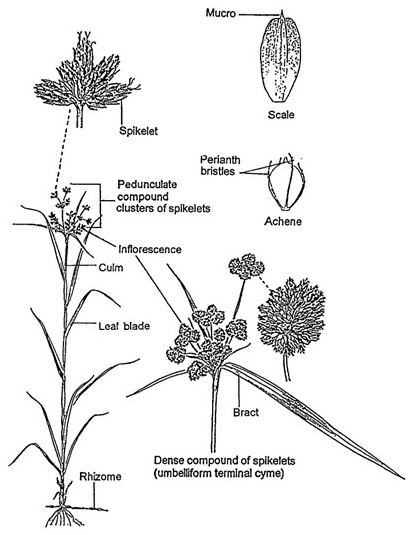
Key to Intermountain Scirpus species
- 1. Inflorescence diffuse, spikelets clustered in small, distinct floral heads; scales mucronate.Scirpus. microcarpus
- 1. Inflorescence more compact, spikelets undistinguishable in dense globose clusters at least 1 cm thick; scales tapered at the apex, the midrib extending as an awn.Scirpus pallidus
Scirpus microcarpus
Panicled bulrush, Red-tinge bulrush, Smallfruit bulrush
Scirpus microcarpus var. longispicatus M. Peck, S. m. var. rubrotinctus (Fernald). M.E. Jones, S. rubrotinctus Fernald, S. sylvaticus L. var. digynus Boeckeler
Coarse, leafy-stemmed perennials arising singly or few together from stout, reddish, creeping rhizomes with prominent nodes; culms erect, obscurely triquetrous to semi-terete, smooth to scabrous above, 6–17 dm tall, 6–20 mm thick near the base.
Several, distributed along the stem; sheaths hyaline ventrally below the mouth, tinted with reddish-purple dots; blades grasslike, wide, flat, margins scabrous, 1.5–6 dm long, 6–20 mm wide, often surpassing the culms.
2–5, spreading, leaflike, unequal, sheathless, green to black or red basally, the longest 1–3 dm long, 2–5 mm wide, often surpassing the inflorescence.
Terminal, compound umbelliform terminal cymes, spreading, flexuous, 8–15 cm wide; rays divaricate or ascending; spikelets numerous, sessile in small, pedunculate clusters of 2–18, oval, small, pale brown to grayish brown, 2–6 (8) mm long, 1.2–3.5 mm wide.
Spirally arranged, oblong, apex acute to truncate-mucronate, largely hyaline and cellular reticulate, blackish, especially distally, or greenish black with a green or pale, ill-defined to prominent midstripe, 1–2.3 mm long, 0.8–1.2 mm wide, deciduous.
Perfect; perianth bristles 4–6, stout, straight or curved, minutely and sparsely retrorsely barbellate, brownish, slightly surpassing the achene, rarely exserted beyond the scale; stamens 2; 1.2 mm long; styles bifid for one-half to two-thirds their length.
Broadly ovoid to obovoid, lenticular, smooth, pale brownish or creamy white, commonly 0.7–1.6 mm long, 0.8–1.0 mm wide, including the short stylar apiculus.
Fruiting: June–August.Wet soil, marshes, streambanks, pond and lake margins, canals, and meadows from sea level to 2900 m elevation. Southern Canada, south through the western United States, especially at higher elevations, eastward to New England; Mexico, eastern Asia. Widespread in the Intermountain Region.
S. cyperinus has a grayish white, somewhat cottony appearance at maturity due to the long perianth bristles and has a more northern distribution.
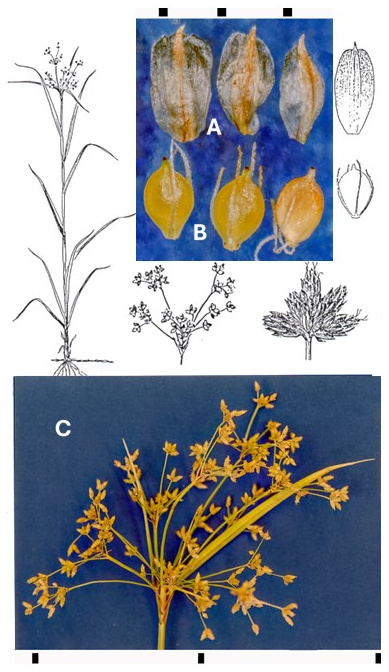
Scirpus pallidus
Pale bulrush, Cloaked bulrush
Scirpus atrovirens Willdenow var. pallidus Britton
Coarse, robust, leafy-stemmed perennials from short, stout rhizomes; culms loosely clustered, erect, triquetrous, solid, smooth, 4–18 dm tall, 0.5–1 cm thick.
Several, cauline; sheaths hyaline just below the V-shaped mouth, greenish or pale; blades flat with scabrous margins, 20–55 cm long, 6–18 mm wide.
2–4, spreading, leaflike, unequal, sheathed or sheathless, bases green, margins green to brown, the longest often more than 10 cm, exceeding the inflorescence.
Terminal, compound, umbelliform cyme with dense, round to oblong clusters of spikelets to 1 cm thick, sessile or on ascending or drooping rays up to 10 cm long; spikelets mostly ovoid, greenish-brown or blackish, 3–4.5 mm long, about 1.5 mm wide.
Spirally arranged, ovate-elliptic, tapered at the apex, glabrous, hyaline and cellular-reticulate, light brown, greenish black on the upper margins, midrib prominently thickened and excurrent as a short awn, usually 1.5–3 mm long, including the 0.5-mm awn, 1–1.5 mm wide.
Perianth bristles mostly 6, stout, straight or curved, minutely and retrorsely barbellate above the middle, tan to reddish brown, equaling or often shorter than the achene, enclosed within the scale, persistent. Stamens 2; anthers about 1 mm long; styles trifid.
Oblong obovoid, unequally trigonous, abruptly tapered toward the apex, base somewhat cuneate, pale brown to stramineous or whitish, 0.8–1.2 mm long, 0.5–0.8 mm wide including the minute stylar apiculus.
Fruiting: June–August.Wet areas, pond and ditch banks, marshes, and stream edges from sea level to 2900 m elevation. Southern Canada, south through the western and midwestern United States. Scattered throughout the Intermountain Region, but absent from Nevada. It may hybridize with S. atrovirens, which it resembles.
S. microcarpus has a diffuse inflorescence with the spikes clustered in smaller, distinguishable heads, and mucronate scales.
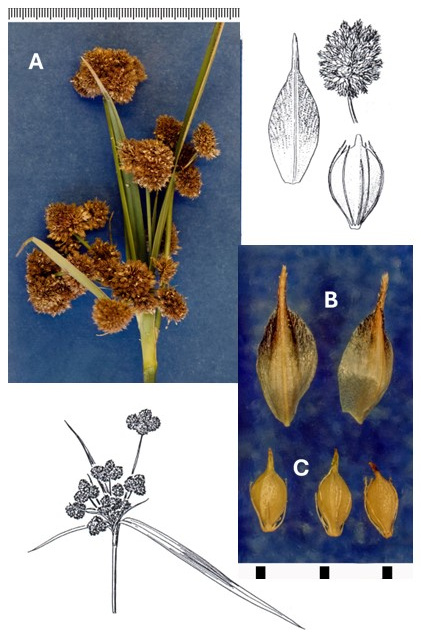
Trichophorum
Bulrush, Clubrush, Trichophore
Perennial clumping plants; rhizomes present or lacking; culms trigonous or terete,
10–50 cm or taller; leaves basal or subbasal; sheaths ligulate, not fibrous, mostly bladeless or distal sheaths with linear blades to 10 mm long, 1 mm wide; inflorescence 1, terminal; spikelet 1; involucral bracts generally 1, about as long as spikelet, scale-like, suberect, apex mucronate or short awned; scales 3–9, spirally arranged, each subtending a flower; flowers few, perfect; perianth bristles 0–6, smooth to scabrous, whitish, shorter than to about 20 times as long as the achene; stamens 3; styles trifid, linear, base persistent; achenes ovoid, trigonous or plano-convex, minutely apiculate, brown.
A circumpolar and circumboreal genus of nine species, six in North America. Occurs in North America, the Andean mountains, and tropical mountains of southeast Asia.
See Figure 64.
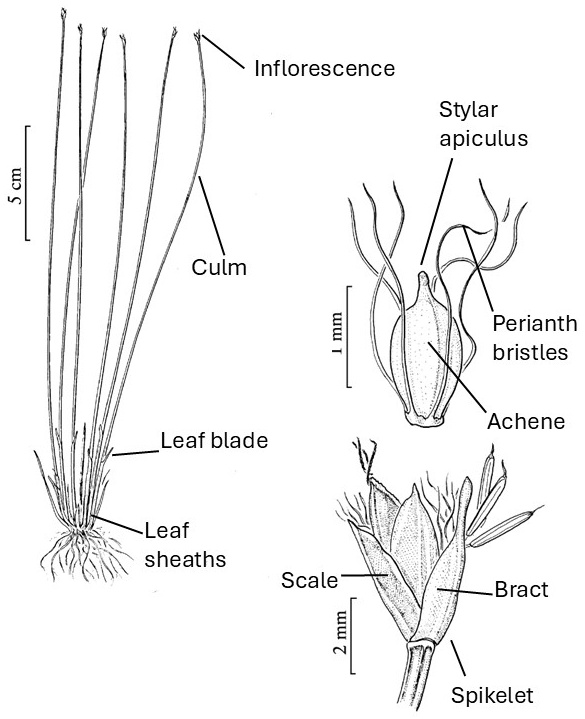
Trichophorum cespitosum
Tufted bulrush, Deerhair bulrush, Tufted clubrush
Scirpus bracteatus Bigelow, S. cespitosus L.
Very densely tufted perennial; rhizomes short or lacking; culms erect, slender, stiff, subterete, smooth, unevenly ribbed, 1–5 dm tall, about 1 mm thick, covered at the base by persistent leaf sheaths.
Basal leaves bladeless, reduced to several scalelike, shiny, grayish or brown sheaths; upper leaf borne toward the base, blade short to rudimentary, channeled, light green, (1.5) 4–6 (8) mm long, shorter than the culms.
Light to medium brown, deciduous, 3.3–4.5 mm long, prominently nerved with a broad, blunt awn, subequal to or exceeding the spikelet.
A terminal, solitary spikelet, oblong, 3–9 flowered, light to medium brown or stramineous, 3.3–7 mm long, 1.2–3 mm wide.
Lanceolate, mucronate to acute at the tip, awnless, mostly hyaline-scarious, reddish or light to dark brown, 2–3 mm long, 1–1.2 mm wide.
Perianth bristles 6, smooth to scabrous, white or distally brownish, up to twice as long as the achene and often exserted at maturity, deciduous before the achene; stamens; 3, anthers 1.5–2.6 mm; styles trifid.
Broadly obovoid with a short, dark, stylar apiculus, unequally trigonous with blunt angles, smooth, medium to dark brown at maturity, about 1.5 mm long, less than 1 mm wide.
Fruiting: July–August.Sphagnum bogs, fens, marshes, and peaty meadows from sea level to 3400 m; circumboreal, extending south in North America to North Carolina, western Oregon, western Montana, the Sawtooth Mountains of central Idaho, and the Uinta Mountains of Utah.
Similar to the genus Eleocharis in having a small, solitary, terminal spike but differing in having an involucral bract, rudimentary leaf blade, stylar apiculus, and lacking a tubercle capping the achene.
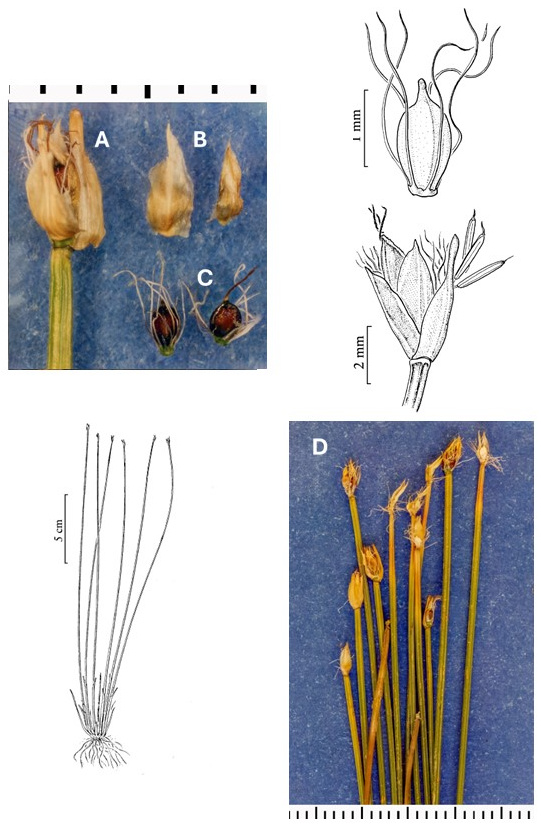
Glossary
Online botanical glossaries
- Beentje, Henk. 2010. The Kew plant glossary an illustrated dictionary of plant terms. Royal Botanic Gardens, Kew. 160 p. https://staugorchidsociety.org/PDF/The-Kew-Plant-Glossary-an-Illustrated-Dictionary-of-Plant-Terms-by-Beentje-Henk-z-lib.org_.pdf
- Harris, James G.; Harris, Melinda Woolf. 1999. Plant identification terminology an illustrated glossary. Spring Lake, UT: Spring Lake Publishing. 197 p.
- Hickey, M. 2001. The Cambridge Illustrated Glossary of Botanical Terms. Cambridge University Press. 208 p.
- Mori, S.A. & N P. Smith. 2012 onward. The New York Botanical Garden’s glossary for vascular plants Bronx, NY: Virtual Herbarium of The New York Botanical Garden., Bronx. https://sweetgum.nybg.org/science/glossary/ (Terms are illustrated)
- Stevens, P.F. 2017 onward. Angiosperm Phylogeny Website, version 14. St. Louis: Missouri Botanic Garden. http://www.mobot.org/MOBOT/research/APweb/top/glossarya_h.html
Terms commonly used to describe Cyperaceae species
- Abaxial
- The side of a structure facing away from the axis that bears it (e.g., the lower side of a leaf); opposite of adaxial.
- Achene
- A small, dry, thin-walled, one-celled, one-seeded, indehiscent fruit from a superior ovary with a single closed carpel. The seed is attached to the pericarp at one point.
- Acuminate
- Gradually tapered to a long, narrow tip.
- Acute
- Sharp-pointed, the tip forming an angle of less than 90 degrees; the margins near the tip are linear.
- Adaxial
- The side of a structure facing toward the axis that bears it (e.g., the upper side of a leaf); opposite of abaxial.
- Amphicarpic
- Plants that produce seeds above and below ground.
- Androgynous
- Having staminate flowers above the pistillate flowers in the same inflorescence. In the Cyperaceae, the staminate flowers are above the pistillate flowers.
- Angiosperm
- The flowering plants. Plants that produce ovules enclosed in an ovary.
- Annual
- A plant that germinates, flowers, and sets seed during a single year or growing season and then dies.
- Anther
- The pollen-bearing portion of the stamen.
- Anthocyanin
- Water-soluble flavonoid pigments formed in the vacuoles of plant cells that vary in color depending on pH and other factors.
- Antrorse
- Directed forward or upward, often referring to hairs or barbs.
- Apiculate
- Ending abruptly in a short, pointed tip.
- Arachnoid
- With hairs that are cobwebby or long, white, and usually tangled.
- Attenuate
- Very gradually tapering or prolonged to a narrow point; more gradual than acuminate.
- Awn
- A hair- or bristle-like appendage at the apex of a structure (e.g. spikelet scales of the Cyperaceae).
- Axil
- The angle between the axis of a stem and any organ arising from it (e.g. a leaf petiole)
- Axis
- The main stem, stalk, or culm of a plant. The main structure (e.g., of the root, stem, or inflorescence) around which organs of the plant develop.
- Basal
- Toward the base, proximal, or arising from the base.
- Barbellate
- Finely barbed or with short, stiff hairs.
- Beak
- A firm, prolonged appendage or projection, especially of a fruit or seed.
- Biennial
- A plant that completes its life cycle in two years, usually flowering and setting seed the second year.
- Bifid
- Deeply two-cleft, two-lobed, or two-branched, usually at the apex. The two parts are usually equal.
- Bifurcate
- Divided into two forks or branches.
- Blade
- The broad and usually flat, expanded part of a leaf.
- Bract
- A modified or specialized leaf subtending a flower, inflorescence, or part of an inflorescence.
- Bristle
- A sharp, stiff, usually straight, hairlike structure (e.g., modified perianth parts in some Cyperaceae).
- Bulbil
- A small bulblike vegetative reproductive structure produced by some plants in the axils of the leaves or in place of flowers.
- Capitate
- Headlike; an inflorescence with a head or dense cluster of usually sessile flowers; a rounded stigma like the head of a pin.
- Carpel
- The fertile leaf of an angiosperm that bears the ovules; one or more carpels form the pistil.
- Cauline
- Of or on the stem.
- Cellular-reticulate
- With small pits or compartments forming a network (referring to a surface).
- Cellular-roughened
- With small pits or compartments, the surface uneven.
- Cespitose
- Growing in low, dense tufts; clumped or clustered.
- Chaffy
- Having a thin, dry, membranous texture; descriptive of papery scales or bracts.
- Channeled
- Marked with one or more deep longitudinal grooves.
- Ciliate
- With a fringe of hairs along the margin.
- Circumboreal
- Occurring throughout the northern latitudes of the Northern Hemisphere.
- Compound leaf
- A leaf with two or more distinct leaflets.
- Concave
- With the surface bowed inward as the inside of a bowl (opposite of convex).
- Confluent
- Merging together; blending into one.
- Connective
- Part of the stamen that connects the anther cells (pollen sacs). It is distinct from the filaments but sometimes referred to as the filament extension.
- Convex
- With the surface bowed outward as the outside of a bowl (opposite of concave).
- Convolute
- Overlapping structures (e.g., the petals and sepals in a flower bud rolled lengthwise and arranged such that each one overlaps the next (appearing like a closed umbrella).
- Cosmopolitan
- Occurring worldwide; belonging to the world; not local.
- Cross-rugulose
- Slightly wrinkled laterally.
- Culm
- The stem of a grass or grasslike plant.
- Cuneate
- Wedge-shaped and tapering gradually with the narrow end at the point of attachment forming an angle less than 90o.
- Cylindric
- Having the form of a cylinder; tubular or rod-shaped.
- Cyme
- A determinate inflorescence or flower cluster, often flat or convex-topped in which the central or the terminal flower opens first, followed successively by axillary buds below the central flower.
- Cymose
- Bearing cymes or cymelike (see cyme).
- Deciduous
- Not persistent; falling off seasonally.
- Decumbent
- With a prostrate or curved base and an erect or ascending tip. Stems that spread horizontally with the apex growing upwards.
- Decurrent
- Leaf or stipule bases that continue downward along the stem as wings or lines.
- Deltoid/deltate
- Shaped somewhat like an equilateral triangle.
- Diffuse
- Loosely or widely branching and spreading.
- Dioecious
- Bearing staminate (male) and pistillate (female) flowers on different plants; with male and female plants (see monoecious).
- Disarticulate
- Separating from a pre-existing point of articulation or an abscission joint at maturity.
- Distal
- Toward or at the tip or end furthest from the point of attachment (opposite of proximal or basal end).
- Distichous
- Arranged in two vertical ranks.
- Divaricate
- Widely divergent or spreading from the axis.
- Divergent
- Gradually spreading from the axis.
- Dorsal
- Pertaining to the back, or upper surface relative to leaves (adaxial).
- Dorsiventrally flattened
- Front (ventral) and back (dorsal) surfaces flattened.
- Elliptic
- With the form of a flattened circle, widest in the center and with the ends equal and rounded.
- Embryo
- The rudimentary plant within a seed.
- Emergent
- Rising from or standing in water.
- Endosperm
- Food storage tissue of a seed.
- Erose
- With margins finely and irregularly toothed or eroded.
- Excurrent
- Running through to the apex and beyond, as a midrib projecting beyond an apex (e.g., the midrib of some bracts).
- Exserted
- Projecting beyond the containing structure.
- Filament
- Threadlike; the stalk of the stamen that supports the anther; generally fine or threadlike.
- Filiform
- Threadlike; long, slender.
- Flaccid
- Weak, limp, lax.
- Floret
- A small flower; a single flower within an inflorescence as in the spikelet of grasses or sedges.
- Floriferous
- Bearing flowers.
- Glabrous
- Smooth, without hairs or scales.
- Hirtellous
- Minutely hirsute (minutely stiff or coarse hairs).
- Hyaline
- Thin and translucent or transparent.
- Hypogynous
- With the sepals, petals, and stamens inserted below the pistil and free from it.
- Indurate
- Hard (Indurated--Hardened).
- Inflorescence
- A flower-bearing branch or network of branches.
- Involucel
- A secondary involucre as at the secondary branch base in a compound umbel.
- Involucre
- A whorl of separate or united bracts or leaves subtending a flower or an inflorescence.
- Involute
- Rolled inward toward the upper side; usually refers to leaves or bracts.
- Keel
- A projecting longitudinal ridge or rib along the midrib of a leaf, bract, or petal; like the keel of a boat.
- Lacerate
- With the margins irregular, appearing to have been torn. The margins are more deeply shredded than described for erose.
- Lamella
- A thin, flattened layer, scale or membrane.
- Lamellar
- Consisting of thin layers.
- Lanceolate
- Lance-shaped; narrowly ovate, broadest toward the base, and tapering to the apex, several times as long as broad (3:1 or greater).
- Lenticular
- In the shape of a lentil or biconvex lens; circular in cross-section.
- Lustrous
- Shining, having luster.
- Membranaceous (membranous)
- Thin, soft, pliable, and often almost translucent.
- Midrib
- The center or main rib of a leaf or other structure; the main vascular bundle and support structure; the continuation of the petiole that runs the full length of the leaf.
- Midstripe
- The area along the midrib or the middle of a leaf, bract, or scale.
- Monoecious
- With staminate (male) and pistillate (female) flowers borne on the same plant.
- Mucro
- A short, abrupt tooth-like tip.
- Mucronate
- Tipped with a short, sharp, stiff point or mucro.
- Mucronulate
- Diminutive of mucronate, tipped with a very short, stiff point.
- Nerve
- A simple or unbranched vascular bundle in a leaf, bract, or another flat organ, often visible on the surface (see vein).
- Node
- The point on the stem where leaves. branches, and inflorescences originate; a joint on a stem; the point on an axis that bears other structures.
- Nodose
- With knobby or knotty swellings.
- Nodulose
- Diminutive of nodose; provided with minute knobs or knots.
- Ob
- Latin prefix, meaning in a reverse direction; the opposite condition relative to the remainder of the word.
- Oblanceolate
- Lanceolate, but with the narrowest part toward the base.
- Oblique
- An asymmetrical leaf that is larger on one side of the midrib than the other.
- Obliquely cleft
- An opening with the sides unequal or slanting.
- Obovate
- Ovate but attached at the narrow end (two dimensional).
- Obovoid
- A three-dimensional figure, obovate in outline.
- Obsolete
- Rudimentary, scarcely detectable, or completely lacking.
- Obtuse
- Blunt to almost rounded at the end, forming an angle of 90 to 180 degrees.
- Orbicular
- Circular or nearly so in outline (two dimensional); globose, spherical (three dimensional).
- Ovary
- The expanded lower portion of the pistil (gynecium) that contains the ovule(s) or seeds and becomes the fruit.
- Ovate
- Flat and having the outline of an egg; broadest toward the base (two dimensional).
- Ovoid
- An egg-shaped object ovate in outline.
- Ovule
- The structure within the ovary of a flower that becomes a seed after fertilization.
- Panicle
- An indeterminate inflorescence whose primary axis bears branched secondary axes, a compound raceme or corymb.
- Paniculiform
- With the form of a panicle.
- Papillose
- Bearing minute rounded or fingerlike projections.
- Pedicel
- The stalk of a single flower in an inflorescence or flower cluster.
- Peduncle
- The lower, unbranched stalk of a solitary flower or inflorescence (flower cluster). It is distinct from the rachis of an inflorescence.
- Perennial
- A plant that lives more than two growing seasons.
- Perfect
- A flower with functional stamens and pistils.
- Perianth (tepals)
- Collective terms for the calyx (sepals) and corolla (petals), especially when they are indistinguishable, incomplete, or modified.
- Perigynium
- (plural = perigynia) —An inflated saclike structure enclosing the ovary (achene) of female flowers and fruits in Carex.
- Pistil
- The female (seed bearing) structures of a flower, consisting usually of an ovary and one or more styles and stigmas.
- Pistillate flower
- A female flower with one or more pistils, but no fertile stamens.
- Plano-convex
- Flat on one surface or side, rounded on the opposite side.
- Proximal
- Toward the base or basal (opposite of distal); toward the point of origin or attachment.
- Puberulent
- Minutely pubescent; the hairs barely visible to the naked eye.
- Pubescent
- Covered with downy hairs.
- Punctate
- Dotted with depressions or translucent glands.
- Puncticulate/punctulate
- Minutely punctate, diminutive of punctate.
- Rachilla
- The axis of the spikelet in grasses and some Cyperaceae.
- Rachis
- A central or main elongated axis of an inflorescence or a compound leaf.
- Ray
- A stalk, a pedicel or a peduncle within an umbel.
- Reticulate
- In the form of a network (describes a surface).
- Retrorse
- Bent or turned abruptly backward or downward (recurved); pointing away from the apex.
- Rhizomatous
- Bearing rhizomes (see rhizome).
- Rhizome
- A creeping, perennial, usually horizontal underground stem from which roots and shoots emerge.
- Rhombic
- Diamond shaped, an equilateral parallelogram.
- Rib
- A primary or prominent vein (vascular bundle) of a leaf, bract, or other structure.
- Rudimentary
- Imperfectly developed, usually minute; vestigial.
- Rufous
- Reddish brown.
- Rugose
- Deeply wrinkled.
- Rugulouse
- Slightly rugose, finely wrinkled.
- Scabrous or scabrid
- Rough or harsh to the touch due to the presence of very short, stiff hairs or short, sharp projections.
- Scaberulous
- slightly or minutely scabrous.
- Scale
- In Cyperaceae: Small, thin, reduced and rudimentary leaves arranged spirally or distichously on the rachilla of the spikelets and subtending the florets (some may be empty).
- Scarious
- Thin, dry, membranous, and chaffy in texture, not green.
- Septate
- Divided by one or more transverse partitions.
- Sessile
- Without a stalk, attached directly at the base.
- Sheath
- The basal portion of the rush, sedge, or grass leaf that forms a tubular cover surrounding the stem.
- Spicate
- An inflorescence arranged in the form of or resembling a spike.
- Spike
- An unbranched, elongate, indeterminate inflorescence with sessile (stalkless) or subsessile flowers along the rachis maturing from the base upwards. In the Cyperaceae the inflorescence may be an aggregation of spikelets or a single spikelet.
- Spikelet
- A small spike or a secondary spike in a compound inflorescence.
- Stamen
- The male reproductive component of a flower, consisting of an anther and a filament.
- Staminate flower
- A male flower with one or more stamens (no pistils).
- Stigma
- The usually sticky pollen-receptive surface of the pistil where the pollen germinates; usually a small head at the apex of the style but may be sessile on the ovary.
- Stipitate
- Provided with a stalk-like base that is not a pedicel, peduncle or petiole.
- Stramineous
- Straw-colored (tan or light brown).
- Striate
- Striped with fine parallel longitudinal lines, furrows or ridges.
- Stylar apiculus
- The basal part of the style that may remain to cap the achene as a small point following loss of the distal portion of the style.
- Style
- A slender stalk that connects the stigma and the ovary through which the pollen tube grows following fertilization.
- Sub
- Latin prefix, meaning under or below; almost, or not quite.
- Subumbellate
- A modified umbel with flowers arising from slightly different points. The inflorescence appears clustered, rather flat, and even topped.
- Swale
- A hollow, or depression, especially one in a wet marshy area.
- Temperate
- Having a moderate or mild climate.
- Tepals
- Units of an undifferentiated perianth; the sepals and petals are similar and not easily distinguished.
- Terete
- Cylindrical and somewhat circular in cross section.
- Terrestrial
- A plant growing with its shoot in the air and its root system in soil; not aquatic.
- Tooth
- A small projection at the sheath apex in some Eleocharis species.
- Trifid
- Three-branched or lobed; divided into three parts.
- Trigonous
- Three-angled in cross section with the angles obtuse.
- Triquetrous
- Triangular in cross section with three acute, sharp, or projecting angles.
- Truncate
- Cut squarely across at the apex or base.
- Tuber
- The thickened branch of an underground stem or root (then referred to as a root tuber).
- Tubercle
- A small wart-like projection or swelling; this describes the basal part of the style capping the achene in some members of the Cyperaceae.
- Tufted
- Growing in tufts or clumps; cespitose.
- Umbel
- An inflorescence (flower cluster) in which three to many nearly equal pedicels (stalks) radiate from a nearly common point (simple umbel) at the top of the peduncle.
- Umbellate
- Bearing umbels; umbel-like.
- Umbelliform
- In the form of an umbel; having the form, but not the structure of an umbel.
- Vascular
- Pertaining to the conducting tissues of vascular plants (phloem for food and xylem for water).
- Vasculated
- Containing plant conducting tissues.
- Vein
- Conducting tissue in plants; visible as threadlike structures or strands in leaves and flower parts (see nerve).
- Ventral
- Pertaining to the abaxial or lower surface of a leaf or other structure.
- Villose
- Pubescence with long, soft, weak, often bent or curved, but not matted hairs.
Index of Scientific Names
Accepted names are in bold; synonyms lead to the species they refer to.
- Amphiscirpus
- Amphiscirpus nevadensis
- Bolboschoenus
- Bolboschoenus fluviatilis
- Bolboschoenus glaucus
- Bolboschoenus maritimus subsp. fluviatilis
- Bolboschoenus maritimus subsp. paludosus
- Carex
- Carex bipartita
- Carex elynoides
- Carex myosuroides
- Carex simpliciuscula
- Cladium
- Cladium californicum
- Cladium mariscus var. californicum
- Cyperaceae
- Cyperus
- Cyperus acicularis
- Cyperus acuminatus
- Cyperus alterniflorus
- Cyperus aristatus
- Cyperus arundinaceus
- Cyperus bipartitus
- Cyperus cupreus
- Cyperus difformis
- Cyperus erythrorhizos
- Cyperus esculentus
- Cyperus esculentus var. heermannii
- Cyperus esculentus var. leptostachyus
- Cyperus halei
- Cyperus hansenii
- Cyperus inflexus
- Cyperus latiflorus
- Cyperus niger var. rivularis
- Cyperus occidentalis
- Cyperus rivularis
- Cyperus schweinitzii
- Cyperus schweinitzii var. uberior
- Cyperus squarrosus
- Cyperus stenolepis
- Cyperus strigosus
- Cyperus washingtonensis
- Dulichium
- Dulichium arundinaceum
- Eleocharis
- Eleocharis acicularis
- Eleocharis acicularis var. bella
- Eleocharis acicularis var. minima
- Eleocharis bella
- Eleocharis bolanderi
- Eleocharis calva
- Eleocharis coloradoensis
- Eleocharis disciformis
- Eleocharis engelmannii
- Eleocharis engelmannii var. detonsa
- Eleocharis engelmannii var. monticola
- Eleocharis erythropoda
- Eleocharis fernaldii
- Eleocharis flavescens var. flavescens
- Eleocharis flavescens var. thermalis
- Eleocharis macrostachya
- Eleocharis monticola
- Eleocharis monticola var. levisita
- Eleocharis montevidensis var. bolanderi
- Eleocharis montevidensis var. disciformis
- Eleocharis montevidensis var. parishii
- Eleocharis obtusa
- Eleocharis obtusa var. ellipsidalis
- Eleocharis obtusa var. gigantea
- Eleocharis obtusa var. jejuna
- Eleocharis palustris
- Eloecharis parishii
- Eleocharis pauciflora
- Eleocharis pauciflora var. fernaldii
- Eleocharis pauciflora var. suksdorfiana
- Eleocharis parvula var. anachaeta
- Eleocharis parvula var. coloradoensis
- Eleocharis perlonga
- Eleocharis quinqueflora
- Eleocharis quinqueflora subsp. fernaldii
- Eleocharis quinqueflora var. suksdorfiana
- Eleocharis rostellata
- Eleocharis rostellata var. congdonii
- Eleocharis rostellata var. occidentalis
- Eleocharis smallii
- Eleocharis suksdorfiana
- Eleocharis thermalis
- Eleocharis xyridiformis
- Elyna bellardii
- Eriophorum
- Eriophorum altaicum var. neogeum
- Eriophorum angustifolium
- Eriophorum angustifolium subsp. angustifolium
- Eriophorum chamissonis
- Eriophorum chamissonis var. aquatile
- Eriophorum gracile
- Eriophorum latifolium var. viridicarinatum
- Eriophorum leucocephalum
- Eriophorum polystachion
- Eriophorum russolum subsp. rufescens
- Eriophorum scheuchzeri
- Eriophorum viridicarinatum
- Fimbristylis
- Fimbristylis puberula
- Fimbristylis spadicea
- Fimbristylis thermalis
- Hemicarpha
- Hemicarpha micrantha
- Hemicarpha subsquarrosa
- Isolepis
- Isolepis subsquarrosa
- Kobresia
- Kobresia bellardii
- Kobresia bipartita
- Kobresia myosuroides
- Kobresia simpliciuscula
- Lipocarpha
- Lipocarpha aristulata
- Lipocarpha micrantha
- Mariscus
- Mariscus californicus
- Marisucs schweinitzii
- Mariscus stenolepis
- Mariscus strigosus
- Pycreus rivularis
- Schoenoplectiella
- Schoenoplectiella saximontana
- Schoenoplectus
- Schoenoplectus acutus
- Schoenoplectus acutus var. acutus
- Schoenoplectus acutus var. occidentalis
- Schoenoplectus americanus
- Schoenoplectus bergsonii
- Schoenoplectus californicus
- Schoenoplectus fluviatilis
- Schoenoplectus glaucus
- Schoenoplectus heterochaetus
- Schoenoplectus pungens
- Schoenoplectus pungens var. badius
- Shoenoplectus pungens var. longispicatus
- Schoenoplectus saximontanus
- Schoenoplectus subterminalis
- Schoenoplectus tabernaemontani
- Schoenoplectus validus
- Schoenus
- Schoenus albus
- Schoenus nigricans
- Scirpus
- Scirpus acicularis
- Scirpus acutus
- Scirpus americanus
- Scirpus ardea
- Scirpux atrovirens
- Scirpus atrovirens var. pallidus
- Scirpus bergsonii
- Scirpus bracteatus
- Scirpus californicus
- Scirpus campestris
- Scirpus cespitosus
- Scirpus chamissonis
- Scirpus chilensis
- Scirpus coloradoensis
- Scirpus cyperinus
- Scirpus flavescens
- Scirpus fluviatilis
- Scirpus glaucus
- Scirpus lacustris subsp. tabermontani
- Scirpus leucocephalus
- Scirpus maritimus var. fluviatilis
- Scirpus maritimus var. paludosus
- Scirpus micranthus
- Scirpus microcarpus
- Scirpus microcarpus var. longispicatus
- Scirpus microcarpus var. rubrotinctus
- Scirpus nevadensis
- Scirpus obtusus
- Scirpus olneyi
- Scirpus pacificus
- Scirpus pallidus
- Scirpus paludosus
- Scirpus palustris
- Scirpus pauciflorus
- Scirpus puberulus
- Scirpus pungens
- Scirpus quinqueflorus
- Scirpus rostellatus
- Scirpus rubrotinctus
- Scirpus saximontanus
- Scirpus scheuchzeri
- Scirpus spadiceus
- Scirpus subsquarrosus
- Scirpus subterminalis
- Scirpus sylvaticus var. digynus
- Scirpus tabernaemontani
- Scirpus validus
- Trichophorum
- Trichophorum cespitosum
- Trichophorum palustre var. calvum
Index of Common Names
- Alkali bulrush (Bolboschoenus maritimus subsp. paludosus)
- American bulrush (Schoenoplectus americanus)
- Awned flatsedge (Cyperus squarrosus)
- Awned halfchaff sedge (Lipocarpha aristulata)
- Bald spikerush (Eleocharis erythropoda)
- Bayonet grass (Bolboschoenus maritimus subsp. paludosus)
- Beaked spikerush (Eleocharis rostellata)
- Bearded flatsedge (Cyperus squarrosus)
- Bearded nutgrass (Cyperus squarrosus)
- Beautiful spikerush (Eleocharis bella)
- Bellard bog sedge (Kobresia myosuroides)
- Bellard kobresia (Kobresia myosuroides)
- Black bogrush (Schoenus nigricans)
- Black sedge (Schoenus nigricans)
- Blackhead sedge (Schoenus spp.)
- Blunt spikerush (Eleocharis obtusa)
- Blunt spikesedge (Eleocharis obtusa)
- Bog sedge (Kobresia spp.)
- Bogrush (Schoenus spp.)
- Bolander’s spikerush (Eleocharis bolanderi)
- Bulrush (Amphiscirpus spp., Schoenoplectiella spp., Schoenoplectus spp., Scirpus spp., Trichophorum spp.)
- California bulrush (Schoenoplectus californicus)
- California sawgrass (Cladium californicum)
- Chairmaker’s bulrush (Schoeplectus americanus)
- Chairmaker’s rush (Schoenoplectus pungens var. badius, S. p. var. longispicatus)
- Chamisso’s cottongrass (Eriophorum chamissonis)
- Chufa flatsedge (Cyperus esculentus)
- Cloaked bulrush (Scirpus pallidus)
- Clubrush (Trichophorum spp.)
- Colorado spikerush (Eleocharis coloradoensis)
- Common spikerush (Eleocharis palustris, Eleocharis macrostachya)
- Common threesquare bulrush (Schoenoplectus pungens var. badius, S. p. var. longispicatus)
- Common tule (Schoenoplectus acutus)
- Confusing spikerush (Eleocharis macrostachya)
- Cottongrass (Eriophorum spp.)
- Cottonsedge (Eriophorum spp.)
- Creeping spikerush (Eleocharis palustris)
- Deerhair bulrush (Trichophorum cespitosum)
- Delicate spikerush (Eleocharis bella)
- Dense cottongrass (Eriophorum scheuchzeri)
- Dulichium (Dulichium spp.)
- Dwarf spikerush (Eleocharis coloradoensis)
- Engelmann’s spikerush (Eleocharis engelmannii)
- False nutsedge (Cyperus strigosus)
- Few-flowered spikerush (Eleocharis quinqueflora)
- Fewflowered spikesedge (Eleocharis quinqueflora)
- Fimbristyle (Fimbristylis spp.)
- Fimbry (Fimbristylis spp.)
- Flatsedge (Cyperus spp.)
- Fringed style (Fimbristylis spp, F. spadicea)
- Giant bulrush (Schoenoplectus americanus)
- Great bulrush (Schoenoplectus tabernaemontani)
- Green-keeled cottongrass (Eriophorun viridicarinatum)
- Hairy fimbry (Fimbristylis puberula)
- Halfchaff sedge (Lipocarpha spp.)
- Hardstem bulrush (Schoenoplectus acutus)
- Hemicarpha (Lipocarpha spp.)
- Hot springs fimbry (Fimbristylis thermalis)
- Kobresia (Kobresia spp.)
- Many-spiked cottongrass (Eriophorum angustifolium subsp. angustifolium)
- Marisque (Cladium spp.)
- Naked-stemmed bulrush (Shoenoplectus spp.)
- Narrowleaf cottonsedge (Eriophorum angustifolium subsp. angustifolium)
- Needle spikerush (Eleocharis acicularis)
- Needle spikesedge (Eleocharis acicularis)
- Nevada bulrush (Amphiscirpus nevadensis)
- Nutgrass (Cyperus spp.)
- Olney’s threesquare bulrush (Schoenoplectus americanus)
- Pale bulrush (Scirpus pallidus)
- Pale spikerush (Eleocharis flavescens var. flavescens, E. macrostachya)
- Panicled bulrush (Scirpus microcarpus)
- Parish’s spikerush (Eleocharis parishii)
- Pretty spikerush (Eleocharis bella)
- Red-tinge bulrush (Scirpus microcarpus)
- Redroot flatsedge (Cyperus erythrorhizos)
- Redroot nutgrass (Cyperus erythrorhizos)
- Redrooted spikerush (Eleocharis erythropoda)
- River bulrush (Bolboschoenus fluviatilis)
- Rocky Mountain bulrush (Schoenoplectiella saximontana)
- Rough sand sedge (Cyperus schweinitzii)
- Rusty cottongrass (Eriophorum chamissonis)
- Salt marsh bulrush (Bolboschoenus maritimus subsp. paludosus)
- Sawgrass (Cladium spp.)
- Scheuchzeri’s cottongrass (Eriophorum scheuchzeri)
- Schweinitz cyperus (Cyperus schweinitzii)
- Schweinitz flatsedge (Cyperus schweinitzii)
- Sedge family (Cyperaceae)
- Sharpscale bulrush (Schoenoplectiella saximontana)
- Shealted cottongrass (Eriophorum scheuchzeri)
- Short-pointed flatsedge (Cyperus acuminatus)
- Simple bog sedge (Kobresia simpliciuscula)
- Simple kobresia (Kobresia simpliciuscula)
- Slender bulrush (Schoenoplectus heterochaetus)
- Slender cottongrass (Eriophorum gracile)
- Slender cottonsedge (Eriophorum gracile)
- Slender flatsedge (Cyperus bipartitus)
- Slender spikerush (Eleocharis acicularis)
- Smallflower halfchaff sedge (Lipocarpha micrantha)
- Small-flowered hemicarpha (Lipocarpha micrantha)
- Small-flowered bulrush (Lipocarpha micrantha)
- Smallfruit bulrush (Scirpus microcarpus)Softstem bulrush (Scoenoplectus tabernaemontani)
- Spikerush (Eleocharis spp., E. macrostachya)
- Spikesedge (Eleocharis spp., E. erythropoda, E. palustris)
- Strawcolored cyperus (Cyperus strigosus)
- Strawcolored nutgrass (Cyperus strigosus)
- Streamside flatsedge (Cyperus bipartitus)
- Sukdorf’s spikerush (Eleocharis suksdorfiana)
- Swaying bulrush (Schoenoplectus subterminalis)
- Tall cottongrass (Eriophorum angustifolium subsp. angustifolium)
- Tapertip flatsedge (Cyperus acuminatus)
- Tassel cottongrass (Eriophorum viridicarinatum)
- Thinleaf cottonsedge (Eriophorum viridicarinatum)
- Three-way sedge (Dulichium arundinaceum)
- Threesquare (Schoenoplectus spp., S. americanus, S. pungens var. badius, S. p. var. longispicatus)
- Torrey’s spikerush (Eleocharis rostellata)
- Trichophore (Trichophorum spp.)
- Tuberous bulrush (Bolboschoenus spp., B. glaucus)
- Tufted bulrush (Trichophorum cespitosum)
- Tufted clubrush (Trichophorum cespitosum)
- Tule (Schoenoplectus californicus, Scirpus spp.)
- Tule bulrush (Schoenoplectus acutus, S. validus)
- Twig-rush (Cladium spp.)
- Umbrella sedge (Cyperus spp.)
- Variable flatsedge (Cyperus difformis)
- Walking sedge (Eleocharis rostellata)
- Water bulrush (Schoenoplectus subterminalis)
- Water clubrush (Schoenoplectus subterminalis)
- White cottongrass (Eriophorum scheuchzeri)
- White cottonsedge (Eriophorum scheuchzeri)
- Yellow nutgrass (Cyperus esculentus)
- Yellow nutsedge (Cyperus esculentus)
- Yellow spikerush (Eleocharis flavescens var. flavescens)