

Description
Anchor Chains:
Used anchor chains are commonly utilized for brush and tree control, smoothing disturbed land (e.g., rootplowing), and/or seedbed preparation. Anchor chains are most effective in decadent stands of non-sprouting brush or thick stands of older trees that have encroached sagebrush habitats. Chaining has high production (acres/hr) and relatively low cost.
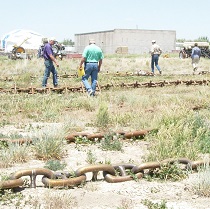
Chains are sized by the diameter of the round stock, and sizes range from 1 to 6 inches. Revegetation projects normally use chain sizes between 2 and 3 inches. Within this range, individual links are 12 to 18 inches in length and weigh between 25 and 86 pounds. The resulting weight per foot of chain is about 37 to 88 pounds, respectively. Anchor chain is usually sold in 90-foot lengths called “shots.” Further specifications on weight and link size are listed in Appendix.
Anchor chains are designed for use on large ships and off-shore drilling rigs. Used anchor chain is sometimes used for seedbed preparation in revegetation. Chains are sized by the diameter of the round stock. Revegetation projects normally use chain sizes between 2 and 3 inches. Within this range, individual links are 12 to 18 inches in length and weigh between 25 and 86 pounds. The resulting weight per foot of chain is about 37 to 88 pounds, respectively. Anchor chain is usually sold in 90-foot lengths called “shots.” Further specifications on weight and link size are listed in the Appendix.
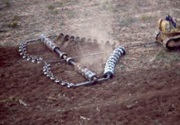
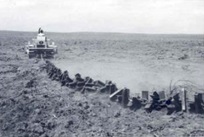
Modified chains are anchor chains with material added to the chain links for the purpose of increasing soil disturbance. Railroad rails, rods, blades, or disks have been used. A modification known as an “Ely Chain” uses 18 inch pieces of railroad rail (70 to 90 lb/yard) welded to each or every other chain link. A chain with disk blades welded to every other chain link is known as a “disk chain.” The optimum blade diameter is 28 inches. Diking chains use blades (12 x 4 inches) welded to opposite sides of every chain link to form small basins in the soil as the chain rotates. The combination of the disk and diking chain is called a disk-chain-diker. A unit with 20 disk blades is 35-feet wide and requires a 165- to 200-horsepower crawler tractor to pull it.
Chains (anchor or Ely) and chain harrows can be used to help prepare the seedbed and incorporate seed after wildfire. These methods are also effective for providing variable planting depths for diverse mixtures. Anchor chains are pulled in a U- or J- shape between two tractors or dozers and chain harrows are pulled by a single tractor or dozer. The chain harrow can be paired with a seed broadcaster for single pass seeding. Seeding only requires on one pass over the site to cover the seed, so seed should be applied before the final pass.
Modified Chains:
Modified chains are anchor or other chains with material added to the chain links for the purpose of increasing soil disturbance and/or uprooting more shrubs. Railroad rails, rods, blades, or disks have been used.
A modification known as an “Ely Chain” uses 18 inch pieces of railroad rail (70 to 90 lb/yard) welded to each or every other chain link. Chain harrows are similar to Ely chains, but designed to be used with a single tractor or dozer. It is not designed for tree removal. Header bars have tires to keep material from balling and scouring the ground.
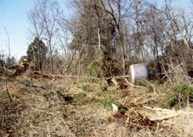
A chain with disk blades welded to every other chain link is known as a “disk chain.” The optimum blade diameter is 28 inches. Diking chains use blades (12 x 4 inches) welded to opposite sides of every chain link to form small basins in the soil as the chain rotates. The combination of the disk and diking chain is called a disk-chain-diker. A unit with 20 disk blades is 35-feet wide and requires a 165- to 200-horsepower crawler tractor for pulling. Elevated chaining reduces the force required to fell large trees. A roller ball 4 or 6 feet in diameter fabricated from ½ -inch-steel plate is placed in the center of a chain to support the chain above the ground. For elevated chaining to be effective, tree height should be 20 feet or more.
Application
Anchor Chains:
Anchor chains are pulled in a “U” shape between two tractors or dozers. The distance between the two tractors depends on the force required to pull the chain. An initial distance of 1/3rd the length of the chain is a rule-of-thumb. Size and length of the chain are factors as well as the size of the tractors. The distance between tractors can be greater when preparing a seedbed than when felling trees. Chain length is usually between 200 to 400 feet. Length can be adjusted easily with standard cutting and welding tools. Crawler tractors used for chaining vary from 140 to 350 horsepower. Production rates vary widely between 10 and 70 acres/hour. Chaining a second time in the opposite direction increases the effectiveness of removing tree stumps and can be useful in increasing soil disturbance for seeding. Chaining is not effective on trees with limber trunks. Chaining is very cost effective especially on large areas. It is more effective when combined with raking, herbicides, or fire to control sprouting shrubs.
Used anchor chain can be purchased from marine supply or salvage companies located in coastal cities of the United States.
Modified Chains:
Modified chains must rotate to achieve the desired results. Swivels fabricated in welding shops or modified from track rollers are attached to each end of the chain to allow chain rotation. Railroad-rail chains are towed in a “J” shape rather than a “U” to achieve maximum soil disturbance. Disk chains are towed on a diagonal to achieve optimum disking action. This type chain was developed to achieve tillage on debris- and shrub-littered rangelands at chaining costs. As the diking chain rolls, basins 4-inches deep are formed to collect rainfall. The combined disking and diking chains provide limited shrub control so they are used mainly in seedbed preparation (see also Anchor Chain and Modified Chain).
Used anchor chain and accessories can be purchased from marine supply or salvage companies located in coastal cities of the United States. Used railroad rails can be purchase from local train companies. Disk blades can be purchased from local tractor dealers. Local fabrication shops can modify the chains.
The chain harrow, although rugged, its tires, axels, and other parts can be damaged by large rocks and very rough terrain. Partial to complete non-sprouting shrub control can be attained by increasing or decreasing the number of passes across a site.
Considerations:
- There are several chain configurations. Options include Ely chains (welded cross bar) and smooth chains. Both types of chains are available in different link sizes depending on the desired weight. Ely chains and heavier chains cause more ground disturbance, and can also be more difficult to pull (heavier does not necessarily mean better).
- Ensure the tractor/dozer is paired appropriately with the chain type/weight, treatment, and terrain. Both horsepower and weight of tractors/dozers need to be specified on contracts to ensure they are capable of accomplishing the project.
- Chaining for shrub or tree control is most effective on older plants. Young, supple plants will often remain and be released. Chaining should not be used on sprouting shrubs.
- Tree chaining typically requires two passes in opposite directions to fully uproot trees. Full to partial control of shrub species is possible by increasing or decreasing the number of passes.
- Proper operation is critical. The chain should be pulled in a “U” or “J” shaped pattern. When pulled too straight, the chain is uplifted and skips over the vegetation and soil. Chains should maintain contact with the soil for maximum vegetation control.
Anchor chains are pulled in a “U” shape between two crawler tractors. The distance between the two tractors depends on the force required to pull the chain. An initial distance of 1/3rd the length of the chain is a rule-of-thumb. Size and length of the chain are factors as well as the size of the tractors. The tractors can be further apart when preparing a seedbed than when felling trees. Chain length is usually between 200 to 400 feet. Length can be adjusted easily with standard cutting and welding tools. Crawler tractors used for chaining vary from 140 to 350 horsepower. Production rates vary from 20 to 70 acres/hour. Chaining has been used effectively on debris-littered land to prepare seedbeds for broadcast seeding. Soil disturbance is usually in the top 1 to 2 inches of soil. Chaining a second time in the opposite direction is useful if soil disturbance for seeding is insufficient after the first pass. Chaining has also been used to cover the seed following broadcast seeding. Chain size and soil type and condition must be considered to achieve desired results. Dry, clay soil may require multiple passes with a heavy chain while one pass may be sufficient in sandy loam soil. Chains have a tendency to become buried in very sandy soils with dunes.
Modified chains must rotate to achieve the desired results. Swivels fabricated in welding shops or modified from track rollers are attached to each end of the chain to allow chain rotation. Railroad-rail chains are towed in a “J” shape rather than a “U” to achieve maximum soil disturbance. Disk chains are towed on a diagonal to achieve optimum disking action. This type chain was developed to achieve tillage on debris- and shrub-littered rangelands at chaining costs. As the diking chain rolls, diamond shaped basins 4-inches deep are formed at the rate of 18,000/acre to collect rainfall. The combination of disking and diking chains enhances seedbed preparation and provides limited shrub control. Seedbeds prepared with the disk-chain-diker have produced grass densities double those in seedbeds prepared by standard chaining, and the disk-chain-diker method is cost and energy effective.
Considerations:
- Ely chains and heavier chains cause more ground disturbance, and can be more difficult to pull. Ely or smooth chains should be pulled in a “U” or “J” shaped
pattern. If pulled too straight, the chain can skip over the ground. Soil contact should be maintain for best seed incorporation. - Although chain harrows are rugged, large rocks and very rough terrain can damage tires, axles and other parts.
Used anchor chain and accessories can be purchased from marine supply or salvage companies located in coastal cities of the United States. Used railroad rails can be purchased from local train companies. Disk blades can be purchased from local tractor dealers. Local fabrication shops can modify the chains.
Images



References / Additional Information
Cain, D. 1971. The Ely Chain. 1972 Proceedings of the Cal-Neva Wildlife Transactions: 82-86.
Roby, G.A.; Green, L.R. 1976. Mechanical methods of chaparral modification. Agric. Handbook 487. U.S. Department of Agriculture, Forest Service. 46 p.
Stevens, R.; Monsen, S.B. 2004. Chapter 9. Mechanical plant control. In: Monsen, S.B.; Stevens, R.; Shaw, N.L., comps. Restoring western ranges and wildlands, vol. 1. Gen. Tech. Rep. RMRS-GTR-136-vol-1. Fort Collins, CO: U.S. Department of Agriculture, Forest Service, Rocky Mountain Research Station. p. 65-88.
Wiedemann, H.T. 2007. Sculpting brush mechanically: Current state of the art. Rangelands. 29(5): 10-17.