

Description
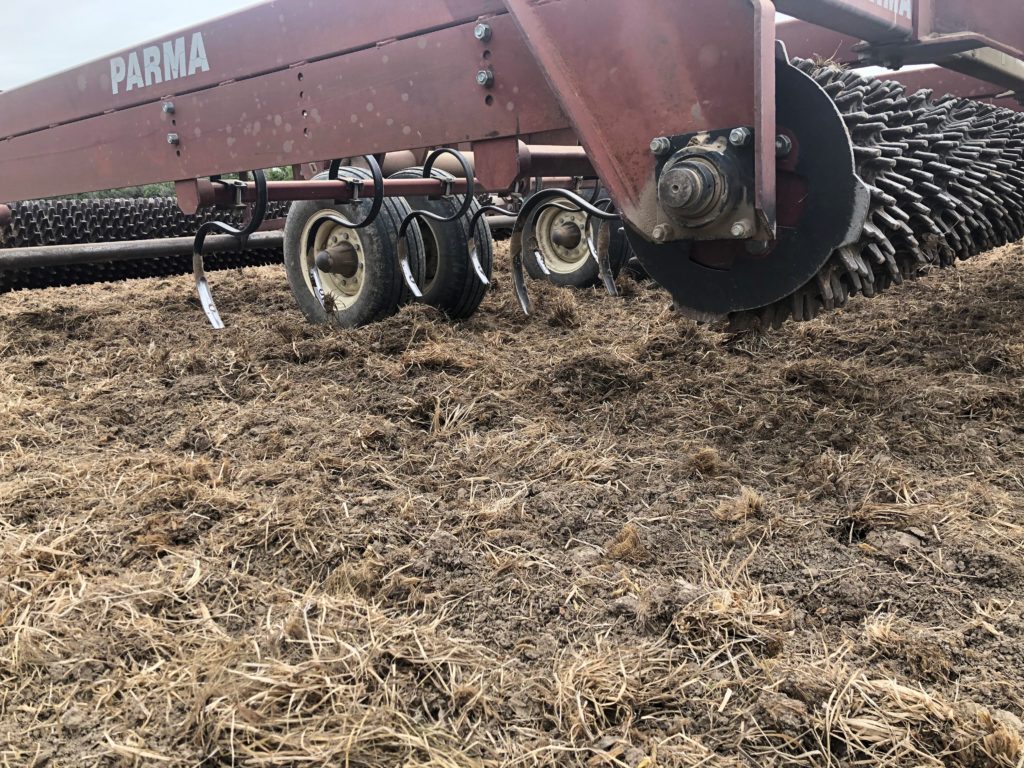
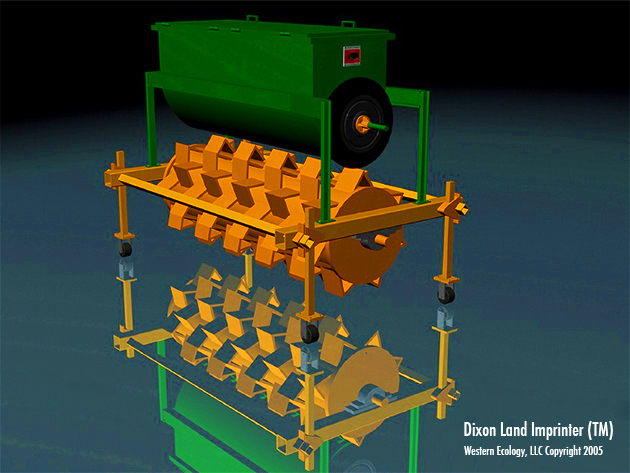
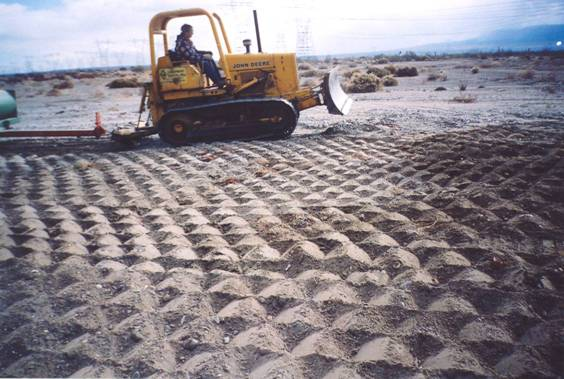
Land imprinters use a heavy drum with wedges to imprint small depressions into the soil to reduce runoff and erosion, increase infiltration, and crush small shrubs. Land imprinters are similar to roller choppers. They can be fabricated in widths from 6 to 10 feet, with drum diameters ranging from 24 to 36 inches. Land imprinters are pulled by a crawler or rubber-tired tractor.
Application
Land imprinters are used for seedbed preparation. The heavy drums firm soil while the wedges form depressions that trap rainfall and seed. They were developed for use in the desert Southwest but have been used elsewhere. A seeder can be attached to the front or rear frame. Land imprinters operate satisfactorily on rough terrain with small shrubs, but they are not suitable for dense stands of brush. They are not effective in moist, sticky soil. A current use is for seeding highway rights-of-way.
Images



References / Additional Information
Clary, W.; Johnson, T. 1983. Land imprinter results in Utah. In: 37th Annual Report of the Vegetative Rehabilitation and Equipment Workshop (VREW); 1983 February 13-14; Albuquerque, NM. Missoula, MT: U.S. Department of Agriculture, Forest Service Equipment Development Center: 23-24. (Report compares land imprinter and rangeland drill on wind-eroded site).
Dixon, R.M. 1980. Arid land seeding. In: 34th Annual Report of the Vegetative Rehabilitation and Equipment Workshop (VREW). 1980 February 10-11. San Diego, CA. Missoula, MT: U.S. Department of Agriculture, Forest Service Equipment Development Center: 8-9. (Report discusses Dixon rangeland imprinter, Laird rangeland imprinter, and rangeland imprinter).
Dixon, R.M. 1981. Arid land seeding. In: 35th Annual Report of the Vegetative Rehabilitation and Equipment Workshop (VREW); 1981 February 8-9; Tulsa, OK. Missoula, MT: U.S. Department of Agriculture, Forest Service Equipment Development Center: 12-13.
Dixon, R.M. 1982. Land imprinting activities. In: 36th Annual Report of the Vegetative Rehabilitation and Equipment Workshop (VREW); 1982 February 4-5; Denver, CO. Missoula, MT: U.S. Department of Agriculture, Forest Service Equipment Development Center: 20-21.
Dixon, R. 1991. Land imprinting activities. In: Rangeland Technology Equipment Council. 1990 Annual Report. 9122-2805-MTDC. Missoula, MT: U.S. Department of Agriculture, Forest Service Technology and Development Center: 38-46.
Dixon, R.M.; Carr, A.B. 1999. Land imprinting for restoring revegetation in the desert Southwest. In: Tallman, B.; Finch, D.M.; Edminster, C.; Hamre, R., eds. 1998. The future of arid grasslands: Identifying issues, seeking solutions. 1996 October 9-13; Tucson, AZ. Proceedings RMRS-P-3. Fort Collins, CO: U.S. Department of Agriculture, Forest Service, Rocky Mountain Research Station: 325-328.
Frasier, G. 1978. Land imprinting. In: 32nd Annual Report of the Vegetative Rehabilitation and Equipment Workshop (VREW). 1978 February 5-6; San Antonio, TX. U.S. Department of Agriculture, Forest Service Technology and Development Center: 30-33.
Haferkamp, M.R.; Miller, R.F.; Sneva, F.A. 1985. Seeding rangelands with a land imprinter and rangeland drill in the Palouse Prairie and sagebrush-bunchgrass zone. In: 39th Annual Report of the Vegetative Rehabilitation and Equipment Workshop (VREW); 1985 February 14-15; Salt Lake City, UT. Missoula, MT: U.S. Department of Agriculture, Forest Service Equipment Development Center: 19-22. (Report discusses various site preparation and seeding methods, land imprinters, and rangeland drill).
Haferkamp, M.R.; Miller, R.F.; Sneva, F.A. 1991. Seeding rangelands with a land Imprinter and rangeland drill in the Palouse Prairie and sagebrush-bunchgrass zone. In: Rangeland Technology Equipment Council. 1990 Annual Report. 9122-2805-MTDC. Missoula, MT: U.S. Department of Agriculture, Forest Service Technology and Development Center: 60.
Johnson, T. 1982. Rangeland land imprinting in Utah. In: 36th Annual Report of the Vegetative Rehabilitation and Equipment Workshop (VREW); 1982 February 4-5; Denver, CO. Missoula, MT: USDA Forest Service Equipment Development Center: 16-17.
Johnston, D.B.; Mann, R.K. 2024. Rangeland pitting for revegetation and annual weed control. Rangelands. 46(1): 23-30.
Martin, M.H.; Ibarra, F.A.; Cox, J.R.; Morton, H.L. 1986. Chemical and mechanical brush control and the response of native grasses in the Chihuahuan and Sonoran Desert. In: 40th Annual Report of the Vegetative Rehabilitation and Equipment Workshop (VREW); 1986 February 9-10; Orlando, FL. Missoula, MT: U.S. Department of Agriculture, Forest Service Equipment Development Center: 21-23. (Report discusses disk plow, disk plow with contour furrowing, land imprinter, and two-way railing).
Stevens, R.; Monsen, S.B. 2004. Chapter 9. Mechanical plant control. In: Monsen, S.B.; Stevens, R.; Shaw, N.L., comps. Restoring western ranges and wildlands, vol. 1. Gen. Tech. Rep. RMRS-GTR-136-vol-1. Fort Collins, CO: U.S. Department of Agriculture, Forest Service, Rocky Mountain Research Station: 65-88.