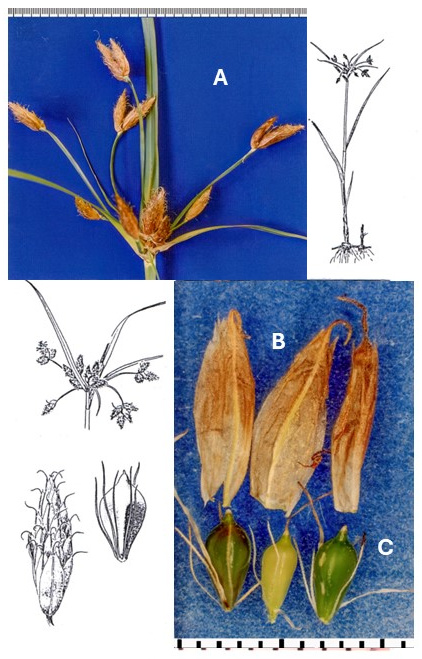

Bolboschoenus fluviatilis
River bulrush
Bolboschoenus maritimus subsp. fluviatilis (Torrey) À. Löve & D. Löve, Schoenoplectus fluviatilis (Torrey) M.T. Strong, Scirpus fluviatilis (Torrey) A. Gray, Scirpus maritimus L. var. fluviatilis Torrey
Stout perennials from horizontal rhizomes thickened at the rooting nodes; culms erect, sharply triangular, often with concave sides, smooth, 1–2 m tall, 5–15 mm thick.
Several, distributed along the culm and shorter than or equal to it; sheaths about half the culm length, fronts of the sheath with veins that nearly reach the papery summit; blades flat with finely scabrous midrib and margins, 7–22 mm wide.
3–6, unequal, the lower ones leaflike, flat, spreading and ascending, exceeding the inflorescence, 20 cm or more long, 4–15 mm wide.
Open, subumbellate (compact when very young); spikelets 10–40, ovoid to lanceolate, tan to brown, 10–25 mm long, 5–10 mm wide, solitary or in clusters of 2–3 (8) on 4–12 flexuous rays up to 10 cm long.
Spirally arranged and loosely imbricate, narrowly oblong with the apex notched, thin, scarious, often lacerate distally, orange-brown or straw-colored, 7–10 mm long, 3–4 mm wide; the midrib excurrent as an awn, 2–3 mm long, 0.5 mm wide, exceeding the notch and often recurved.
Perfect; perianth bristles 6, unequal, retrorsely barbellate, tightly attached to and equaling the achene; stamens 3; styles trifid.
Narrowly obovoid, unequally trigonous, tapered at the base, apiculate at the somewhat rounded apex, minutely cellular-reticulate, dull gray-brown to dark brown, 3.8–5.5 mm long (including the 0.2–0.8 mm beak), 2–2.9 mm wide.
Fruiting: summer.Marshes, shores of lakes and streams to about 2100 m, often emergent in water, not salinity tolerant. Often forms dense, monospecific stands that rarely flower and are therefore often overlooked. In the Intermountain Region known only from northern Utah, southeastern Oregon, and southwestern Idaho. Widespread in most of temperate North America.
Easily confused with the introduced Bolboschoenus glaucus, which has slender culms and leaves with lax inflorescences.