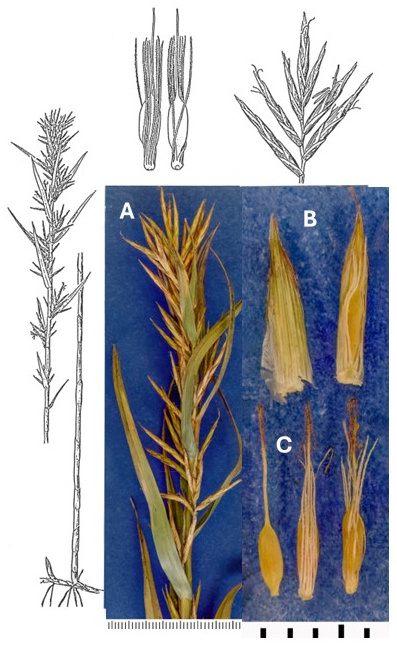

Dulichium arundinaceum
var. arundinaceum
Three-way sedge
Cyperus arundinaceus L.
Perennial; rhizomes long, 3–5 mm thick; culms 2–14, arising singly, stout, erect, cylindric, stout, jointed with hollow internodes, leafy, 2–10 dm tall, 4 mm thick.
Numerous, well distributed along the stem; lower 2–14 leaves firm, bladeless, green sheaths with brown, hyaline margins at the mouth, sheaths not splitting; upper 3-15 leaves spreading or ascending with flat, leathery, glabrous 3-ranked grasslike blades with acute tips, 4–15 cm long, (1.5) 3.5–8 mm wide; distal 5–20 leaves are bracts.
6–30 cm long, consisting of 1-17 spikes, about 2-5 cm long in sheath axils; spikelets 5-20 per spike, 2-ranked, flat, ascending to spreading, linear-lanceolate, greenish to brownish, 15–30 mm long, 1.2–2.5 mm wide; rachilla hyaline winged, readily disarticulating with the scale at maturity.
4–8 per spike, 2-ranked, decurrent, lanceolate, acute to acuminate, prominently many-nerved, light green becoming pale, hyaline along the margins, spongy at the base, (3) 5–9.5 mm long, about 2 mm wide.
Perfect, sessile, borne singly in the scale axils; perianth bristles 6–9, rigid, retrorsely barbellate, about 4–8 mm long, from shorter than the achene to much longer; stamens 3, longer than the perianth bristles; anthers 3-4 mm; stigmas 2, deeply branched, much exerted from the scale.
Narrowly ellipsoid, flattened or somewhat planoconvex with a short, stout stipe, yellowish brown, 2.5–4 mm long (excluding the 1 mm style base), about 1 mm wide; the persistent, undivided basal portion of the style forms a linear beak.
Fruiting: July–October.Marshy shores, wet meadows, bogs, pond margins, and ditch banks from sea level to 700 m. Distributed from southwestern British Columbia to California and in eastern North America. Rare in the Intermountain Region, known from Valley County, Idaho and east central California.