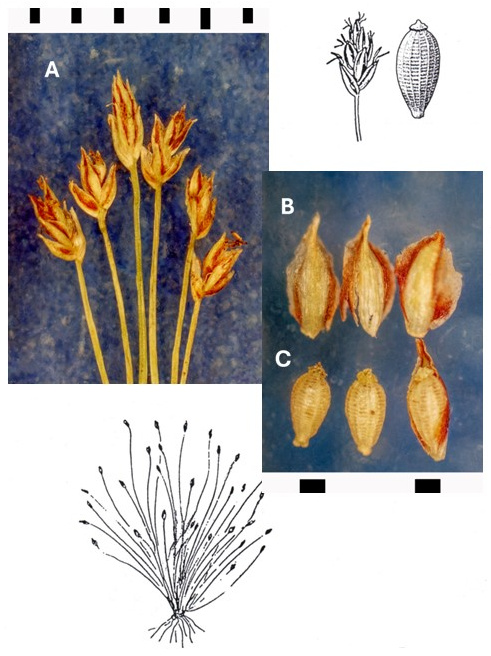

Eleocharis bella
Pretty spikerush, Beautiful spikerush, Delicate spikerush
Eleocharis acicularis (L.) Roemer & Schultes var. bella Piper, E. acicularis (L.) var. minima Torrey ex Britton
Very slender annual (rarely perennial) 1–7 cm tall, forming small, dense, rounded tufts; rhizomes usually absent; culms ascending or spreading, filiform, four-angled or more-or-less cylindric, furrowed, soft to firm, 1–8 cm tall, 0.2–0.3 mm thick.
Usually solitary, straw-colored, apex acute, tooth absent; upper sheath delicately membranous, slightly inflated distally, often disintegrating.
None.
3–10 (15) flowered, ovoid to ovoid-oblong, terete, apex acute to obtuse, greenish-red to reddish-brown, 1.5–4 mm long, 0.8–2 mm thick.
4–15, 8 per mm of rachilla, oblong-ovate, apex acute to acuminate and slightly recurved, midrib obscure to somewhat keeled, midstripe greenish or pale, its margins variably hyaline and somewhat reddish-brown, 1–1.5 mm long, 0.5–0.7 mm wide; lowest scale with a flower and completely clasping the culm.
Perianth bristles absent; stamens 3, anthers 0.3–0.5 mm; styles trifid.
Obovoid, obscurely 3-angled to nearly terete with 6–10 longitudinal ridges (3 ridges prominent), 2–30 very fine horizontal bars, apex blunt, whitish to pale brown or slightly yellowish, 0.6–0.8 mm long, 0.3–0.4 mm wide; tubercles distinct, short and broad, grayish, 0.1–0.2 mm high, 0.1–0.25 mm wide.
Fruiting: spring—summer.Bare, often drying soil along streams, lake shores, and in wet meadows from 100 to 2900 m. Locally common in the western states from Washington and Montana south to California, Arizona, New Mexico, and adjacent Mexico. Intermountain collections are from the Reno area, northeastern Nevada, southeastern Oregon, southwestern and northern Idaho, northeastern and east-central Utah.
Eleocharis bella is easily confused with the closely related E. acicularis, a rhizomatous perennial with scales exceeding 1.5 mm long, apex blunt to acute, anthers and achenes exceeding 0.7 mm in length.