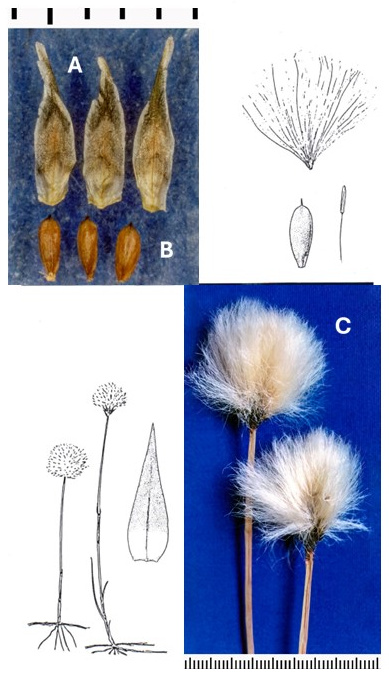

Eriophorum scheuchzeri
White cottongrass, Dense cottongrass, Scheuchzer’s cottongrass, Shealted cottongrass
Eriophorum leucocephalum Boeck., Scirpus leucocephalus T. Koyama, S. scheuchzeri (Hoppe) Vitman
Perennials forming large colonies from long, slender, creeping rhizomes; culms mostly arising singly or in small groups, erect, subterete, somewhat trigonous, smooth, evenly straited, reddish tinged, 1–4 (7) dm tall, about 1 mm wide at the base.
Few, most borne toward the base, slender, smooth; basal sheaths well-developed, septate-nodulose, brown to reddish, persistent; blades slender, channeled or triangular, up to 12 cm long, 1 mm wide, shorter than the culms, sometimes reduced or lacking; distal leaves borne at about the mid-culm are dark tipped and bladeless.
Spikelet solitary, terminal and erect.
Spirally arranged. Numerous, closely clustered; sterile scales proximal, several (7 or fewer), gray to blackish or blackish-purple with inconspicuous midribs not reaching the apex, 4–10 mm long; fertile scales distal, narrowly oblong, very thin, less than 1 mm wide, tapering gradually to an acute or obtuse tip, upper half blackish-green with broad to narrow white hyaline margins, paler toward the base, the inconspicuous midrib reaching to about one-half to two-thirds the scale length.
Perfect; perianth bristles numerous, smooth, straight, soft, mostly white to reddish tinged, 1.5—-3.5 cm long, forming a cotton-like tuft that conceals the fertile scales; stamens 3 with short anthers (0.5–1.0 mm); stigmas trifid, slender.
Oblanceolate, unequally trigonous with blunt angles, brown or blackish, 0.4–2.5 mm long, 0.5–1 mm wide with a short, dark, slender beak.
Fruiting: July–August.Cold, wet places, tundra, meadows, margins of lakes, marshes, and wet peatlands from sea level to 3800 m elevation. Circumboreal and southward in the United States to isolated mountainous areas of Montana, Wyoming, Utah (Duchesne, Summit, Uintah, and Wasatch Counties), Colorado, and New Mexico.