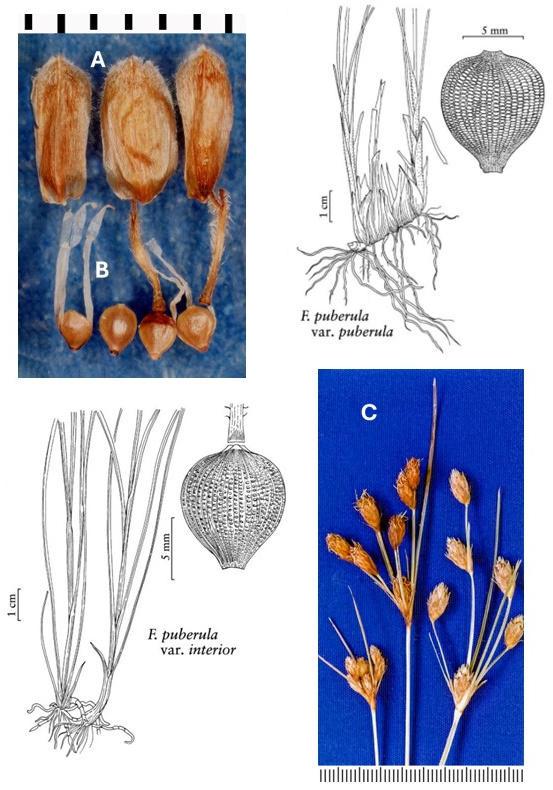

Fimbristylis puberula
Hairy fimbry
Scirpus puberulus Michaux
Robust perennial to 15 dm tall with swollen bases forming small tufts from short, slender, scaly or knotty, contorted rhizomes; culms sometimes solitary, narrow, somewhat triangular distally, striated, glabrous to sparsely pubescent, 1.2–2 mm wide.
Few, borne near the base, ascending, shorter than to equaling the culms; sheaths closed, apically ciliate, ventral side membranous, green to brown, often with minute brownish or reddish spots; ligules absent or present on rhizomatous plants, incomplete or complete; blades narrow, elongate, involute, glabrous to short hairy, 1–2 (4) mm wide, exceeding the sheaths.
2 or more, sheathless, unequal, elongate, scaberulous, ascending, shorter to longer than the inflorescence.
Usually a compound umbelliform cyme, but occasionally a simple umbel, broad, branching, ascending; terminal spikelet sessile and subtended by an involucre of several rays or peduncles 1–7 cm long, each with a terminal spikelet which may be subtended by an involucel with one or more secondary rays with terminal spikelets; spikelets many-flowered, ovoid to lance-ovoid, elliptic-cylindric, red-brown, 5–10 mm long, 3–5 mm thick.
Numerous, spirally arranged, ovate to oblong, apex rounded, lustrous, reddish brown or grayish, lower surface glabrous to puberulent, 2.5–3.5 mm long; midrib lighter, raised dorsally and prolonged into a mucro or short awn.
Perfect; perianth lacking; stamens 3; style bifid above the middle, somewhat flattened and fringed below the branched stigmas, about 2 mm long.
Broadly obovoid, biconvex, finely ribbed and lightly cross-rugulose at high magnification, shiny, yellow to dark brown, 1.5 mm long, about 1 mm wide.
Fruiting: July–August.Moist stream sides, prairie swales, pinelands, sandy or clay soils from sea level to 1000 m. Uncommon in the Intermountain Region, occurrences have been noted for Utah and Nevada. Primarily a midwestern species in the United States.