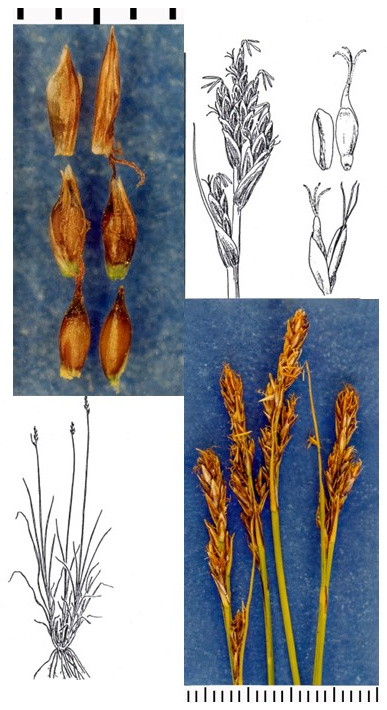

Kobresia simpliciuscula
Simple bog sedge, Simple kobresia
Carex bipartita Allioni, C. simpliciuscula Wahlenberg,
Kobresia bipartita (Allioni) Dalla Torre
Perennial, densely cespitose, lacking rhizomes; culms erect, terete to subterete, smooth, 0.5–3.5 (5) dm tall, longer than the leaves.
Few, borne on the lower fifth of the stem; sheaths very thin ventrally and soon breaking open, margins scarious; leaf sheaths brownish with bases of some dry blades persistent; blades flat or strongly folded, somewhat channeled, triangular and scabrous towards the tip, 2–20 cm long, 0.5–1.2 (2) mm wide.
Ovate to oblong-ovate, brown with hyaline margins; lowest bract elongate and leaflike, equaling or shorter than the inflorescence; upper bracts reduced.
Compound, 1.5–4 cm long with 3–12 spikes, each subtended by a scarious bract; spikelets few flowered; proximal spikelets 2-flowered and androgynous or 1-flowered and pistillate; distil spikelets 1-flowered, staminate.
Outer floral scale ovate to oblong with a conspicuous midrib reaching nearly to the tip, largely scarious, brownish, 2–4 mm long, 1–1.8 mm wide; inner scale thinner, lacking the conspicuous midrib, partially enclosing the achene with the margins free to the base.
Perianth lacking; stamens 3, styles trifid.
Elliptical, unequally trigonous, brown with a darker stylar base, 2–3 mm long, 1 mm wide.
Fruiting: June–August.Bogs, fens, tundra, calcareous meadows, gravels, rocky areas, edges of beaver ponds and other wet, usually calcareous places from sea level to 3500 m elevation. Circumboreal. South irregularly in western North America in high-elevation locations of northeastern Oregon, central and southeastern Idaho, Utah, and the Rocky Mountains to northern New Mexico.