
Schoenoplectiella saximontana
Rocky Mountain bulrush, Sharpscale bulrush
Schoenoplectus saximontanus (Fernald) J. Raynal, Scirpus bergsonii Schuyler, Scirpus saximontanus Fernald, Scirpus supinus L. var. saximontanus (Fernald) T. Koyama
Tufted annuals with fibrous roots, lacking evident rhizomes (if present, short and 1 mm in diameter); culms cylindric, unequal, erect or often arching, slender and wiry, ridged when dry, 1–60 cm tall, 1 mm thick.
3–4, basal but with 1 (2) on the lower half of the culm; sheaths prominent, splitting, not leaving fibers; blades 1–2, rudimentary to longer than the sheath, 1–200 mm long, 0.2–1 mm wide, proximally C-shaped in section, distally flat, smooth or the margins spinulose near the tip.
Main bract erect or somewhat curved, resembling a continuation of the culm, 5–15 cm long; subsidiary bracts inconspicuous.
Compact heads of 6–20 spreading spikelets, a single spikelet, or with 1–2 branches to 15 mm long with clusters of 4–7 spikelets; spikelets 6–20 mm long, about 3 mm thick.
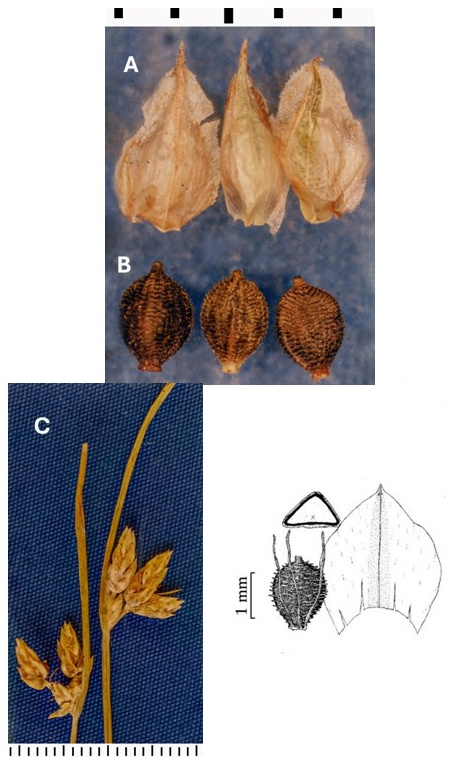
Broadly ovate, glabrous, margins minutely ciliate, apex rounded and not notched, pale brown to colorless, sometimes with a thick green midrib that is keeled distally, 2.5–3.5 mm long, 1.5–2.5 mm wide; mucro or awn bent outward, not contorted, sparsely spinulose, 0.2–0.5 mm long, longer on basal scale.
Perfect; perianth bristles absent; stamens 3; styles all trifid; solitary pistillate amphicarpic flowers often present in basal leaf sheaths.
Blackish brown, sharply triquetrous, surface with conspicuous, wavy, transverse ridges, 1.3–1.9 mm long (includes 0.1 mm long apiculus), 1–1.4 mm wide; Achenes of amphicarpic flowers are trigonous, transverse ridges less evident, 2.2–3 mm long with a tapered beak (0.3 mm).
Fruiting: summer.On wet and often sandy soil or emergent in freshwater swales, shores, ponds, ditches, and disturbed areas from ssea level to 2200 elevation. Rare and local in the Intermountain Region. British Columbia and California east to Ohio and Texas, mostly in the Great Plains from North Dakota to Texas; Mexico. Known only from Millard, Salt Lake, and Uintah Counties in Utah and Klamath County, Oregon.
Schoenoplectus subterminalis is perennial with a single erect spikelet, and smooth achenes. It forms mats of long, slender rhizomes that are often vegetative and submerged.