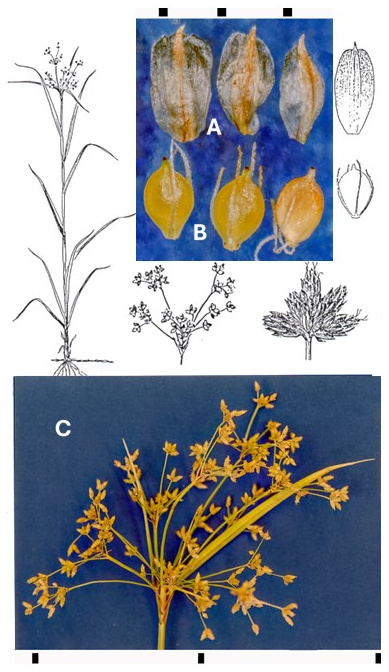

Scirpus microcarpus
Panicled bulrush, Red-tinge bulrush, Smallfruit bulrush
Scirpus microcarpus var. longispicatus M. Peck, S. m. var. rubrotinctus (Fernald). M.E. Jones, S. rubrotinctus Fernald, S. sylvaticus L. var. digynus Boeckeler
Coarse, leafy-stemmed perennials arising singly or few together from stout, reddish, creeping rhizomes with prominent nodes; culms erect, obscurely triquetrous to semi-terete, smooth to scabrous above, 6–17 dm tall, 6–20 mm thick near the base.
Several, distributed along the stem; sheaths hyaline ventrally below the mouth, tinted with reddish-purple dots; blades grasslike, wide, flat, margins scabrous, 1.5–6 dm long, 6–20 mm wide, often surpassing the culms.
2–5, spreading, leaflike, unequal, sheathless, green to black or red basally, the longest 1–3 dm long, 2–5 mm wide, often surpassing the inflorescence.
Terminal, compound umbelliform terminal cymes, spreading, flexuous, 8–15 cm wide; rays divaricate or ascending; spikelets numerous, sessile in small, pedunculate clusters of 2–18, oval, small, pale brown to grayish brown, 2–6 (8) mm long, 1.2–3.5 mm wide.
Spirally arranged, oblong, apex acute to truncate-mucronate, largely hyaline and cellular reticulate, blackish, especially distally, or greenish black with a green or pale, ill-defined to prominent midstripe, 1–2.3 mm long, 0.8–1.2 mm wide, deciduous.
Perfect; perianth bristles 4–6, stout, straight or curved, minutely and sparsely retrorsely barbellate, brownish, slightly surpassing the achene, rarely exserted beyond the scale; stamens 2; 1.2 mm long; styles bifid for one-half to two-thirds their length.
Broadly ovoid to obovoid, lenticular, smooth, pale brownish or creamy white, commonly 0.7–1.6 mm long, 0.8–1.0 mm wide, including the short stylar apiculus.
Fruiting: June–August.Wet soil, marshes, streambanks, pond and lake margins, canals, and meadows from sea level to 2900 m elevation. Southern Canada, south through the western United States, especially at higher elevations, eastward to New England; Mexico, eastern Asia. Widespread in the Intermountain Region.
S. cyperinus has a grayish white, somewhat cottony appearance at maturity due to the long perianth bristles and has a more northern distribution.