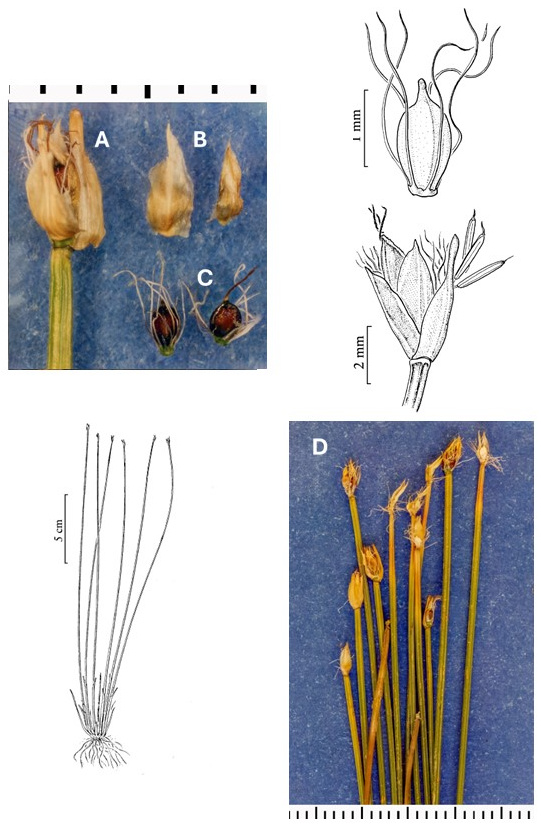

Trichophorum cespitosum
Tufted bulrush, Deerhair bulrush, Tufted clubrush
Scirpus bracteatus Bigelow, S. cespitosus L.
Very densely tufted perennial; rhizomes short or lacking; culms erect, slender, stiff, subterete, smooth, unevenly ribbed, 1–5 dm tall, about 1 mm thick, covered at the base by persistent leaf sheaths.
Basal leaves bladeless, reduced to several scalelike, shiny, grayish or brown sheaths; upper leaf borne toward the base, blade short to rudimentary, channeled, light green, (1.5) 4–6 (8) mm long, shorter than the culms.
Light to medium brown, deciduous, 3.3–4.5 mm long, prominently nerved with a broad, blunt awn, subequal to or exceeding the spikelet.
A terminal, solitary spikelet, oblong, 3–9 flowered, light to medium brown or stramineous, 3.3–7 mm long, 1.2–3 mm wide.
Lanceolate, mucronate to acute at the tip, awnless, mostly hyaline-scarious, reddish or light to dark brown, 2–3 mm long, 1–1.2 mm wide.
Perianth bristles 6, smooth to scabrous, white or distally brownish, up to twice as long as the achene and often exserted at maturity, deciduous before the achene; stamens; 3, anthers 1.5–2.6 mm; styles trifid.
Broadly obovoid with a short, dark, stylar apiculus, unequally trigonous with blunt angles, smooth, medium to dark brown at maturity, about 1.5 mm long, less than 1 mm wide.
Fruiting: July–August.Sphagnum bogs, fens, marshes, and peaty meadows from sea level to 3400 m; circumboreal, extending south in North America to North Carolina, western Oregon, western Montana, the Sawtooth Mountains of central Idaho, and the Uinta Mountains of Utah.
Similar to the genus Eleocharis in having a small, solitary, terminal spike but differing in having an involucral bract, rudimentary leaf blade, stylar apiculus, and lacking a tubercle capping the achene.