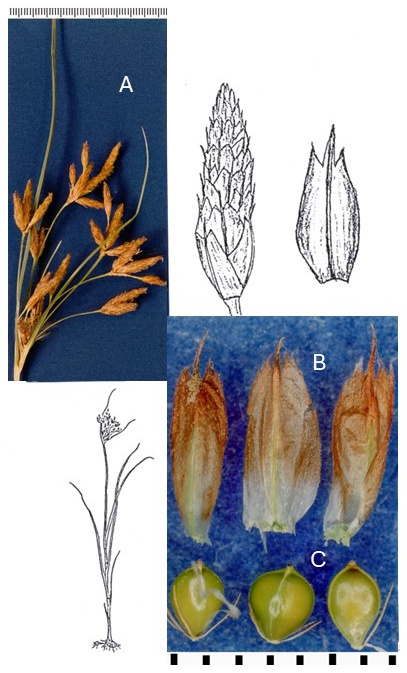

Bolboschoenus glaucus
Tuberous bulrush
Schoenoplectus glaucus (L.) Kartesz, Scirpus glaucus L.
Slender, erect perennials from dark brown rhizomes that bare tubers about 2 cm thick; culms obtusely triangular, smooth, to 1.5 m tall, 1.5–3 mm thick.
Sheaths reach to middle of culm; veins diverge below the membranous summit leaving a triangular area that is veinless; blades 2–6 mm wide.
1–3, leaf-like, elongate, narrow, 2–3 mm wide, flat proximally, scaberulous distally, the lowest longer than the inflorescence.
Open, subumbellate, compact when very young; spikelets 3–30, ovoid to narrowly lanceolate, medium brown to reddish brown, 10–40 mm long, 3–5 mm thick, mostly solitary or in clusters of 2–7 on 3–11 lax rays that are less than 9 cm long.
Loosely imbricate, oblong with the apex mostly lacerate and deeply notched, membranous-hyaline, orange-brown or straw-colored, 5–6 mm long, 2.5 mm wide; the midrib prolonged into a straight or slender, somewhat recurved awn that is 0.25 mm wide at the base.
Perianth bristles 4–6, unequal, minutely retrorsely barbellate, light to medium brown, shorter than to equaling the achene, persisting through dispersal; stamens 3; styles trifid.
Obovoid with a cuneate base and rounded apex, bluntly to obscurely trigonous, pale brown to blackish when mature, 2.5–3.3 mm long (including the minute apiculus), 1.3–2.3 mm wide.
Fruiting: summer.B. glaucus occurs along shores and in waste places from sea level to about 800 m. In California it is a weed of rice fields and managed ponds in wildlife refuges. It is slightly salinity tolerant. In the Intermountain Region it is known only from southwestern Idaho and west-central Oregon. Hybrids with B. maritimus have been reported from Idaho. The species is widespread from the Mediterranean to central Asia and southern Africa. Introduced in North America, it is most abundant in California.
B. glaucus is easily confused with small specimens of the native and more robust B. fluviatilis because of their similar inflorescences and with B. maritimus subsp. paludosus because of hybridization and their similar leaf sheaths and floral scales.