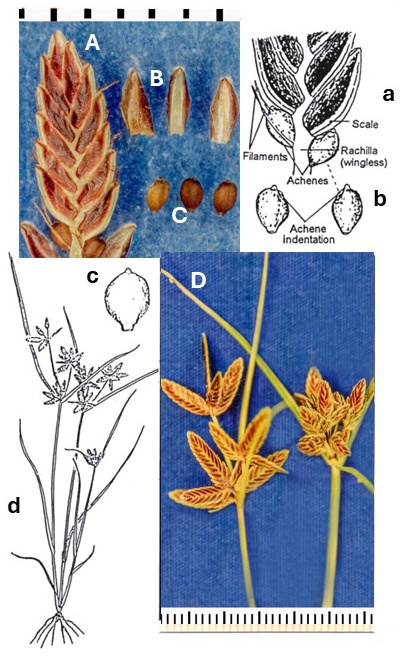

Cyperus bipartitus
Slender flatsedge, Streamside flatsedge
Cyperus niger Ruiz & Pav. var. rivularis (Kunth) V.E. Grant, C. rivularis Kunth, Pycreus rivularis (Kunth) Palla
Small, densely tufted annual with fibrous roots; culms slender, triangular to rounded, smooth, multistriate, 0.5–3 dm tall, 0.3–1.4 mm thick, sometimes thickened at the base.
Few, 1–3 to a culm, all borne near the base, slender, flat to V-shaped, margins smooth, becoming scaberulous distally; shorter to longer than the culms, 1-8 cm long, 0.5–2 mm wide; lower basal sheath brown or reddish brown.
2–4, leaflike, horizontal to mostly ascending, V-shaped to flat, unequal, 1–12 cm long, 0.5–1.5 mm wide; the longest bract much surpassing the inflorescence; others reduced, spreading.
One to several capitate clusters of ascending to spreading spikelets aggregated at a point; clusters are 7-14 mm long, 9-14 mm wide, the primary or terminal cluster sessile at the top of the peduncle; others (if present) with 1-10 spikelets on 1-4 slender rays 2–3 cm long; spikelets lanceolate to ovate, flat with thinner edges, mostly reddish purple, 3–12 mm long, 2–3 mm wide.
Persistent, wingless or minutely winged, slightly angular-twisted, about 0.5 mm wide.
Floral scales 6–24 per spikelet, ovate to lanceolate, obtuse at the tip, prominently 2–3-ribbed medially, 2-keeled, pale greenish to yellowish along the midrib, strongly splotched anthocyanic and somewhat shiny along the margins, 2–2.7 mm long, 0.75–2.3 mm wide, very closely set, strongly overlapping and giving the spikelets a smooth outline, deciduous from the rachilla at maturity.
Perfect; perianth absent; stamens 2 (rarely 3); anthers 0.5 mm long; style deeply bifid, stigmas 2.
Broadly ovoid, lenticular, olive to blackish or dull brown, becoming minutely roughened or cross-ridged at maturity, sometimes with prominent indentations on the upper half of the angle (ventrally) next to the rachilla, 1.0–1.9 mm long, 0.6–0.9 mm wide.
Fruiting: June–August.Exposed shorelines, ditches, disturbed wetlands, sandy streambanks from sea level to 1500 m, tolerant of alkali. Uncommon in the Intermountain Region. Collections have been made in southeastern Oregon, southwestern Idaho, and central and northeastern Utah. More frequent eastward across the United States, also in southern Canada, and the mountains of Mexico and Central and South America.