
Cyperus difformis
Variable flatsedge
Cyperus lateriflorus Torrey
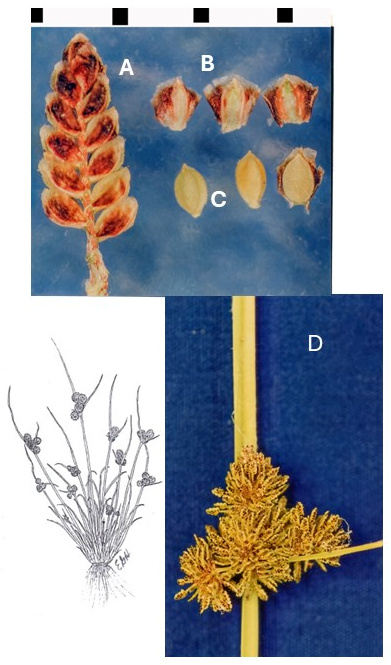
Small, tufted annuals; roots fibrous, reddish; culms 1–15, sharply triangular, narrowly winged on the angles, smooth, soft, 1–3 dm tall, 1.5–2.5 mm thick.
2–7, borne toward the base, flat, keeled, 2–22 cm long, 2–4 mm wide, shorter than the culms; lower sheath with reddish venation at the base and reddish speckles toward the hyaline mouth.
2–4, flat, keeled, margins and keel slightly scabridulous (especially near the tip), 1–22 cm long, up to 3.5 mm wide, sometimes wider than the culms; the largest bract erect, appearing as a continuation of the culm; other bracts reduced and spreading.
Very tight clusters of 30–120 spikelets forming globose (7–17 mm diameter) to irregular lobate heads (2–32 mm diameter); the central cluster sessile; the lateral (0) 1–5 on short rays less than 3 cm long; spikelets oblong, flat or compressed, yellowish to reddish purple, about 3 mm long, 1.1 mm wide.
Obscurely winged, persistent, not angular-twisted or only obscurely so, not flattened.
6–20, 2-ranked, 3-nerved, closely spaced, orbicular, apex obtuse with a small mucro, greenish to pale, 3-nerved medially, margins hyaline to transparent, very small, about 0.7–1 mm long, 0.5–1 mm wide, deciduous.
Perfect; perianth lacking; stamens 1–2; anthers broadly oval, about 0.1 mm long; styles bifid or trifid.
Broadly oblong with a cuneate base, unequally trigonous, ventrally concave, apex short apiculate, surface papillose and finely reticulate, pale brown to yellowish brown at maturity, 0.5–0.8 mm long (about equaling the subtending scale), about 0.3–0.5 mm wide.
Fruiting: July–November.A common weed of moist to wet sandy or muddy soils in disturbed areas. Occurs along ditches, roadsides, ponds, streambanks, shores, and rice fields from sea level to 1000 m. In the Intermountain Region known from banks of the Boise River in Canyon County, Idaho. Native to the Eastern Hemisphere and widely introduced in the Western Hemisphere.