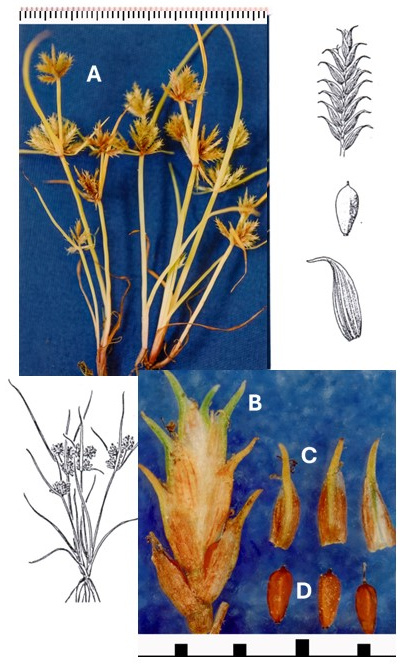

Cyperus squarrosus
Bearded flatsedge, Awned flatsedge, Bearded nutgrass
Cyperus aristatus Rottb., C. inflexus Muhlenberg
Very small tufted annual with fibrous roots; fresh herbage sweet, celery-scented; dry herbage clover scented; culms 1–20, slender, sharply triangular, smooth, unequally ribbed or striated, 0.3–1.5 dm tall, 0.5–2 mm wide.
Few, all borne near the base, flat to V-shaped, keeled distally, light green, shorter to longer than the culms, 2–10 cm long, 0.5–2.5 mm wide; sheaths of older leaves reddish brown.
Leaflike, 1–6, elongate, unequal, 1–15 cm long, some or all surpassing the inflorescence.
1–4 capitate clusters of spikelets, 5–15 mm wide; terminal cluster sessile, others (if present) on slender rays up to 3 cm long; spikelets 1–30 in a cluster, lanceolate to oblong, somewhat compressed, greenish, yellowish, or reddish brown, 4–10 mm long, 1–2.2 mm wide.
Straight, wingless, persistent.
4–20 per spikelet, somewhat closely set, oblong-lanceolate, 5–11 nerved (prominent when dry), slenderly bristle tipped, prominently spreading or recurved (prominent when dry), greenish or yellowish to reddish brown, midrib commonly greenish or paler, 1–2 mm long including the awn, 0.4–0.8 mm wide, deciduous.
Perfect; perianth lacking; stamens 1; style trifid.
Narrowly obovoid or oblong, trigonous, obtusely angled, papillose, stipitate, apex truncate and apiculate, light brown or reddish brown to blackish, 0.6–1.0 mm long, 0.3–0.5 mm wide; stipe 0.06–1.0 mm.
Fruiting: June–November.Seeps, springs, disturbed areas in wet meadows and wetlands, flood plains, drying margins of ponds and lakes, and river sandbars from sea level to 2500 m elevation. Occurs throughout much of the continental United States and Mexico, including scattered locations across the Intermountain Region.