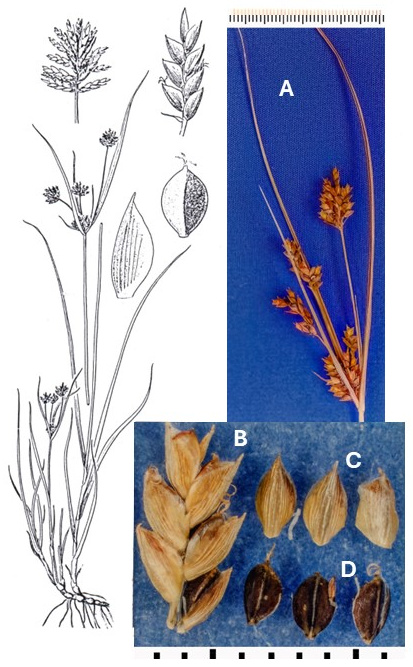

Cyperus schweinitzii
Schweinitz cyperus, Rough sand sedge, Schweinitz flatsedge
Cyperus alterniflorus Schweinitz, Mariscus schweinitzii (Torrey) T. Koyama,
C. schweinitzii Torrey var. uberior Kük.
Tufted perennial from short, irregularly thickened rhizomes; culms bulbous at the base, triquetrous, glabrous or often antrorsely scabrous distally, 1–7 dm tall, 1.5–2 mm thick.
3–5 to a culm, crowded toward the base; sheaths papery, 1-4 cm long, brownish or yellowish proximally, lowest sheaths bladeless; blades well developed, elongate, flat to V-shaped, keeled, rough margined, (2) 7–35 cm long, 1–6 mm wide.
Leaflike, 3–7, erect to ascending, narrow but sometimes slightly wider than the leaves, unequal, up to 10 cm long; the longest 2–4 times longer than the inflorescence.
1-several, umbellate to ovoid, unequal spikes, the terminal spike sessile, others on rays up to 8 cm long; spikelets linear-oblong, laterally compressed, pale brown, 0.5–2.5 cm long, mostly 2–4 mm wide.
Narrowly or obscurely winged, wings sometimes scarious but scarcely hyaline, more or less deciduous.
5–10, broadly ovate, apex rounded and erose, convex on the dorsal side, mucronate with the midrib excurrent as a short point, straitly 9–15 nerved, centers green when fresh, margins straw-colored, whitish, or red spotted, (2.3) 3–4 mm long, the lowest ones shorter, 2–3.2 mm wide, well-spaced, spreading, the tip of each scale surpassing the scale below it by about half its length, deciduous at maturity.
Perfect; perianth lacking; stamens 3; style trifid almost to the base.
Ovoid or elliptical or infrequently obovoid, equally trigonous, cuneate to stipelike at the base, apex obtuse, surface papillose, dark brown or blackish, 2–2.5 mm long, 0.9–2.6 mm wide; style somewhat persistent.
Fruiting: early spring—early summer.Lakeshores, streambanks, sandy openings in woods, dunes and sandy soils, from sea level to 2000 m elevation. In the Intermountain region reported from Kane County, Utah. Washington to Alberta and east to southern Quebec, south to Arizona, Texas, and Mexico. Not reported for the southeastern United States.