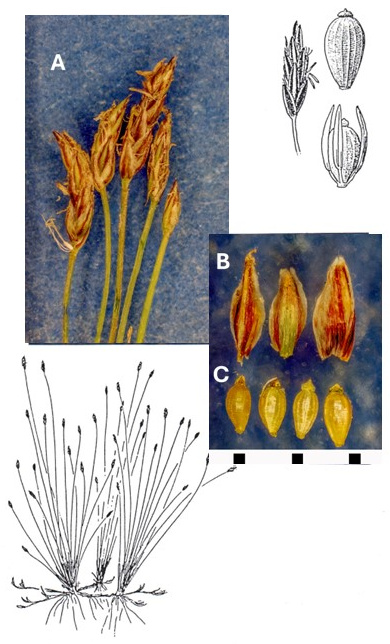

Eleocharis acicularis
Needle spikerush, Needle spikesedge, Slender spikerush
Scirpus acicularis L.
Small, slender perennial, 1–60 cm tall, often forming large, rooted mats or floating masses from slender rhizomes 0.25–0.5 mm thick with 5–15 mm internodes; culms sometimes arching, filiform, more-or-less cylindric or sometimes flattened, smooth or with 3–12 angles or ridges, soft or firm, 0.2–0.5 mm thick. Culms of submerged plants are terete, smooth, soft, and translucent with the air cavity partitions visible. Phenotypic plasticity, often associated with water depth, complicates identification.
Usually solitary, needle-like, tightly sheathing to loose and inflated distally; proximally purplish, distally delicately membranous, with the apex rounded to acute, usually disintegrating; tooth absent.
Absent.
One, 3–15 (25) flowered, ovoid to lanceolate, nearly cylindric, apex acute, purplish brown with a greenish midrib when fresh, 2–8 mm long, 1–2 mm thick. Submerged and floating plants often lack spikelets.
4–25; 4–6 per mm of rachilla; ovate-lanceolate, purplish or pale, midrib region prominent and green with hyaline margins, apex obtuse to acute, 1.5–3.5 mm long, 1–1.5 mm wide; lowest scale completely clasps the culm and includes a flower.
Perianth bristles generally absent, uncommonly 2-4, slender, shorter than to equaling or sometimes exceeding the achenes; stamens 3; anthers 0.7–1.3 mm long; styles trifid.
Obovoid or ovoid-oblong, obscurely 3-angled to nearly terete with 8–12 longitudinal ribs and 30–60 very fine horizontal bars, whitish to pale gray or faintly yellowish, 0.7–1.1 mm long, 0.4–0.6 mm wide; tubercles distinct, conic to triangular and ribbed, basally constricted, 0.1–0.2 mm high, 0.15–0.25 mm wide. Achenes often absent in submerged, non-flowering submerged plants, complicating identification.
Fruiting: spring—fall.Freshwater lakes, streams, drying soil, bogs, wet meadows, vernal pools, and disturbed areas from sea level to 3300 m. Often submerged. Common throughout the Intermountain Region and most of North America and Eurasia, local in Central and South America and Australia.
Terrestrial plants of E. acicularis are easily confused with E. bella, a closely related species. E. bella is apparently annual with scales 1–1.5 mm long, apex acute to acuminate and usually slightly recurved, anthers 0.5 mm, and achenes less than 0.8 mm long. E. acicularis may also be confused with the diminutive, unrelated E. coloradoensis, which lacks a flower in the axil of the lowest spikelet scale and produces very different achenes and tubercles. Submerged vegetative plants of E. acicularis often have very long, filiform culms similar to those of Schoenoplectus subterminalis.