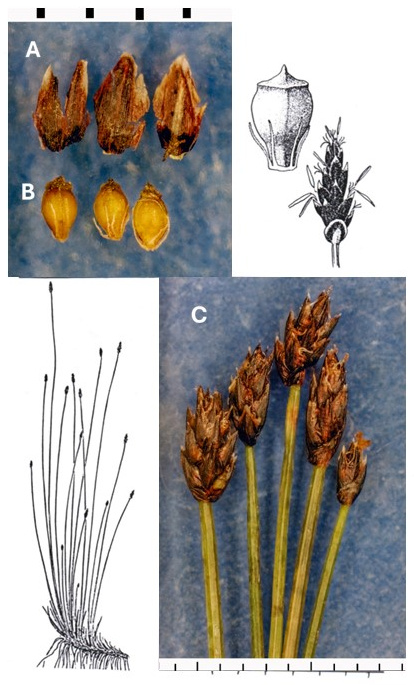

Eleocharis bolanderi
Bolander’s spikerush
Eleocharis montevidensis Kunth var. bolanderi (A. Gray) V.E. Grant
Perennial, 10–30 (50) cm tall, forming densely clustered tussocks from short ascending rhizomes 1.5–4 mm thick and mostly hidden by culms and roots; culms numerous, wiry, cylindric to angled, firm, spongy, striated with 10–18 blunt ridges when dry, 0.2–0.3 (0.5) mm thick. Debris from previous year’s growth persists at the base.
1-2, distal sheaths persistent, rarely splitting, commonly purplish to brownish at the base becoming stramineous to spotted purple distally, loosely sheathing and papery upward, papery; apex obtuse to truncate, sometimes cartilaginous; tooth absent.
None.
Solitary, 10–25 flowered, 4–5 per mm of rachilla, ovoid to ellipsoid, 3–8 mm long, 2–3 mm thick, dark brown or blackish, apex obtuse to acute.
8–30, ovate to orbicular, membranous, apex acute to obtuse, blackish brown with a paler tip and no midstripe, 2–3 mm long, 1.5 mm wide; lowest scale broad, orbicular, lacking a flower, completely clasping the culm.
Perianth bristles 3–6, often unequal, minutely retrorsely barbellate, reddish-brown or whitish, up to half as long as the achene; stamens 3; styles trifid.
Obovoid, unequally trigonous and prominently 3-angled or rarely 2-angled, short stipitate, finely rugulose or reticulate, greenish yellow becoming straw-colored or rarely dark brown to black, apex truncate, 0.9–1.2 mm long, 0.6–0.8 mm wide, deciduous with the scales; tubercles variable, usually distinct, sessile on achene, often 3 lobed, very low and broad, white to brown, to 0.3 mm high, 0.4–0.7 mm wide.
Fruiting: late spring—summer.Fresh, often summer-dry springs, seeps, wet meadows, and stream margins from 1000 to 3400 m. In summer masses of dry culms can be found in dry stream beds. Oregon and California east to Colorado. In the Intermountain Region known from southwestern Idaho, northwestern, northeastern and east central Nevada, and the Uinta Mountains and Zion National Park in Utah.
In the Intermountain Region, E. bolanderi might be confused with the introduced E. pachycarpa because of their similar achenes and tussock-forming habits. Eleocharis pachycarpa differs by its sharply 4-angled culms, pale spikelet scales, and tendency to proliferate from spikelets (see key and E. rostellata). It is also easily confused with E. decumbens, known only from the mountains of California and southwestern Oregon and distinguished by its mostly thicker rhizomes (3–4 mm thick), wider culms (0.3–2 mm wide), and longer spikelet scales (3–3.5 mm long).