
Eleocharis erythropoda
Bald spikerush, Redrooted spikerush, Spikesedge
Eleocharis calva Torrey, Scirpus glaucus Torrey, Trichophorum palustre (L.) Farw. var. calvum (Torrey) House
Perennial, 8–80 cm tall, forming mats from long, thin, horizontal rhizomes, 0.5–1.5 mm thick; culms somewhat cylindric, often with blunt ridges when dry, firm to soft, internally spongy, 0.3–1.4 mm thick.
Distal sheaths persistent, not splitting, usually inflated, membranous to papery, often callose, red to golden basally, green to golden distally, apex obtuse to subacute; tooth absent or only 0.1 mm long.
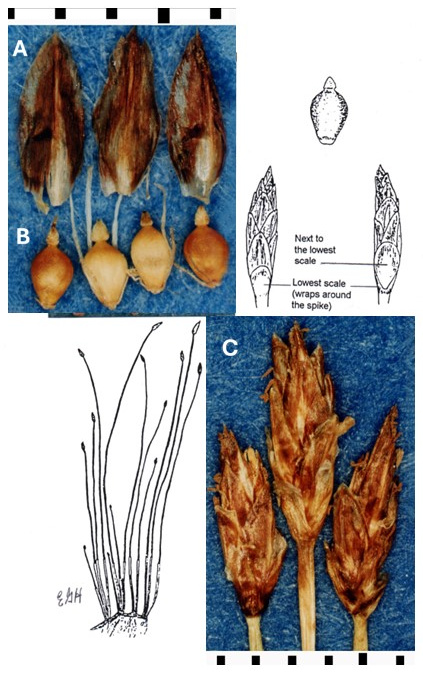
Solitary, ovoid to lanceolate to subcylindric, brown to reddish brown, apex acute, 0.3–18 mm long, 2–3 (4) mm thick.
15–50, 4–5 per mm of rachilla, often spreading in fruit, not prominently tapered, membranous, medium brown without a distinct pale midstripe, apex rounded to subacute, 2–3.5 mm long, about 1.5 mm wide; lowest scale completely clasping the culm and lacking a flower; subproximal scale with a flower; lower scales ovate, distal scales more lanceolate.
Perfect; perianth bristles 0 or 4, usually equal, as long or slightly longer than the achene and tubercle; stamens 3, anthers dark yellow, over 1 mm long; styles deeply bifid.
Broadly oblong-ovoid, lenticular, slightly tapered toward the base and apex, surface smooth or faintly rugulose, straw-colored to brown, 0.9–1.6 mm long, 0.7–1.2 mm thick, deciduous; tubercles distinct, to about 0.6 mm high.
Fruiting: summer.Fresh springs, calcareous or brackish water, fens, wet meadows, stream margins, and marshes from sea level to 2300 m. More common in Utah with scattered populations in eastern Oregon and southern Idaho in the Intermountain Region. Widely distributed and often abundant in temperate eastern North America except the far southeastern area.
Eleocharis erythropoda is easily confused with the closely related E. macrostachya and E. uniglumis, which differ chiefly in the spikelet scale widths as indicated in the key. These three species and E. palustris belong to a circumboreal complex in which intermediates are common. Many authors prefer to treat most of this complex as a single highly variable species. Eleocharis uniglumis (Link) Schultes differs from E. erythropoda in its wider floral scales (1.8–2.5 mm) that are often darker brown and more loosely placed on the spikelet axis.