
Eleocharis flavescens
var. flavescens
Yellow spikerush, Pale spikerush
Eleocharis flavescens var. thermalis (Rydberg) Cronquist, E. thermalis Rydberg, Scirpus flavescens Poiret
Tufted and mat-forming perennials with long, slender, horizontal rhizomes; culms of taller plants erect, cylindric to somewhat flattened, grooved, soft, bright green, 3–42 cm tall, 0.3–0.6 mm thick. Dry leaves and culms accumulate at the base.
1–2, basal; upper sheath inflated distally, loosely wrapping the stem, thinly membranous and often disintegrating, scarious, wrinkled, white; tooth absent.
None.
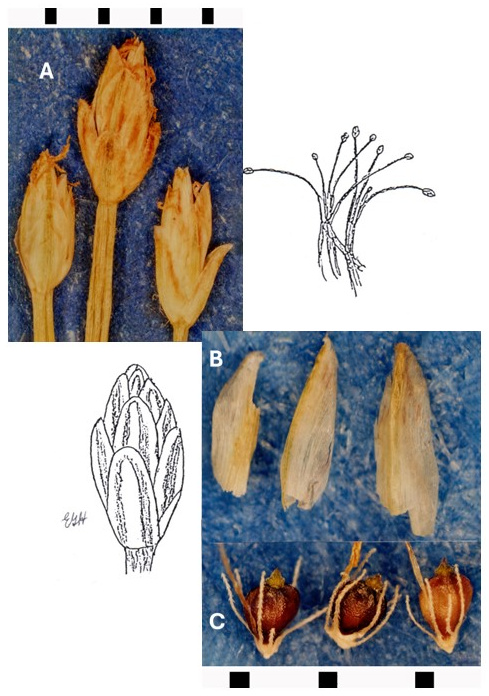
Solitary, 4–16 (20) flowered, ellipsoid or ovoid, pale to light green, apex acute, 1.5–4 (9) mm long, 1–3.5 mm thick.
Up to 65, 5-7 per mm of rachis, loosely appressed to appressed, elliptic or ovate, membranous, straw-colored to brown with a broad greenish to reddish-brown midstrip, margins hyaline scarious, apex obtuse or acute, 1–3 mm long, 0.4–1.6 mm wide; lowest scale without a flower and not amplexicaulis.
Perfect; perianth bristles (0) 5–8, spinulose, rudimentary to slightly exceeding the achene, white to straw-colored; stamens 3; styles bifid, rarely trifid.
Obovoid, lenticular to roundish, rarely trigonous, smooth to finely reticulate, shiny, reddish brown to blackish brown when ripe, 0.4–0.8 (1.0) mm long, 0.3–0.6 mm wide; tubercles distinct, conical, pale, 0.2–0.5 mm high, 0.2–0.4 mm wide.
Fruiting: spring—summer.Brackish wet places, creeks, dunes, hot springs, and salt marshes from sea level to 1600 m elevation. In the Intermountain region known from Cache County, Utah, and around hot springs in Yellowstone Park. In the United States from Montana to California, Arizona, and Texas in the West; Arkansas to Virginia and south to Louisiana and Florida in the East; South America and the Caribbean Islands. Spring—summer.
See Eleocharis geniculata (last paragraph of E. obtusa).