
Eleocharis macrostachya
Pale spikerush, Confusing spikerush
E. perlonga Fernald & Brackett, E. xyridiformis Fernald & Brackett
Perennial forming mats from long horizontal rhizomes; culms cylindric to flattened, irregularly shallowly ribbed, firm to soft, spongy, light green, 10–100 cm tall, 0.5–2.5 (3.5) mm thick.
Distal sheaths persistent, loosely sheathing, rarely splitting abaxially, thickly membranous, basally reddish purple, distally green or straw-colored, apex truncate to obtuse; tooth absent or less than 1 mm long.
None.
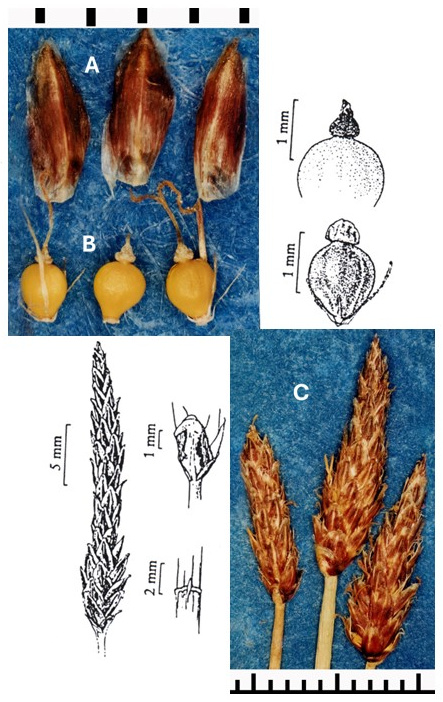
Solitary, 10-many flowered, narrowly lanceolate to ovoid, brown, apex usually acute, 5–40 mm long, slightly wider than the stem.
30–80, 3–5 per mm of rachilla, ovate to oblong, slightly tapered, apex acute to obtuse, membranous, medium to reddish or dark chestnut brown with a straw-colored to green midrib, 2–3.5 mm long, about 1.5 mm wide, often spreading in fruit; lowest scale variable, clasping three-fourths to all of the culm, lacking a flower; subproximal scale with or without a flower; upper scales all with a flower.
Perfect, perianth bristles 4–5 or sometimes rudimentary or absent, unequal, slender to stout, brown, retrorsely barbed, much shorter than the achene to equaling the tubercle; stamens 3; styles bifid.
Ovoid, lenticular, surface smooth to faintly rugulose, straw-colored when young, maturing to dark brown, 1.1–1.9 mm long, 0.8–1.5 mm thick; tubercles distinct, conical with a constricted base, white to brown, to about 0.7 mm high.
Fruiting: spring—summer.Fresh to slightly brackish or alkaline shores, stream beds, vernal pools, wet meadows, marshes, artificial ponds, and ditches from sea level to 2500 m elevation. Common at low to medium elevations throughout most of the West and eastward to southern Manitoba and Mississippi; Mexico and South America. Scattered throughout the Intermountain region.
Eleocharis macrostachya is highly variable and difficult to separate from the closely related species E palustris, E. erythropoda and E. uniglumis (see under E. erythropoda), which differ in the degree that the lowest scale of the spikelet clasps the culm and the presence of a flower in the axil of the subproximal scale as indicated in the key and under E. palustris.