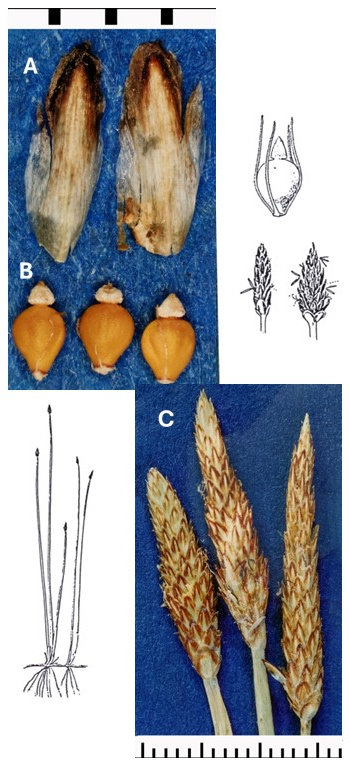

Eleocharis palustris
Common spikerush, Creeping spikerush, Spikesedge
E. smallii Britton, Scirpus paulustris L.
Perennial with culms arising singly or densely clustered, forming mats from long horizontal rhizomes; culms cylindric, terete or oval in cross section, slender to stout, striated, firm to soft, spongy, pale green to dark green, 30–115 cm tall, 0.5–2.5(5) mm wide.
Usually 2 basal; distal portion of the sheaths extend 2–15 cm on the culm, loosely sheathing, firm, membranous to papery, not inflated or callose, apex broadly obtuse to acute, red to black proximally, green to red distally, persistent or sometimes disintegrating or splitting; tooth absent or mucronate.
None.
Solitary, several to many flowered, erect, lanceolate to lanceolate, cylindric, light to dark brown, apex acute to obtuse, 5–25 mm long, 3–7 mm thick.
Lowest scale clasping about 2/3 (to 3/4) of the culm, entire, orbicular, lacking a flower; subproximal 2–3 scales without flowers; upper scales 30–100, 4–8 per mm of rachilla, spreading in fruit, oblong with acute tips, brown, midrib area straw-colored to green, margins hyaline, 2–3.5 mm long, about 1.5 mm wide.
Perianth bristles (0) 4 (5–6), brown, retrorsely barbellate, much shorter than achene to equaling tubercle, rarely twice as long; stamens 2 or 3; anthers 1.3–2.5 mm long; styles bifid.
Obovoid, lenticular, rounded at the apex, surface smooth or faintly rugulose, straw-colored to dark brown or yellowish, 1.1–2.5 mm long, 1–1.5 mm wide; tubercles distinct, constricted at the base, to about 0.7 mm high, at least as high as wide.
Fruiting: May–August.In many plant communities on recently exposed shores, stream beds, and marshes from sea level to 3200 m elevation throughout the Intermountain region. Somewhat alkali tolerant. Widely distributed and common throughout North America but absent from Georgia and Florida. Widespread in temperate North America, Mexico, Eurasia, and New Zealand.
Eleocharis palustris belongs to a highly variable and taxonomically difficult circumboreal species complex well known only in northern Europe. Members of this complex in the Intermountain Region are E. palustris, E. macrostachya, and E. erythropoda. These three species differ mainly in the amount that the lowest scale of the spikelet clasps the culm and in the presence of a flower in the subproximal scale of many spikelets.