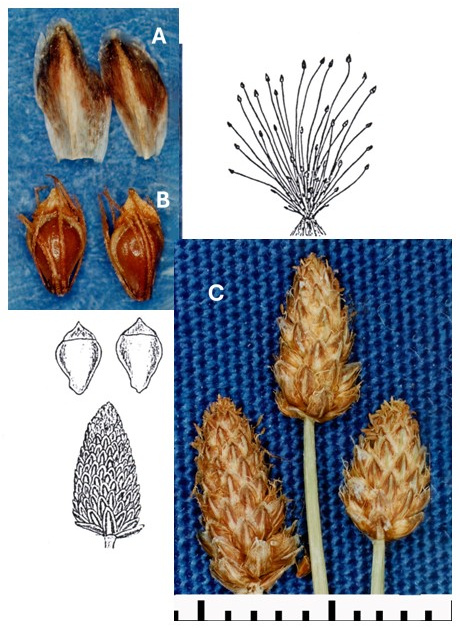

Eleocharis obtusa
Blunt spikerush, Blunt spikesedge
Eleocharis obtusa var. ellipsoidalis Fernald ex Svenson, E. o. var. gigantea Fernald, E. o. var. jejuna Fernald, Scirpus obtusus Willdenow
Densely tufted annual to 50 (90) cm tall; rhizomes absent or not evident; culms cylindric, erect to ascending, slender, firm to soft, spongy, 0.2–2 mm thick.
Usually 2, upper sheath persistent, loosely enveloping the culm, firm, entire, obliquely truncate, purplish at the base, greenish to stramineous distally and slightly thickened at the rim; tooth often present, to 0.3 mm long.
None.
Solitary, erect, many-flowered, broadly ovoid to ellipsoid or lanceolate, apex obtuse, brownish, (2) 5–13 mm long, (2) 3–4 mm thick; achenes and scales deciduous.
15–150, 8–20 per mm of rachilla, ovate-oblong to suborbicular, membranous, margins scarious, midrib seldom keeled, apex obtuse to broadly rounded, brownish orange with paler midstripe, 1–2.5 mm long, 1–1.5 mm wide; lowest scale clasping about 2/3 of the culm, without a flower.
Perfect; perianth bristles 5–8, present or rarely absent, coarse, retrorsely barbed, brownish, slightly to usually greatly exceeding the tubercle; stamens (2) 3; styles usually trifid and bifid in the same spikelet.
Ovoid to broadly ovoid, lenticular, smooth, shiny, straw-colored ripening to dark brown, 0.9–1.3 mm long, 0.7–0.9 mm wide; tubercles distinct, sessile on achene, compressed, lamellate-deltoid, the base not narrowed, 0.3–0.5 mm high, 0.5–0.8 mm wide.
Fruiting: summer—fall.Fresh wet shores, marshes, and disturbed places to 1600 m. In the Intermountain Region reported from southern Idaho, west-central Nevada, and southwestern Utah. Southern British Columbia to Prince Edward Island south to northern California, Colorado, Texas, and Georgia; Hawaii and other Pacific Islands.
Eleocharis obtusa is easily confused with the closely related E. engelmannii, E. geniculata, and E. ovata, which differ as indicated in the key (see also E. engelmannii). E. geniculata is known from southern Nevada and southeastern Utah in the Intermountain Region. It is distributed in the southern states from California to Florida and in most northeastern states. The species also occurs south to South America and in Africa, Asia and the Pacific Islands. Eleocharis ovata (Roth) R. & S. closely resembles E. obtusa, from which it differs mainly in its smaller tubercles that are 0.3–0.5 mm wide. Plants, spikelets, and achenes of E. ovata are also usually smaller. E. ovata is known from British Columbia to Labrador and south to Oregon, Oklahoma, and Virginia, with an isolated locality in Arizona.