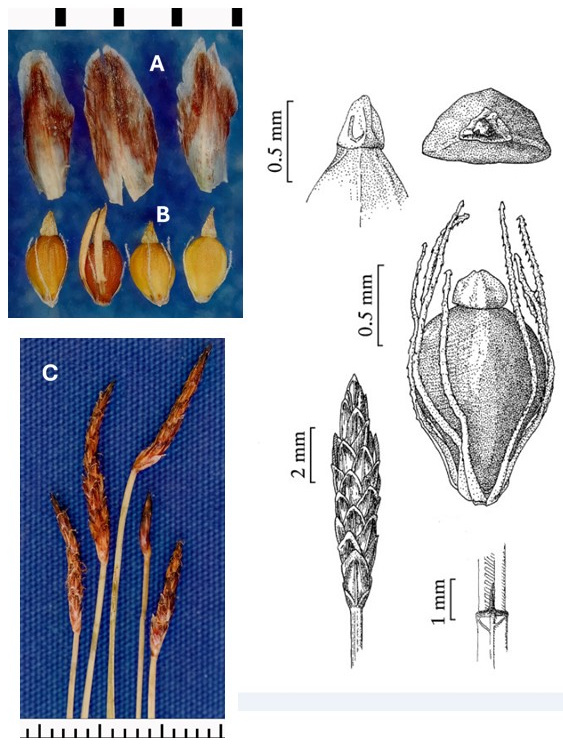

Eleocharis parishii
Parish’s spikerush
Eleocharis disciformis Parish, E. montevidensis Kunth var. disciformis (Parish) V.E. Grant, E. m. var. parishii (Britton) V.E. Grant
Perennial arising singly or forming mats from long horizontal rhizomes; culms slender, cylindric to elliptic, 6-8 ribbed when dry, firm to soft, minutely reddish spotted, 10–50 cm tall, 0.2–0.7 (1) mm thick.
Usually 2, basal; upper portion of the sheaths thickly membranous to thinly papery, persistent, not splitting, often reddish brown becoming stramineous, apex subtruncate to obtuse; tooth to 1 mm long, present on leaves of all or some culms.
None.
Solitary, erect, much wider than the stem, narrowly lanceolate, purplish to reddish brown, apex acute to acuminate, 3–20 mm long, 1.5–2.5 mm thick, 2–7 times longer than wide.
Lowest scale completely clasping the culm, entire, lacking a flower; subproximal scale with a flower or empty; upper scales 15–40, fertile, 3–4 per mm of rachilla, appressed or spreading in fruit, ovate-lanceolate, orange-brown with greenish midstripe and a pale, purplish to brownish hyaline apex and margins, 2–3 mm long, 1 mm wide; lower ones shorter, broader with an obtuse apex; upper scales acute, membranous, keeled.
Perfect; perianth bristles 3–7, rarely absent to rudimentary, often unequal, retrosely barbellate, straw-colored or whitish, to slightly exceeding the tubercle; stamens 3; styles trifid.
Often falling with the scales, obovoid, planoconvex or unequally trigonous, smooth, yellow brown to dark brown, 0.8–1.4 mm long, 0.5–0.7 mm wide; tubercles distinct, pyramidal-conic to about 0.3 mm high, not noticeably constricted at the base, often higher than wide.
Fruiting: spring—fall.Fresh to brackish water, springs, shores, and stream margins to 2700 m. In the Intermountain Region found in Nevada, Utah, and southern Idaho. It is locally common from southern California east to New Mexico, Texas, and Kansas.
Eleocharis parishii is easily confused with the closely related E. montevidensis which is more southern in distribution and differs mainly in its narrow lanceolate spikelets, scale tips that are broadly rounded, often horizontally wrinkled, and curved outward. They often co-occur.