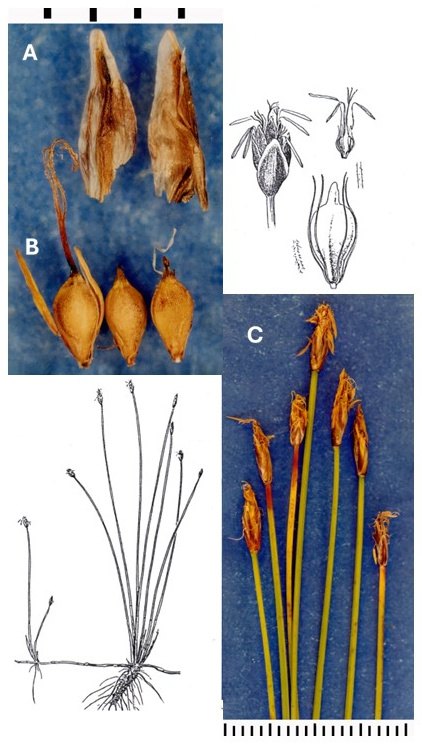

Eleocharis quinqueflora
Few-flowered spikerush, Fewflowered spikesedge
Eleocharis fernaldii (Svenson) Á. Löve, E. pauciflora (Lightfoot) Link, E. p. var. fernaldii Svenson, E. quinqueflora (Hartmann) O. Schwarz subsp. fernaldii (Svenson) Hultén, Scirpus pauciflorus Lightfoot, S. quinqueflorus Hartmann
Perennial, occurring singly or forming mats from fairly long, filiform, horizontal rhizomes; small bulbs (“resting buds”) often present on the rhizomes or culm bases; culms erect, cylindric to elliptic, somewhat ridged when dry, hard to soft, 5–35 cm tall, 0.2–0.5 (1) mm thick; culm bases often swollen, bulb-like, and covered with papery scales.
1-2, basal; sheaths 1-2, extending up to 3 cm on the culm, upper portion of sheaths membranous to papery, reddish becoming stramineous distally, apex subtruncate to acute; tooth absent.
Absent.
Solitary, erect, 3–9 flowered, ovoid or oblong, reddish brown, apex acute, 3–8 mm long, 1.5–4 mm thick.
3–10 per spikelet, broadly ovate, membranous, purplish to blackish with hyaline margins, often lacking a paler midstripe, apex obtuse, 2.5–6 mm long, 1.5–2.5 mm wide; lowest scale completely clasping the culm and with (seldom without) a flower; second scale with a flower; lowest 2–3 scales are at least half as long as the spikelet or sometimes reduced.
Perfect; perianth bristles (0) 3–6, often unequal, slender, finely retrosely barbellate, rudimentary to equaling the tubercle; stamens 3; styles trifid or trifid and bifid in same spikelet.
Obovoid, broadest above the middle, unequally trigonous or rarely lenticular, smooth or with fine longitudinal ridges, straw-colored to medium brown or gray-brown, usually narrowed to a distinct beak, 1.6–2.3 mm long, 0.7–1.3 mm wide; tubercles rarely absent, usually merging with achene summit, higher than wide, about 0.3 mm high, 0.2–0.3 mm wide.
Fruiting: spring—summer.Boggy streams, fens, wet meadows, seeps, springs, and hot springs from sea level to 3600 m elevation, sometimes occurring above timberline. Tolerant of salinity and alkali. Locally distributed in all Intermountain states. Occurs across most of North America, except for the Southeast; Eurasia. Circumboreal.
Eleocharis quinqueflora is easily confused with the closely related E. suksdorfiana, which is more robust. See the characteristics given in the key.