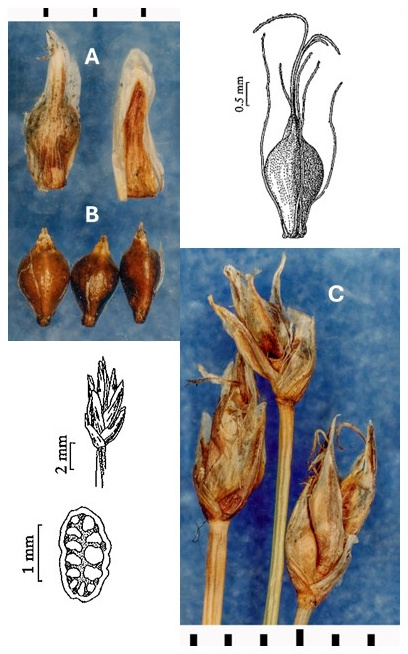

Eleocharis suksdorfiana
Suksdorf’s spikerush
Eleocharis pauciflora (Lightfoot) Link var. suksdorfiana (Beauverd) Hultén, E. quinqueflora (Hartmann) O. Schwarz var. suksdorfiana (Beauverd) J.T. Howell
Perennials forming mats from long horizontal rhizomes 0.5–1.5 mm thick; bulbs (“resting buds”) unknown; culms erect, cylindric to slightly flattened, twice as wide as thick, firm to hard, bluntly ridged when dry, not swollen (bulb-like) at the base, 12–40 cm tall, 0.5–1.2 mm thick.
Usually 2, basal; distal leaf sheath straw-colored to brown or reddish proximally and green to reddish distally; apex subtruncate to obtuse; tooth absent.
Absent.
Solitary, erect, ovoid or oblong, 4–10 mm long, 2-–4 mm thick.
Floral scales 8–12 per spikelet, lanceolate to ovate, membranous, 3.5–5 mm long, 2–2.5 mm wide; lowest scale completely clasps the culm and lacks (seldom with) a flower, 3–5 mm long, half or more as long as the spikelet; second scale with a flower.
Perfect; perianth bristles 6, about equal, slender, spinules dense, the longest bristle equaling the achene to exceeding the tubercle; stamens 3; styles trifid or trifid and bifid in same spikelet.
Trigonous, some lenticular, apically narrowed to a distinct straw-colored beak, smooth or with fine longitudinal ridges, medium to dark brown or gray, 2–2.7 mm long, 0.7–1.3 mm wide; tubercles to about 0.5 mm high, often not distinct, usually merging with achene summit in form, texture and color.
Fruiting: late spring—summer.Fens, bogs, wet meadows, seeps, springs, and ponds from (0) 1100 to 3300 m elevation. Locally distributed in Nevada, Oregon, and southern Idaho. Southern British Columbia to California and east to Alberta and Colorado.
Eleocharis suksdorfiana is easily confused with the closely related E. quinqueflora, within which it has usually been placed. These species differ as given in the key. E. suksdorfiana has long horizontal rhizomes, lacks stoloniferous culms, and produces achenes that are finely ridged longitudinally.