
Eleocharis rostellata
Beaked spikerush, Torrey’s spikerush, Walking sedge
Eleocharis rostellata (Torrey) Torrey var. congdonii Jeps., E. r. (Torrey) Torrey var. occidentalis S. Watson, Scirpus rostellatus Torrey
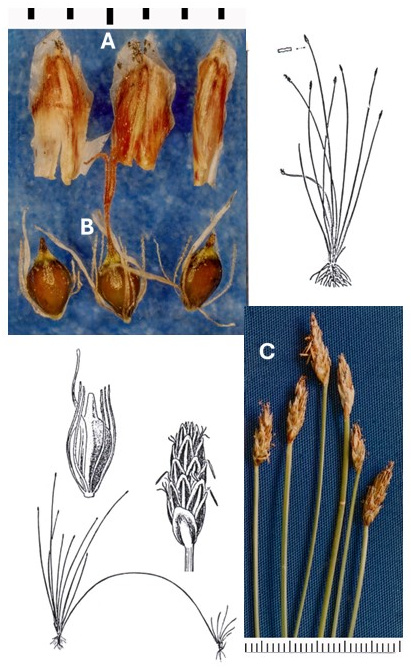
Perennial, loosely clustered or in dense tussocks from short ascending rhizomes (mostly hidden by the crowded culms) or mats from rooting culm tips; culms erect, firm, wiry, flattened, 1.5–3 times as wide as thick; fruiting culms 10–50 cm tall, 0.3–2 mm thick; sterile culms longer (to 1 m or more), arching over or decumbent and rooting at the tips.
Usually 2, basal, leaf sheaths brownish, greenish or reddish purplish, extending up to 8 cm on the culm; upper sheath firm or papery, apex obtuse to subacute and reddish; tooth absent.
Absent.
Solitary, (5) 10–20 (35) flowered, erect, ovoid or oblong, wider than the stem, brownish to blackish-purplish, apex acute, 5–17 mm long, 2.5–5 mm thick; spikelets on stolons rudimentary and non-flowering.
Lowest scale ovate, without a flower and completely clasping the culm, 2–4 mm long, longer than the other scales, but rarely more than half the spikelet length; subproximal scale with a flower; upper floral scales 10–40, ovate-lanceolate, membranous to cartilaginous, apex obtuse to acute, straw-colored to medium brown with broad pale hyaline margins, midrib may be paler, purplish to blackish-purple spots sometimes present, 3.5–6 mm long, 2–3 mm wide.
Perfect; perianth bristles (0) 4–6 (8), unequal, stout, retrorsely barbellate, olive to brown, equaling the achene or tubercle; stamens 3, anthers about 2 mm long; styles trifid or trifid and bifid.
Variable, obovoid, trigonous to lenticular, rugulose to finely reticulate or smooth and shiny, medium brown to dark brown or olive green, abruptly tapered to a distinct beak, 0.9–2.8 mm long, 2–3 mm wide; tubercles absent or obscure to prominent, conic, often merging with the achene in form, color, and texture, 0.15–0.3 mm high, 0.5 mm thick.
Fruiting: summer-fall.Very wet brackish to fresh fens, springs, hot springs, and shores to 2400 m. Indicator of saline or calcareous soils. Locally distributed in Idaho, Nevada, Utah and Wyoming; Found across most of the United States. Newfoundland to Vancouver, Canada, south through Central and South America to northern Argentina; Europe. Very competitive and forms large monospecific colonies.
The introduced Eleocharis pachycarpa is similar to E. rostellata in forming tussocks from short, ascending rhizomes and sometimes proliferating spikelets. It differs in its slender, sharply 4-angled culms, different achenes, and the proliferating culms that are not greatly elongating or mat forming (see key herein and E. bolanderi).