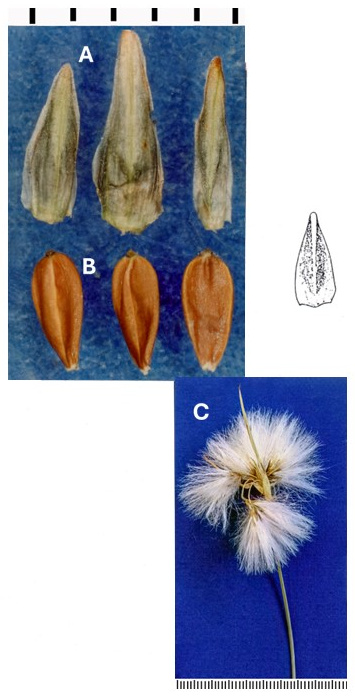

Eriophorum viridicarinatum
Thinleaf cottonsedge, Green-keeled cottongrass, Tassel cotton-grass
Eriophorum latifolium Hoppe var. viridicarinatum Engelmann
Perennials from creeping rhizomes; culms tufted or sometimes solitary, not sharply trigonous, glabrous, finely striated, up to 10 dm tall, 0.9–1.2 mm wide distally.
Several, basal and cauline; lower leaf sheaths overlapping, bases persistent; ventral sheath of cauline leaves veined except for a small hyaline area next to the concave mouth; blades elongate, flat, distally trigonous, minutely scabrous, up to 30 cm long, 2–6 mm wide; uppermost blade much exceeding the sheath.
2-4 blade-bearing bracts, foliaceous, flat, coarsely ribbed toward the base, triangular distally, minutely scabrous, green; lowest bract erect, equaling or exceeding the inflorescence; upper bracts reduced, brownish throughout.
Subumbels of 3–30 many-flowered, oblong to ovoid, terete spikelets, 6–10 mm long in flower, 15–30 mm long in fruit, most on slender, lax, minutely hairy, scabrous peduncles up to 6 cm long in mature inflorescences.
Spirally arranged, ovate-lanceolate, several nerved, pale to gray proximally, greenish or blackish-green distally, 4–6 mm long, 2.5 mm wide at the base; margins narrow, hyaline, scarious; prominent pale to green midrib expanded distally and extending to the blunt or acute tip or sometimes excurrent.
Perfect; perianth bristles numerous, straight, smooth, white to cream or buff, 15–25 mm long; stamens 3, anthers 0.8–2 mm long; stigmas 3-branched.
Narrowly obovoid, unequally trigonous, tapered toward the base, apex rounded, brown or reddish brown, about 3 mm long and 1.5 mm wide.
Fruiting: June–July.Cold, wet, especially peaty places in swamps, bogs, fens, and wet woods from sea level to 3000 m elevation. A North American species distributed from Alaska to Newfoundland and south from Washington to Colorado, North Dakota, Iowa, Illinois and east to Delaware. Peripheral to the Intermountain Region, occurring in Fremont and Teton Counties in southeastern Idaho, and possibly in Park and Teton counties in northwestern Utah.
Fertile scales of E. angustifolium are very thin and not consistently greenish black, the basal portion purplish brown, the midvein not expanded distally and does not reach the tip.