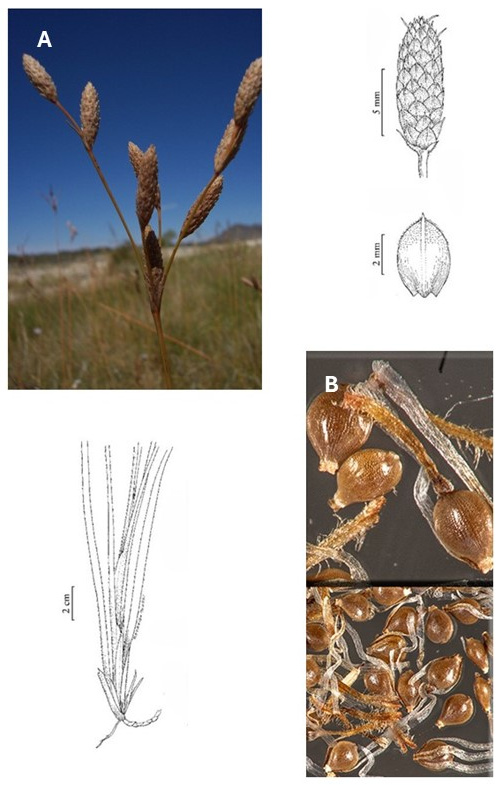

Fimbristylis thermalis
Hot springs fimbry, Hot springs fimbristylis
Fimbristylis spadicea (L.) Vahl, Scirpus spadiceus L.
Robust perennial, 0.5–1.5 dm tall; rhizomes long, slender, scaly; culms solitary or cespitose, terete but flat distally, grooved.
All near the culm base, spreading to ascending, one-half the length of the culms; sheaths smooth to puberulent on the backs, margins entire, ligules of short hairs; blades narrow, flat, margins scabrid-ciliate, proximally pubescent or not, 1–3.5 (4) mm wide.
Few, narrow, short, longest bract shorter than the inflorescence.
Simple or usually compound, elongate cymose corymbs, scapes narrow with scabrid ribs, up to 6 cm long; spikelets numerous, ovoid to cylindric-ellipsoid, pale dull brown, 8–15 mm long, 3–4 mm wide.
Fertile scales ovate, ciliate, apex broadly acute, pale brown, 3.5–4 mm long; midrib greenish and excurrent as an acute mucro.
Perfect; stamens 3; styles bifid, flat, fimbriate, especially distally.
Ovoid, biconvex, dark gray to brown, shiny, sides with 20 or more rows of pits, 1.5 mm long, mucronate.
Fruiting: spring—fall.Wet alkaline soils, seeps, hanging gardens, marshes, pond and lake margins, often near hot springs from 100 to 1350 m elevation. Utah, Nevada, Arizona, California, and Mexico. In the Intermountain Region this species occurs in scattered locations in Nevada and is uncommon in Utah. It may occur in the northeastern portion of California within the region.