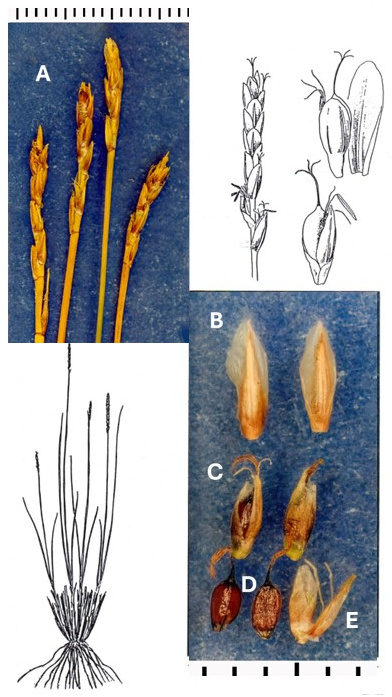

Kobresia myosuroides
Bellardi bog sedge, Bellardi kobresia
Carex myosuroides Villars, Elyna bellardii (Allioni) C. Koch, Kobresia bellardii (Allioni) Degland
Densely tufted perennial; culms slender, smooth, terete, (0.5) 1–2 (5) dm tall, 1 mm wide, longer or shorter than the leaves.
Few, mostly basal; cauline leaves on the lower stem, wiry; old sheaths persistent, bladeless, glossy, brown; blades slender, flat to tightly involute or channeled, glabrous but sometimes scabrous along the margins, 2–20 cm long, 0.3–0.8 mm wide.
None.
Spike solitary, terminal, slender, stramineous to brownish, 1–3 cm long, about 2–3 mm thick; spikelets 8–20, small, spirally arranged.
Outer floral scale larger than the inner scale, 3–4 mm long, mostly scarious with hyaline margins, the midrib distinct nearly to the acute to obtuse tip; the inner floral scale brown to hyaline, smooth, equaling the achene, margins free to the base, 2–3.5 mm long.
Those in proximal spikelets mostly androgynous (a staminate flower above a pistillate flower, but occasionally only a pistillate flower); the distil spikelets staminate, stamens 3, anthers 1–1.5 mm, styles trifid.
Broadly oblong, unequally trigonous with blunt greenish angles when fresh, shiny dark brown with a darker persistent apiculate stylar base, short stipitate, approximately 2.5 mm long, 1 mm wide.
Fruiting: June–August.Alpine tundra communities, rock stripes and talus, open dry or somewhat moist places from sea level to 3500 m elevation. Circumboreal, extending south irregularly in the United States in high elevation areas, often above timberline in Washington, southeastern Idaho, northeastern Utah, southeastern Oregon, California, and the Rocky Mountains south to New Mexico.
Carex elynoides: achene is wrapped in a closed perigynium (See Hurd et al. (1998)).