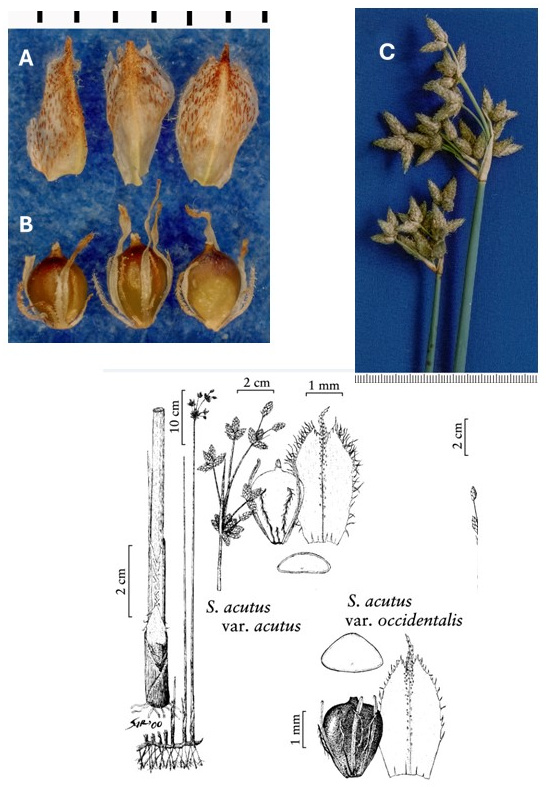

Schoenoplectus acutus
Hardstem bulrush, Common tule
Scirpus acutus var. Muhlenberg ex Bigelow
Stout perennials 1–3 (4) m tall, forming large colonies from thick rootstocks and robust, brown rhizomes; culms stout, cylindric, usually firm, largest air cavities about 0.5–1.5 mm wide, 1–4 m tall, 2–10 (30) mm thick.
3–4, all basal; sheaths prominent, strongly veined, reddish tinged basally, ventrally hyaline and splitting leaving fibers, dorsally septate-nodulose; ligules glabrous; blades 1–2, poorly developed, C-shaped to flat in cross section, smooth or margins minutely spinulose, 1–12 cm long and 3–7 mm wide, shorter than the sheaths.
Main bract erect to divergent, usually green, 1–9 cm long, sometimes resembling a continuation of the culm, shorter or longer than the inflorescence; subsidiary bracts small, chaffy, brownish, margins sometime scabridulous.
Open to compact, 2–3 times branched, branches 6 (18) cm long, sometimes drooping; spikelets 3–100 or more, ovoid, in sessile clusters of 2–8 at the ends of rather erect branches or many (never all) solitary, mostly grayish brown to stramineous, 6–24 mm long, 3–4 mm thick.
Thin, most very scabrous, margins prominently lacerate and ciliate with long contorted hairs, wholly reddish to orange-brown to partly or wholly straw-colored, often with numerous reddish raised cells, 3–4 mm long, 2–3 mm wide; the apex notched 0.3–0.5 mm deep; midrib firm, scabrous, excurrent as a 0.5–2 mm long awn that is straight, irregularly bent, or some in the same spikelet markedly contorted. Note: The marginal cilia and awns are often worn off late in the season.
Perfect; perianth bristles (4) 6 (8), retrorsely spinulose, brown, equal to much shorter than the achene; stamens 2–3; styles all bifid or bifid and trifid in the same spikelet.
2-angled or some in same spikelet obscurely trigonous and dorsally keeled, smooth, shiny, gray-brown to dark brown, 2–3 mm long (including the 0.2–0.4 mm-long apiculus), 1.2–1.7 mm wide, more or less hidden by the scale when mature.
Fruiting: June–September.Marshes, shores, fens, springs, washes, and floodplains from sea level to 2680 m elevation. Often emergent in water to 1 m deep, usually growing with Typha spp. Tolerant of salts and alkali. Locally common in the Intermountain Region. Distributed from southern Alaska to Nova Scotia, south to California, Texas, and North Carolina, Mexico, and east Pacific islands.
Schoenoplectus acutus is easily confused with S. tabernaemontani and S. heterochaetus. In addition to the differences given in the key, S. tabernaemontani differs in that the scales of its spikelets are usually less scabrous, more often uniformly orangish brown,
usually without minute reddish raised cells, and its inflorescences are sometimes with all spikelets solitary. S. heterochaetus differs in that its spikelets are all solitary, styles all trifid, achenes all prominently 3-angled (in the Intermountain Region some achenes of S. acutus are dorsally keeled but not prominently 3-angled), and perianth bristles 4 (rarely 5). Probable interspecific hybrids among S. acutus, S. tabernaemontani, and S. heterochaetus are common in eastern North America but rare in the Intermountain Region. Schoenoplectus acutus also can be mistaken for S. californicus, which has only 2–4 perianth bristles that are dark red-brown, strap-like, and with blunt (not sharp-pointed) hairs.
S. acutus var. occidentalis has bifid and trifid styles in the same spikelet, some often obscurely 3-angled (dorsally keeled) achenes. It is widespread in western North America. S. a. var. acutus, with styles all bifid and achenes all 2-angled, occurs in midwestern and northeastern North America and in Washington.