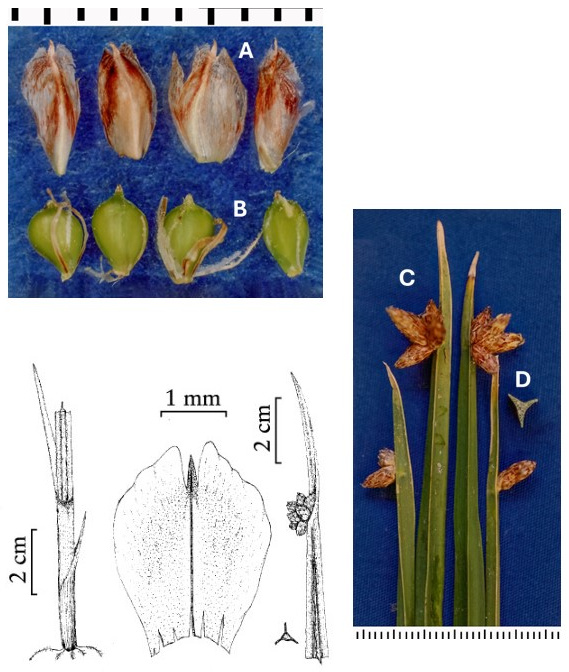

Schoenoplectus americanus
Olney’s three-square bulrush, American bulrush, Chairmaker’s bulrush
Scirpus americanus Persoon, S. chilensis Nees & Meyen ex Kunth, S. olneyi A. Gray
Stout perennials, forming colonies of scattered culms from long rhizomes; culms erect or arched, sharply triangular, sides usually deeply concave throughout, rarely nearly flat, usually very soft, dark green, 0.4–2.5 m tall, 3–10 mm thick.
1-4, all basal, not crowded, less than half the culm length; sheaths not ventrally splitting or leaving fibers, lower sheaths bladeless; blades 1–3, V-shaped near the base, mostly triangular and laterally flattened distally, smooth, the uppermost much shorter than to about equaling its sheath (rarely 1.5 times longer), 2–20 cm long, 2–8 mm wide.
Proximal bract, erect, V-shaped, acute at the tip, green, appearing as a continuation of the culm, about one-third as long as the inflorescence, 1–6 (10) cm long; distal bracts 1–2, scale-like, inconspicuous.
Compact head, sessile, appearing lateral on the culm; spikelets 2–20, ovoid or oblong, acute to obtuse apically, 5–15 mm long, 3–5 mm thick.
Broadly ovate, 3–4 mm long, 2–3 mm wide, thin, smooth, hyaline, orangish red to purple-brown or straw-colored, often with linear spots, margins often minutely ciliate; apex shallowly notched 0.1–0.4 mm deep; mucro or awn sparsely spinulose, straight to bent, not contorted, longer or shorter than the notch.
Perfect; perianth bristles (2) 5–6 (7), often unequal, retrorsely spinulose, brown, one-half to about equaling the achene; stamens 3; styles bifid or bifid and trifid in the same spikelet.
Obovoid, lenticular or obscurely trigonous, smooth, brown at maturity, 1.8–2.8 mm long including the 0.1–0.3 mm beak, 1.3–2 mm wide.
Fruiting: June–September.Mineral-rich or brackish marshes, shores, fens, and springs from sea level to 2200 m elevation. Often emergent in water and alkali tolerant. Widespread but less common than S. pungens throughout the Intermountain Region. Southern British Columbia to Nova Scotia, south to California, and Florida; Mexico to South America.
Schoenoplectus pungens: Besides the differences given in the key, the culms of S. pungens often have nearly flat sides, the inflorescence has up to 5 (rarely 10) spikelets, leaf blades and involucral bracts are longer, scale tips are more deeply notched and the excurrent midribs longer.
Schoenoplectus americanus was long called Scirpus olneyi. Probable hybrids of S. americanus and S. pungens occasionally occur.