
Schoenoplectus pungens
var. longispicatus
Common threesquare, Chairmaker’s rush, Threesquare
Scirpus pungens Vahl
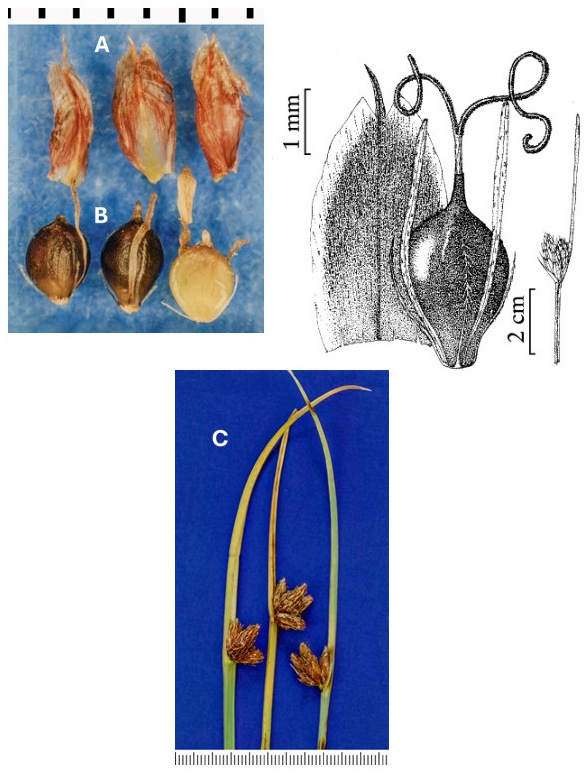
Colonial perennial with somewhat scattered culms from long, scaly, often vertical rhizomes from 1–6 mm in diameter; culms erect to somewhat arching, sharply triangular, smooth, the sides nearly convex to concave proximally, concave to flat distally, dark to yellowish green, 0.1–2 m tall, 1–6 mm thick.
All basal; sheaths fronts membranous, often splitting and leaving fibers, lower sheaths bladeless; ligules bifid; blades 2–6, V-shaped in cross section near the base, trigonous to laterally flattened near the apex, smooth or margins spinulose; the uppermost blade 1–5 times as long as its sheath, 5–75 cm long, 2–9 mm wide.
Main bract erect, trigonous proximally, 1–20 cm long, appearing as a continuation of the culm, 3–7 times as long as the inflorescence; upper 1–2 bracts usually inconspicuous, shorter than the spikelets, resembling enlarged scales with awns one-third of the bract length.
Compact, sessile head or solitary spikelet appearing lateral on the culm; spikelets 1–5 (rarely to 10), 5–23 mm long, 3–5 (7) mm thick.
Broadly ovate, smooth or the lighter midrib with a few spinules, margins minutely ciliate when young, bright (sometimes very dark) brown to straw-colored, often with linear spots, 3.5–6 mm long, 2–3 mm wide; apex notched 0.5–1 mm deep; awn irregularly bent, sparsely spinulose, not contorted, 0.5–2.5 mm long, equaling to exceeding the notch.
Perfect; perianth bristles 4–8 (usually 6), slender to stout, often unequal, retrorsely spinulose, brown, rudimentary to equaling the achene and firmly attached to it; stamens 3; styles all trifid in the Intermountain Region.
Broadly obovoid to ovoid, lenticular or unequally trigonous, smooth, brown when mature, (2) 2.5 (3.5) mm long (includes the 0.1–0.5-mm apiculus or beak), 1.3–2.3 mm wide.
Fruiting: May–August.Fresh or brackish marshes, shores, streams, springs, shallow lakes, and fens from sea level to 2400 m elevation. Often emergent in water and tolerant of alkali. Widespread and common in the Intermountain Region. South-central Alaska to Labrador and south to California and Florida; Mexico, South America, West Indies, Europe, Australia, and New Zealand.