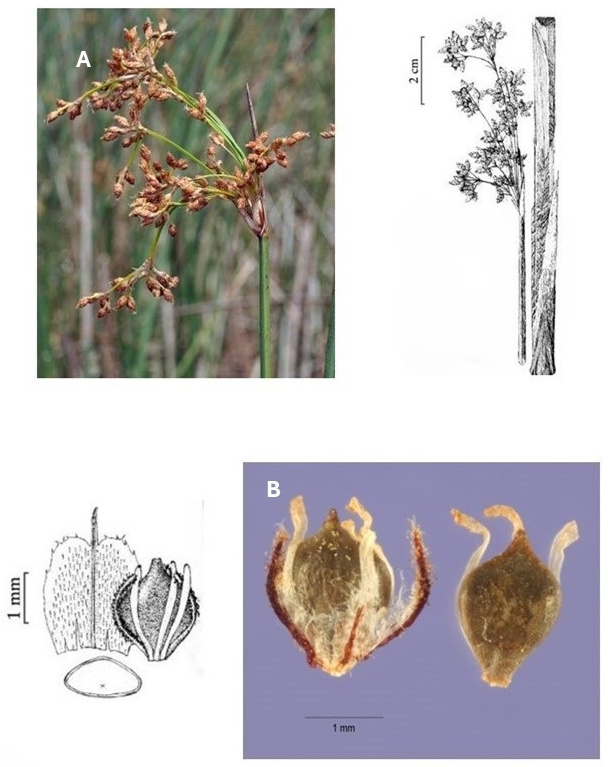

Schoenoplectus californicus
California bulrush, Giant bulrush, Tule
Scirpus californicus (C.A. Meyer) Steudel
Stout perennial, forming large colonies from long, robust rhizomes 10–15 mm in diameter; culms bluntly triangular throughout, or nearly cylindric and becoming obscurely triangular near the inflorescence, firm and not easily crushed between the fingers, 1–4 m tall, 4–10 mm thick.
3–4, basal; sheaths one-sixth of culm length, fronts ventrally hyaline and splitting leaving coarse fibers; blades 0–1, nearly flat, smooth, up to 2 cm long and 2 mm wide, about half the sheath length.
Main bract usually erect, stiff, margins often scabrous, 1–8 cm long, sometimes resembling a continuation of the culm, shorter than the inflorescence.
Panicle-like and open with third level branching; branches arched and flexible, 21 cm long; spikelets 25–150 or more, solitary or in clusters of 2 or more at the branch tips, 5–11 mm long, about 3 mm thick.
Oval, orangish brown with numerous short, linear reddish spots, 2.5 mm long, 2 mm wide, smooth except for the thick, sparsely scabrous midrib, margins minutely ciliate, apex rounded, shallowly notched 0.1–0.2 mm deep; awn not contorted, bent outward, about 0.3–0.5 mm long.
Perfect: perianth bristles 2–4, strap-shaped or trigonous with blunt tips, edges fringed, dark reddish brown, equaling the achene; stamens 3; styles all bifid.
Ovoid to obovoid, lenticular, smooth, gray-brown, 1.8–2.2 mm long (including the 0.2 mm long beak), 1.3 mm wide.
Fruiting: spring—summer.Fresh to brackish water, marshes and shorelines from sea level to about 1400 m elevation. Often emergent and salinity tolerant. In the Intermountain Region, known only from along the Colorado River in southernmost Nevada. California to Florida; Mexico to South America, West Indies, Pacific Islands.
Easily confused with Schoenoplectus tabernaemontani and S. acutus, both of which have completely cylindric culms and (4) 6–8 perianth bristles with sharp-pointed hairs.