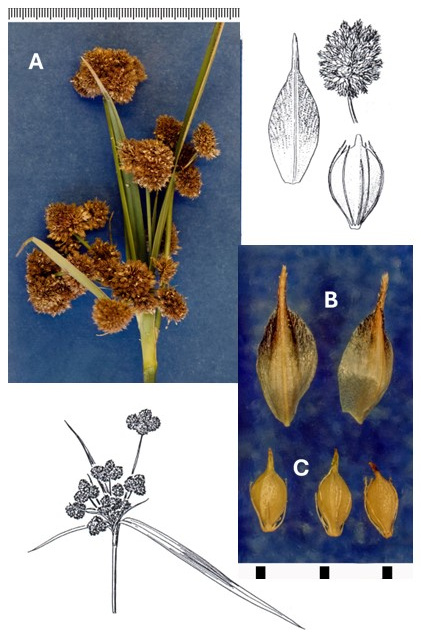

Scirpus pallidus
Pale bulrush, Cloaked bulrush
Scirpus atrovirens Willdenow var. pallidus Britton
Coarse, robust, leafy-stemmed perennials from short, stout rhizomes; culms loosely clustered, erect, triquetrous, solid, smooth, 4–18 dm tall, 0.5–1 cm thick.
Several, cauline; sheaths hyaline just below the V-shaped mouth, greenish or pale; blades flat with scabrous margins, 20–55 cm long, 6–18 mm wide.
2–4, spreading, leaflike, unequal, sheathed or sheathless, bases green, margins green to brown, the longest often more than 10 cm, exceeding the inflorescence.
Terminal, compound, umbelliform cyme with dense, round to oblong clusters of spikelets to 1 cm thick, sessile or on ascending or drooping rays up to 10 cm long; spikelets mostly ovoid, greenish-brown or blackish, 3–4.5 mm long, about 1.5 mm wide.
Spirally arranged, ovate-elliptic, tapered at the apex, glabrous, hyaline and cellular-reticulate, light brown, greenish black on the upper margins, midrib prominently thickened and excurrent as a short awn, usually 1.5–3 mm long, including the 0.5-mm awn, 1–1.5 mm wide.
Perianth bristles mostly 6, stout, straight or curved, minutely and retrorsely barbellate above the middle, tan to reddish brown, equaling or often shorter than the achene, enclosed within the scale, persistent. Stamens 2; anthers about 1 mm long; styles trifid.
Oblong obovoid, unequally trigonous, abruptly tapered toward the apex, base somewhat cuneate, pale brown to stramineous or whitish, 0.8–1.2 mm long, 0.5–0.8 mm wide including the minute stylar apiculus.
Fruiting: June–August.Wet areas, pond and ditch banks, marshes, and stream edges from sea level to 2900 m elevation. Southern Canada, south through the western and midwestern United States. Scattered throughout the Intermountain Region, but absent from Nevada. It may hybridize with S. atrovirens, which it resembles.
S. microcarpus has a diffuse inflorescence with the spikes clustered in smaller, distinguishable heads, and mucronate scales.