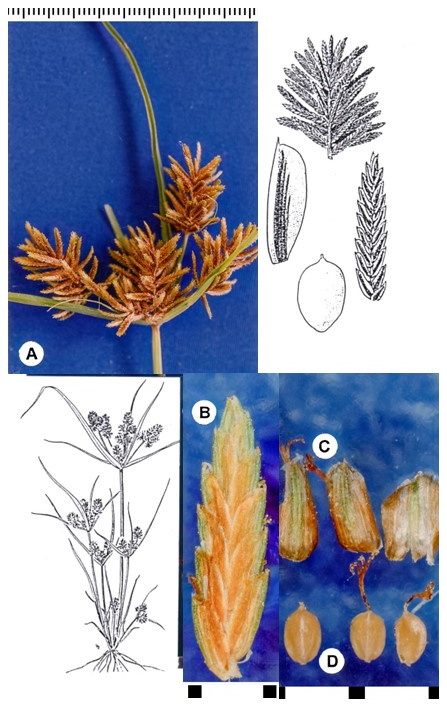

Cyperus erythrorhizos
Redroot flatsedge, Redroot nutgrass
Cyperus cupreus J. Presl & C. Presl, C. halei Torrey ex Britton, C. occidentalis Torrey, C. washingtonensis Gandoger
Annual; roots reddish, fibrous; culms tufted or occasionally arising singly or few together, sharply triangular to rounded, rather stout, smooth, (0.5) 1–7 (10) dm tall, 1–4 mm wide.
Several, crowded toward the base, lower leaves reddish; sheaths loosely envelope the culm; blades flat to an inverse W shape, elongate, scaberulous along the midrib and margins, shorter to longer than the culm, 5–25 (90) cm long, 2–10 mm wide.
4–10, leaflike with scaberulous margins, horizontal to ascending, unequal, up to 40 cm long, the larger ones sometimes wider than the leaves and longer than the inflorescence.
1-3 (6) cylindric to ovoid spikes 1-4 cm long bearing 40–80 loosely clustered spikelets spirally arranged on an elongate rachis; the terminal cluster sessile; the lateral clusters on rays 8 cm long or longer; spikelets quadrangular, reddish brown, 3–12 mm long, 1–1.5 mm wide.
Persistent, slightly angular-twisted with narrowly hyaline, readily deciduous wings at the nodes.
6–20 per spikelet, closely set, the broadly rounded tip of each scale surpassing the one below it by 0.4–0.7 mm, oblong-lanceolate or oblong-obovate, inconspicuously 3–5 nerved, greenish along the scarcely excurrent keeled midrib, satiny and golden brown to reddish brown along the margins, 1–1.5 mm long, 0.5–1 mm wide, eventually deciduous.
Perfect; perianth lacking; stamens 3; anthers short, about 1 mm long; style trifid for up to half its length.
Sessile, broadly oblong, unequally trigonous, concave on the ventral side, side angles acute, apex rounded and mucronate, smooth, shining, pale brown or grayish, (0.4) 0.7–2.0 mm long, about 0.5 mm wide.
Fruiting: July–October.Emergent shorelines of ponds, lakes, rivers, marshes, and other wet places from sea level to 1800 m. Weedy in cultivated areas. Occurs at Utah Lake, along the Rio Grande River, and other scattered locations in the Intermountain Region. Native in the United States, southern Canada, and Mexico.