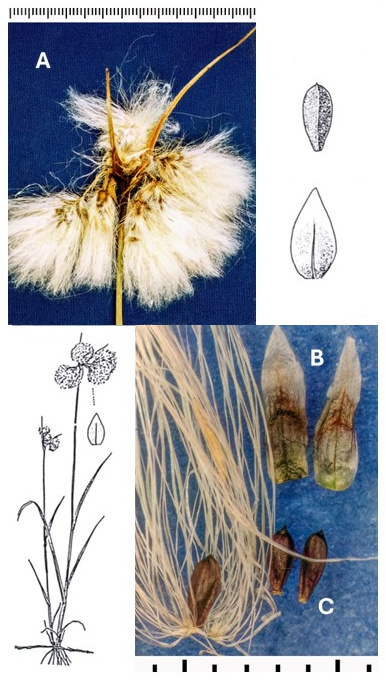

Eriophorum angustifolium
subsp. angustifolium
Tall cottongrass, Many-spiked cottongrass, Narrowleaf cottonsedge
Eriophorum polystachion L.
Robust colonial perennials; culms mostly arising singly from long creeping rhizomes, subterete or obtusely angled, smooth, 2–10 dm tall, 1–1.2 mm thick distally.
Basal and cauline; sheaths with a small area of hyaline tissue near the mouth ventrally, rims may be darker; blades well developed, elongate, mostly flat proximally, tapering distally, apex triangular and channeled, 40 cm long, 1.5–6 (8) mm wide, shorter than the culms; distal blade much longer than the sheath. Blades will stain red when crushed.
Several, blade-bearing, unequal, the lowest leaflike, green to dark purple or black toward the base; longest bract to 2.5–5.5 (12) cm, shorter to equaling or surpassing the inflorescence; upper bracts reduced.
2–10 spreading or pendent spikelets in a compact or open umbelliform cyme; lateral spikelets with slender, compressed, smooth or more commonly minutely scabrous-hirtellous peduncles 0.5–2.5 cm long, central spikelets may be sessile; mature inflorescence cotton-like, 10–20 mm long in flower, 20–50 mm long in fruit.
Spirally arranged, ovate or lanceolate, brown to greenish, blackish or purplish green on the lower half, paler and very thin with broad white margins distally, 5–10 mm long 2–3 mm wide, midrib attenuated distally, not reaching the acute to obtuse tip; proximal scales lack lateral ribs; fertile scales concealed by the long cottony bristles at fruiting.
Perfect; perianth bristles numerous, long, smooth, usually white to pale yellow brown, 1.5–4 cm long, forming cottonlike tufts; stamens 3; anthers 2–5 mm long; stigmas trifid, slender.
Broadly oblanceolate to obovoid with a blunt tip, unequally trigonous, blackish with somewhat paler angles, 2–3.5 (5) mm long, 1–1.5 mm wide, 2–3 times as along as wide; achenes disarticulate readily from the perianth bristles.
Fruiting: July–August.Bogs, swamps, fens, marshes, and wet meadows from sea level to 1100 m. Uniform stands appear reddish due to red leaf tips. Known from northeastern Utah and eastern Idaho in the Intermountain Region. Circumboreal at high latitudes, extending south in North America to New York, Indiana, Illinois, Iowa, Nebraska, New Mexico, Idaho, and northwestern Oregon.
E. gracile: Leaf blades channeled; peduncles hairy and not compressed; perianth bristles not readily disarticulating from the achene; achene stramineous, 3–4 times as long as wide. E. viridicarinatum scale midrib is pale green and expands distally, extending to the tip.