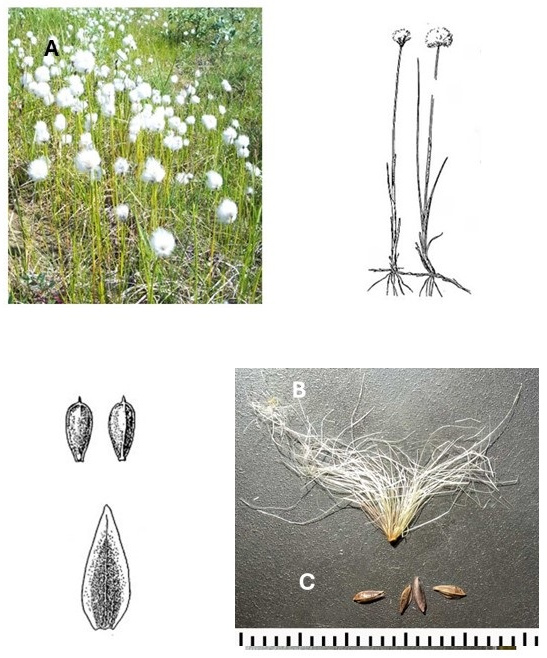

Eriophorum chamissonis
Russett (Rusty) cotton-grass, Chamisso’s cottongrass
Eriophorum altaicum Meinshausen var. neogeum Raymond, E. chamassonis C.A. Meyer var. aquatile (Norman) Fernald, E. russolum Fr. ex Hartm. subsp. rufescens (E.S. Anderson) Hyl., Scirpus chamissonis C.A. Meyer
Perennials forming extensive colonies from long creeping rhizomes; culms solitary or few together, stout, somewhat trigonous, 20–80 cm tall, 1.5–4 mm thick at the base.
Few, borne mostly near the base; basal sheaths persistent, septate-nodulose, brown; blades filiform, trigonous-channeled, smooth, 2–10 cm long, 1–2 mm wide; 1–2 leaf sheaths near the middle of the culm are bladeless and inflated.
Absent.
Spikelet solitary, terminal, erect, globose, broader at the base in fruit, 1.5–4 cm wide.
Spirally arranged, black to purplish brown; proximal scales (up to 7) empty, slightly sheathing at the base, obovate or obovate-trigonous with a blunt apex, margins white, conspicuous, 4–20 mm long; distal scales fertile, ovate-lanceolate, 1 mm wide or more, blackish green with the tip and distal margins paler and hyaline.
Perfect; perianth bristles many, smooth, reddish-brown to white, 20–40 mm long; stamens 3; anthers mostly 1.5–3 mm long; stigmas 3.
Oblong-obovoid, unequally trigonous, dark, apex apiculate, 2–2.7 mm long and as wide.
Fruiting: May–August.Found in peat, bogs, fens, marshes, swamps, and other wet places from sea level to 3000 m elevation. Circumboreal. In the Western Hemisphere from Greenland to Alaska and south to Washington, Oregon, northern and central Idaho, the Uinta Mountains of northeastern Utah, Montana, Wyoming, Colorado, North Dakota, Nebraska, Minnesota, and Wisconsin. The complex exhibits continuous variation with many intermediates.