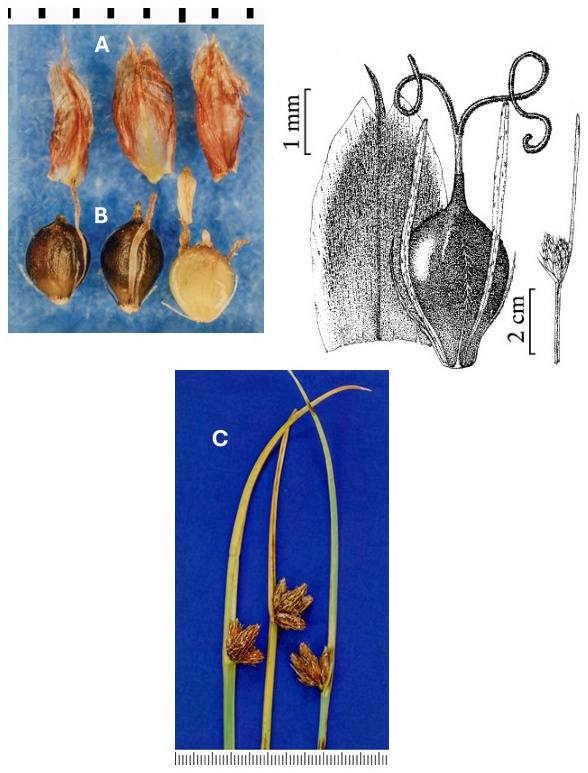

Schoenoplectus pungens
var. longispicatus
Common threesquare, Chairmaker’s rush, Threesquare
Scirpus pungens Vahl
Colonial perennial with somewhat scattered culms from long, scaly, often vertical rhizomes from 1–6 mm in diameter; culms erect to somewhat arching, sharply triangular, smooth, the sides nearly convex to concave proximally, concave to flat distally, dark to yellowish green, 0.1–2 m tall, 1–6 mm thick.
All basal; sheaths fronts membranous, often splitting and leaving fibers, lower sheaths bladeless; ligules bifid; blades 2–6, V-shaped in cross section near the base, trigonous to laterally flattened near the apex, smooth or margins spinulose; the uppermost blade 1–5 times as long as its sheath, 5–75 cm long, 2–9 mm wide.
Main bract erect, trigonous proximally, 1–20 cm long, appearing as a continuation of the culm, 3–7 times as long as the inflorescence; upper 1–2 bracts usually inconspicuous, shorter than the spikelets, resembling enlarged scales with awns one-third of the bract length.
Compact, sessile head or solitary spikelet appearing lateral on the culm; spikelets 1–5 (rarely to 10), 5–23 mm long, 3–5 (7) mm thick.
Broadly ovate, smooth or the lighter midrib with a few spinules, margins minutely ciliate when young, bright (sometimes very dark) brown to straw-colored, often with linear spots, 3.5–6 mm long, 2–3 mm wide; apex notched 0.5–1 mm deep; awn irregularly bent, sparsely spinulose, not contorted, 0.5–2.5 mm long, equaling to exceeding the notch.
Perfect; perianth bristles 4–8 (usually 6), slender to stout, often unequal, retrorsely spinulose, brown, rudimentary to equaling the achene and firmly attached to it; stamens 3; styles all trifid in the Intermountain Region.
Broadly obovoid to ovoid, lenticular or unequally trigonous, smooth, brown when mature, (2) 2.5 (3.5) mm long (includes the 0.1–0.5-mm apiculus or beak), 1.3–2.3 mm wide.
Fruiting: May–August.Fresh or brackish marshes, shores, streams, springs, shallow lakes, and fens from sea level to 2400 m elevation. Often emergent in water and tolerant of alkali. Widespread and common in the Intermountain Region. South-central Alaska to Labrador and south to California and Florida; Mexico, South America, West Indies, Europe, Australia, and New Zealand.
Schoenoplectus pungens was long erroneously called Scirpus americanus. Besides the differences given in the key, S. americanus culm sides are usually deeply concave throughout, and the inflorescence may consist of 20 spikelets. Bolboschoenus maritimus, which often occurs with S. pungens in salty places, has minutely pubescent scales (the hairs often worn off), some leaves attached to the culm above the basal leaves, leaf blades with keeled midribs and often spinulose margins, culms often scabrous on the angles, culm bases with durable corms, ligules absent, and bristles not firmly attached to the achenes.
Plants of Schoenoplectus pungens in the Intermountain Region have styles mostly or all trifid and achenes often obscurely 3-angled and may be called Schoenoplectus pungens (Vahl) Palla var. longispicatus (Pers.) S.G. Smith. Schoenoplectus pungens (Vahl) Palla var. badius (J. Presl & C. Presl) S.G. Smith with dark chestnut scales and trigonous or biconvex achenes has been collected in southeastern Oregon.