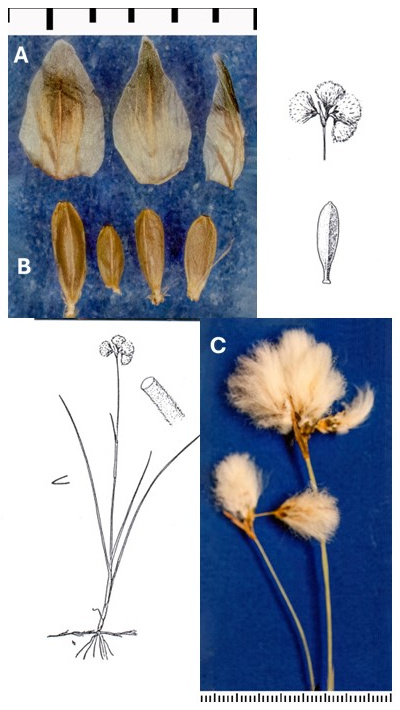

Eriophorum gracile
Slender cottongrass, Slender cottonsedge
Scirpus ardea T. Koyama
Colonial perennials with long, slender rhizomes; culms slender, subterete below, distally triangular and straited to unequally ribbed, 2–6 dm tall, 0.5–0.8 mm wide.
Few, mostly borne toward the base; basal leaves well developed; sheaths septate dorsally, straited, hyaline and brown dotted ventrally; blades narrow and elongate, deeply channeled or triangular distally, 2–30 cm long, 1–2 mm wide; uppermost cauline leaf with reduced blade, 1–4 cm long, 1–1.5 mm wide, usually shorter than its 3.5–5.5 cm long sheath.
Proximal bract similar to the distal leaf but not prominently triangular distally, somewhat spongy, green or brownish, 0.6–2 cm long, usually shorter than the inflorescence; distal bracts reduced, lacking blades, gray or black.
Subumbels of 2–5 spikelets in an umbelliform cyme; spikelets narrowly ovoid, 7–10 mm in flower, 15–25 mm in fruit; lateral spikelets short hirtellous-pubescent with slender, subterete (not compressed), peduncles 3–30 mm long; central spikelets subsessile or short pedunculate.
Spirally arranged, lanceolate to broadly ovate, 5–9 ribbed, scarious, pale near the base, upper portion blackish-green, margins very narrow, apex black and subacute to obtuse, the midrib slender and firm, distally dilated, pale, terminates just below the apex, 3–4 mm long, 1.5–2.3 mm wide, 1.5–2 times longer than wide.
Perfect; perianth bristles numerous, smooth, and mostly white, 10–15 mm long, concealing the fertile scales; stamens 3; anthers 1–3 mm; stigmas deeply trifid.
Narrowly elliptic oblong to narrowly oblanceolate, unequally trigonous (flat side widest), the angles prominent, apex blunt, stramineous to light brown, 1.5–3.5 mm long, 1–1.2 mm wide, 3–4.5 times as long as wide; bristles do not readily disarticulate from the achenes.
Fruiting: May–August.Meadows, bogs, and other wet places from sea level to 4000 m, usually in peaty, acidic substrates. Circumboreal, extending south in North America to Pennsylvania, Iowa, Colorado, central and northern Idaho, central California, and reportedly to eastern Oregon, western Wyoming, Nevada, and Utah.
E. angustifolium: Stouter plants, 2–6 (9) dm tall; leaves flat; blade-bearing bracts 4–5; floral scales 3–4 times longer than wide; peduncles compressed and not hairy; achene 2–3 times as long as wide; mature achenes disarticulate easily from the bristles.