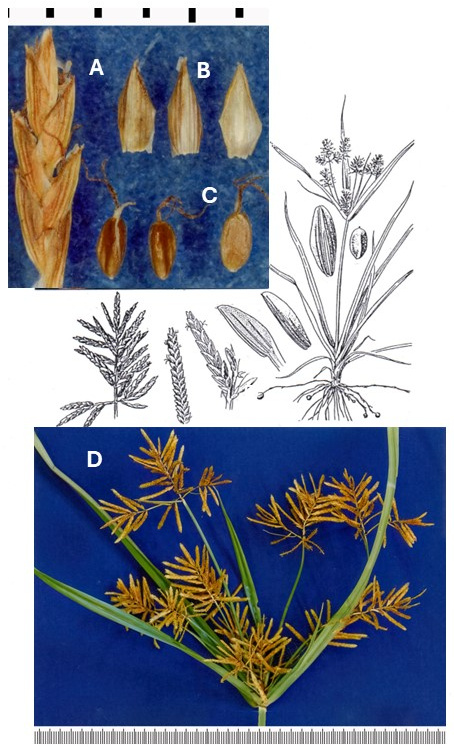

Cyperus esculentus
Yellow nutsedge, Chufa flatsedge, Yellow nutgrass
Highly polymorphic, non-tufted perennial, producing many slender, spongy stolons that terminate with small, edible tubers; culms arise singly, stout, sharply triquetrous, smooth, 1–7 (10) dm tall, 0.6–5 mm wide.
Few to many, sweet-scented, clustered at the base; sheaths pale or reddish brown at the base; blades firm, flat to V-shaped with smooth margins that are scaberulous distally, shorter to longer than the culms, mostly 2–8 mm wide.
3–6, unequal, leaf-like, bright green, V-shaped to V-shaped and flanged, sometimes slightly wider than the lower leaf blades, spreading to ascending, shorter to much exceeding the inflorescence.
Clustered cylindric spikes, 1–4 cm long, 18–35 mm wide; terminal cluster sessile, others single or in groups on 5–10 rays up to 12 cm long; spikelets numerous, spirally arranged on the elongate (4–17 mm long) rachis, divaricate, slender, linear, flattened, reddish to golden brown, 10–20 mm long, 1–3 mm wide.
Persistent with narrow hyaline wings 0.3–0.5 mm wide, the scales disarticulate from it.
6–34 per spikelet, ovate to elliptic, laterally 3–5 nerved, medially 3-ribbed, obscurely mucronulate, pale to greenish along the center, scarious, yellowish brown to reddish brown along the margins, 2–4 mm long (the lowest one shorter), much overlapping laterally, the tip of each scale only slightly exceeding the one below it, deciduous at maturity.
Perfect; perianth lacking; stamens 3; anthers about 1 mm long or longer; style trifid for one-fourth to one-half its length, stigmas 3.
Seldom maturing, sessile, ellipsoid, unequally trigonous, angles acute or obtuse, puncticulate, shiny, brown, 1.3–2 mm long, 0.3–0.8 mm wide; style somewhat persistent.
Fruiting: June–October.Moist and disturbed soil along streams and ditches, lakes, and sandbars. A difficult weed in cropland. Distributed worldwide, but generally lacking in cold temperate regions. Uncommon in the Intermountain Region where collections of C. e. var. leptosctachyus and C. e. var. heermannii are reported from southwestern Idaho, northeastern and east-central Utah, west-central Nevada and southeastern Oregon.